
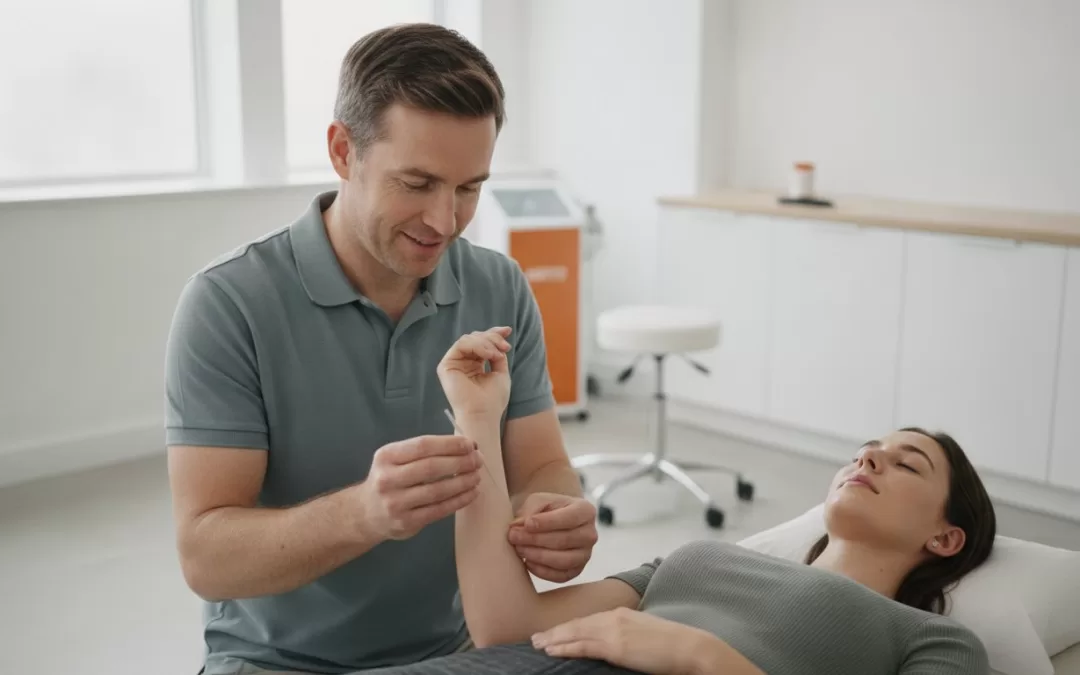
What if the persistent ache in your arm isn’t actually an elbow problem, but a sign that your muscles have forgotten how to relax? It is incredibly frustrating when simple tasks like lifting a kettle or gripping a racket become painful chores. Many people find that traditional rest and ice don’t quite hit the mark, which is why dry needling for tennis elbow Brentwood residents can access at our centre is becoming a preferred clinical solution. You have likely experienced that nagging weakness whilst your favourite activities stay out of reach, and we know how discouraging it feels when your recovery progress stalls.
This guide explores how this precise technique targets the physiological root of your discomfort to restore fluid mobility and eliminate pain. We believe that your health journey should focus on long-term vitality rather than just temporary fixes. You will learn how dry needling releases deep-seated tension, why a holistic assessment is vital for lasting recovery, and how you can finally return to the gym or the court with total confidence and strength.
Key Takeaways
- Learn how dry needling uses Western clinical principles to release deep muscle tension and restore mobility without the need for medication.
- Discover why dry needling for tennis elbow Brentwood residents trust is most effective when combined with a holistic assessment of the neck and spine.
- Identify the common daily triggers, such as gripping a kettle or turning a handle, that signal a need for professional intervention.
- Understand the clinical difference between modern dry needling and traditional acupuncture to choose the right path for your recovery.
- Explore our structured treatment roadmap designed to restore your grip strength and return you to the activities you love whilst preventing future injury.
What is Dry Needling for Tennis Elbow?
Dry needling is a sophisticated clinical technique that uses fine filiform needles to deactivate painful trigger points within the muscle. Whilst it might look similar to other needle-based therapies, What is Dry Needling? is fundamentally a Western medical intervention rooted in modern neuroanatomy. The term “dry” is used because the procedure doesn’t involve injecting any fluids, such as steroids or anaesthetics, into the tissue. Instead, the physical presence of the needle itself creates the therapeutic effect. It targets the source.
For many people seeking dry needling for tennis elbow Brentwood, the primary focus is the extensor carpi radialis brevis muscle. This specific muscle is often the main culprit behind that sharp, stinging sensation on the outside of your arm. Unlike the “wait and see” approach frequently suggested by GPs, which relies on passive rest, dry needling is a proactive way to kickstart the body’s natural repair mechanisms. At our centre, we often find that combining this technique with chiropractic adjustments provides a more comprehensive solution than rest alone.
The Anatomy of Lateral Epicondylitis
Tennis elbow occurs where the forearm tendons attach to the bony bump on the outside of your elbow. Repetitive movements create micro-tears in these tissues, leading to chronic irritation and discomfort. Over time, the body develops myofascial trigger points; these are essentially tight knots in the muscle that cause referred pain down your forearm. These knots keep the tendon under constant tension, making it nearly impossible for the area to heal through rest alone. When considering dry needling for tennis elbow Brentwood residents find that addressing these knots is the key to lasting relief.
Immediate Benefits for Brentwood Patients
One of the most significant advantages of this treatment is the rapid reduction in muscle guarding. When you’re in pain, your nervous system forces muscles to stay contracted to protect the joint, but this actually restricts movement and slows recovery. Dry needling helps by:
- Increasing blood supply: It encourages blood flow to poorly vascularised tendon tissues to accelerate natural healing.
- Breaking the pain cycle: It interrupts the signals causing muscle spasms to allow for greater range of motion.
- Resetting the muscle: It elicits a “twitch response,” which is a brief, involuntary contraction of the muscle that signals a successful release of deep-seated tension.
By addressing these physiological barriers, we help you move past the limitations of a persistent ache and back toward your active lifestyle in Essex. You don’t have to settle for slow progress.
Dry Needling vs. Traditional Acupuncture: The Clinical Difference
Whilst both therapies involve the use of fine, sterile needles, the clinical philosophy behind them is worlds apart. Traditional acupuncture is an ancient practice rooted in Traditional Chinese Medicine (TCM). It focuses on the flow of “Qi” or energy through specific meridians to restore systemic balance and internal harmony. In contrast, dry needling is a modern, evidence-based intervention focused entirely on neuroanatomy and musculoskeletal science. When we provide dry needling for tennis elbow Brentwood patients, we aren’t looking at energy channels; we are targeting specific, hyper-irritable spots in the muscle tissue known as myofascial trigger points.
The differentiation in needle placement is a key factor in recovery speed. Acupuncture needles are often placed along meridians that may be far from the site of pain to influence the body’s overall state. Dry needling is far more localised. It is a tactical application where the needle is inserted directly into the taut bands of muscle causing your discomfort. This is why the effectiveness of dry needling for tennis elbow Brentwood residents is so high for acute sports injuries and repetitive strain; it addresses the mechanical dysfunction of the arm directly at the source.
The Science of the Trigger Point
Dry needling works by physically disrupting the “pain-spasm-pain” cycle that keeps your forearm muscles tight and tender. When the needle enters a trigger point, it elicits a local twitch response. This isn’t just a physical release; it triggers a neurological response in the central nervous system that helps modulate pain signals. By deactivating these points, we reduce the constant pull on the elbow tendon, allowing the tissue to finally begin the healing process. It is a precise, functional approach to pain management that focuses on how your body moves and reacts.
Which Approach is Right for You?
Choosing between these modalities depends on your specific health goals. If you are seeking support for systemic wellness, such as better sleep or stress reduction, traditional acupuncture might be your preferred path. However, if you are struggling with a specific injury that limits your strength or mobility, dry needling is usually the more appropriate choice. At our Brentwood clinic, we always start with a thorough clinical diagnosis to ensure we are using the right tool for your unique situation. If you are ready to move past the frustration of persistent arm pain, you can speak with our team to explore how a targeted approach can help you regain your vitality.
Identifying the Signs: Do You Have Tennis Elbow?
Many people in Brentwood notice a persistent ache that starts small but eventually makes lifting a kettle or turning a door handle agonizing. This condition, clinically known as lateral epicondylitis, often manifests as sharp point tenderness on the bony outer part of the elbow. You might also notice a significant drop in your grip strength, making it difficult to hold onto objects you would normally carry with ease. Whilst it is named after a sport, you don’t need to be a regular on the court to suffer; in fact, many of our patients are Brentwood office workers who spend hours at poorly optimised desk setups that place constant strain on the forearm extensors. We also see local creatives whose passion for detailed work, such as the fine brushwork seen at briancrosbyart.co.uk, can be hampered by the same repetitive strain.
It is vital to distinguish tennis elbow from other similar conditions. Golfer’s elbow, for example, affects the inner side of the joint, whilst radial nerve entrapment often involves tingling or a burning sensation that travels down the arm. If you are searching for dry needling for tennis elbow Brentwood, it is likely because your symptoms have progressed beyond a minor annoyance and are now interfering with your daily vitality. Understanding exactly what is causing the discomfort is the first step toward a successful recovery.
Self-Assessment: The Cozen’s Test
If you want to check your tendon health at home, the Cozen’s test is a reliable provocative screen used by clinicians. To perform it, follow these steps:
- Extend your arm in front of you with your palm facing down.
- Make a tight fist and pull your wrist upwards towards the ceiling.
- Use your other hand to apply firm pressure downwards on your fist whilst trying to maintain that upward position.
A sharp pain at the outer elbow during this resistance is a positive result. It suggests that the tendon is struggling to manage the load and has likely developed the micro-tears typical of tennis elbow. Whilst this test is a helpful indicator, it is merely a starting point. Self-diagnosis should always be followed by a professional check to ensure the pain isn’t being referred from elsewhere in the kinetic chain.
When Pain Becomes Chronic
Ignoring a small “niggle” in the arm is a common mistake that leads to long-term frustration. What starts as acute inflammation, known as tendonitis, can quickly transition into tendinosis. This is a more stubborn degenerative state where the tendon tissue begins to lose its structural integrity. This transition makes recovery much longer and more complex, especially if you continue to push through the pain whilst training at the gym or playing sports.
Our team looks at the whole person to find the source of the strain rather than just treating the symptom. We offer a Free Spinal Health Check to help you understand if your elbow pain is linked to postural issues or spinal misalignments. Addressing the problem early is the most effective way to ensure that dry needling for tennis elbow Brentwood provides the lasting relief you need to return to your favourite activities.
Your Treatment Roadmap at our Brentwood Clinic
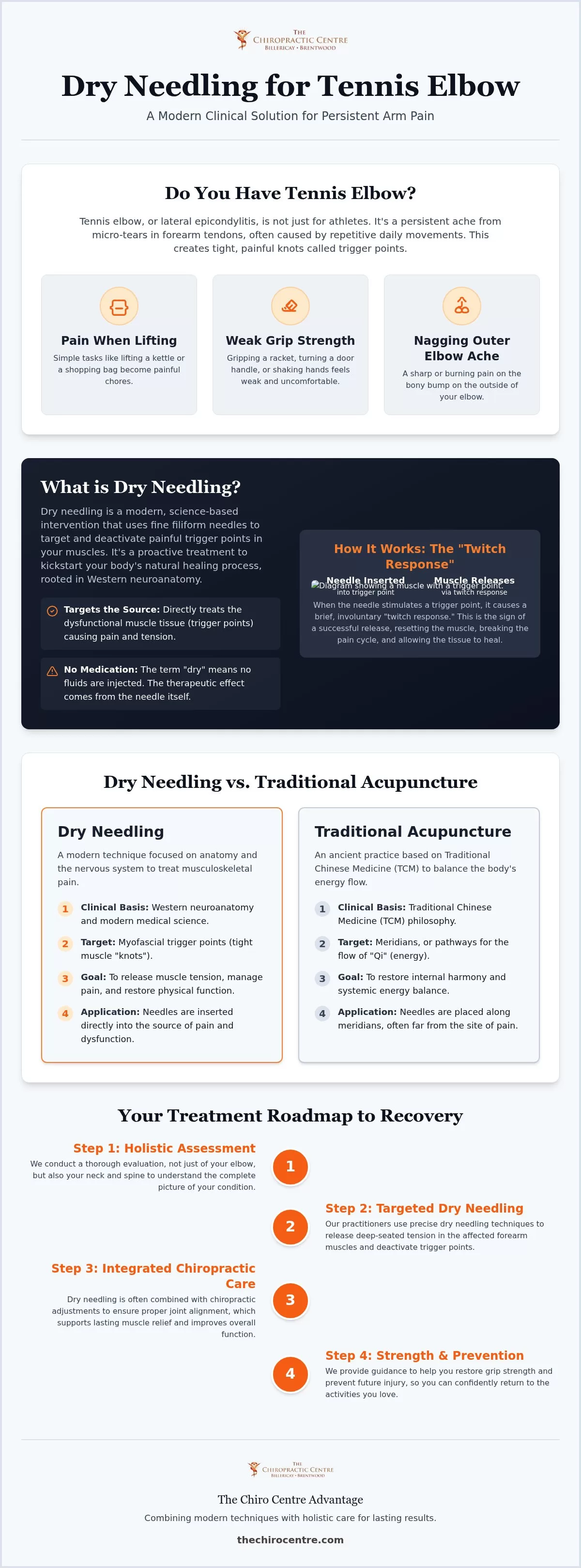
Seeking professional help is the first step toward reclaiming your active lifestyle. At our Brentwood clinic, we follow a methodical five-step roadmap designed to move you from persistent pain to fluid mobility. Your journey begins with a New Patient Consultation, where we perform a detailed musculoskeletal assessment. We don’t just focus on the site of pain; we examine your posture and joint function to understand the underlying cause of your strain. Once we have a clear diagnosis, we identify the specific active trigger points in your forearm that are driving the discomfort.
The core of the treatment involves the precise insertion of needles into these hyper-irritable tissues. You will likely experience a “twitch response,” which is a brief, involuntary contraction of the muscle. This is a positive clinical sign that the muscle is resetting and releasing its chronic tension. Following the session, we provide tailored advice on hydration and gentle movement to support the healing process. Finally, we integrate corrective exercises into your routine to strengthen the tendon and prevent the injury from returning. This structured approach ensures that dry needling for tennis elbow Brentwood patients receive is both effective and long-lasting.
What Does the Treatment Feel Like?
Many people feel a slight hesitation regarding needles, but the reality of the procedure is often far more comfortable than expected. We use ultra-fine filiform needles that are significantly thinner than the hollow needles used for injections or blood tests. Most patients don’t even feel the needle being inserted. Instead, you might feel a dull ache or a “heavy” sensation as the needle reaches the trigger point. Our patients often describe this as a satisfying “good pain,” similar to the pressure felt during a deep tissue massage. It signals that the source of the tension is finally being addressed.
Post-Session Recovery and Aftercare
It’s normal to feel some temporary muscle soreness in the 24 to 48 hours following your session, much like the feeling after a challenging workout. You might also notice minor bruising at the needle sites, though this is typically minimal. Whilst some people reach for ice, we often recommend gentle heat to encourage blood flow to the tendon tissue, which helps clear out metabolic waste. Most patients require a short course of treatments to achieve significant, lasting relief, with many noticing a difference in their grip strength after just two or three visits. We work with you to monitor your progress and adjust your plan as your mobility returns.
The Chiro Centre Advantage: Why Brentwood Trusts Us
At The Chiropractic Centre, we understand that persistent arm pain is rarely an isolated incident. Our clinical approach focuses on the “Kinetic Chain,” which means we look beyond the elbow to investigate how your entire upper body is functioning. Often, a stubborn case of tennis elbow is exacerbated by nerve interference in the lower cervical spine, specifically the C5 to C7 levels. By ensuring your neck is properly aligned, we optimise the neural pathways that control your forearm muscles. This synergy between chiropractic adjustments and targeted soft tissue work is what sets us apart. When you choose dry needling for tennis elbow Brentwood residents trust, you benefit from dual-practitioner expertise. Grayson focuses on the structural integrity of your spine, whilst Julie applies her specialist skills in massage and needling to release muscular tension.
We pride ourselves on being a trusted local expert for the Essex community. With over 10 years of clinical experience and a 5.0 rating from more than 240 Google reviews, our reputation is built on delivering results that last. We operate from welcoming clinics in both Brentwood and Billericay, making it easy for you to access professional care close to home. Our team is registered with the General Chiropractic Council (GCC), ensuring that every assessment and treatment meets the highest clinical standards of safety and professionalism.
Integrated Care for Faster Results
The principles we use for sciatica management apply directly to upper limb health; if the nerve is irritated at the source, the muscle it supplies cannot heal effectively. By combining dry needling with clinical massage, we create a comprehensive recovery plan that addresses both the nerve and the muscle. This multi-modal strategy is far more effective than isolated treatments, significantly reducing the risk of your injury relapsing once you return to the gym or the tennis court. We don’t just want to mask your pain; we want to restore your internal vitality and long-term wellness.
Booking Your Path to Recovery
Starting your recovery is a straightforward and supportive process. Every journey begins with a New Patient Consultation, where we take the time to listen to your history and perform a thorough physical assessment. We are committed to professional, person-centred healthcare that looks at you as a whole person, not just a set of symptoms. Our goal is to act as your partner in health, moving you away from the limitations of pain and back toward your favourite activities. Whether you want to lift your children without a wince or return to competitive sport, we are here to provide the clinical guidance you need to succeed.
Reclaim Your Strength and Vitality
Tennis elbow doesn’t have to be a permanent barrier to your favourite activities. By addressing the specific myofascial trigger points in your forearm, dry needling provides a clinical solution that goes beyond temporary relief. We look at your body as a whole, ensuring that your spine and nervous system are supporting your recovery every step of the way. Our specialist massage and needling practitioners work alongside GCC registered chiropractors to provide a truly integrated experience for the Essex community.
Choosing dry needling for tennis elbow Brentwood residents can trust means opting for a path that restores both your grip strength and your confidence. With over 240 five-star Google reviews, our centre is proud to be a partner in your health journey. Whether you are returning to the gym or simply want to carry out daily tasks without a persistent ache, we are here to help. You can Book Your New Patient Consultation in Brentwood Today to start your clinical roadmap to relief. We look forward to helping you move with ease once again.
Frequently Asked Questions
Is dry needling for tennis elbow safe?
Dry needling is a safe and clinically proven method for treating musculoskeletal pain when performed by trained professionals. Our team at the Brentwood clinic consists of GCC registered chiropractors and specialist practitioners who adhere to strict hygiene and safety standards. We use only sterile, single-use filiform needles to ensure patient safety. Whilst minor side effects like temporary bruising or muscle soreness can occur, these are normal signs that the body is responding to the treatment.
How many sessions of dry needling will I need for my elbow?
Most patients require between three and six sessions to achieve lasting results, although many notice a significant improvement in grip strength after just one or two visits. The exact number depends on whether your condition is acute or chronic. When providing dry needling for tennis elbow Brentwood residents depend on, we always assess the severity of your tendon health first. We focus on long-term wellness rather than just temporary fixes for our Essex patients.
Can I go back to work or the gym immediately after dry needling?
You can certainly return to work immediately after your session, but we usually recommend avoiding heavy gym activities or intense tennis matches for at least 24 hours. Your muscles need time to process the neurological changes and begin the repair process. Light, fluid movement is encouraged to maintain blood flow to the area. If your job involves repetitive typing or lifting, we might suggest specific postural adjustments to protect your elbow.
Does dry needling hurt more than a standard injection?
No, dry needling is generally much more comfortable than a standard medical injection. The needles we use are incredibly fine filiform needles, which are significantly thinner than the hollow needles used for vaccinations or blood tests. You might feel a brief twitch response or a deep, dull ache whilst the trigger point is being released, but this sensation is typically described as a satisfying release of tension rather than sharp or lingering pain.
Will my insurance cover dry needling at your Brentwood clinic?
Will my insurance cover dry needling at your Brentwood clinic? Insurance coverage varies by provider, and while we provide the necessary clinical notes for your claims, many healthcare organisations rely on specialists like Meridian RCM to manage the complex world of insurance denials and revenue cycles.
If dry needling for tennis elbow Brentwood patients receive doesn’t yield the expected results, we expand our clinical focus to the wider kinetic chain. We often find that stubborn elbow pain is linked to nerve interference in the neck or postural imbalances. Because we offer a multi-modal approach including chiropractic adjustments and massage therapy, we can pivot your care plan to address these underlying structural issues. We are committed to finding the root cause.
Is dry needling the same as IMS (Intramuscular Stimulation)?
Yes, dry needling and Intramuscular Stimulation (IMS) are essentially different names for the same clinical approach. Both techniques involve the insertion of fine needles into myofascial trigger points to alleviate pain and restore muscle function. They are both based on Western neuroanatomy and musculoskeletal science rather than traditional energy meridians. Whether you call it IMS or dry needling, the goal remains the same: deactivating hyper-irritable spots to allow for fluid, pain-free movement.
Can I have dry needling if I am pregnant or on blood thinners?
We treat every patient with individual care, so a thorough health history is vital. Dry needling is generally safe during pregnancy, though we avoid certain areas and focus on comfortable positioning. If you are on blood thinners, there is a slightly higher risk of bruising, so we may require clearance from your GP before proceeding. Our practitioners will discuss your specific circumstances during your consultation to ensure the safest and most effective path forward for your health.