

An initial consultation is a practical first step when choosing the right chiropractor in Essex. You can discuss your symptoms, health history and goals, and learn whether chiropractic care may suit your needs. It also gives you the chance to ask about the approach and understand the proposed plan before deciding how to proceed.
When pain or restricted movement affects your day, clear answers and a considered approach matter. Back or neck pain, headaches and mobility concerns each need to be understood in context. Feeling listened to and knowing why a particular approach is suggested can help you make an informed decision.
This guide covers how to compare treatment approaches, interpret patient reviews and consider a chiropractor’s experience. It also offers practical points for choosing care around Brentwood, Billericay, Chelmsford, Stock, Basildon and Wickford, so you can decide what matters most before taking the next step.
Key Takeaways
- Use an initial consultation to discuss your symptoms, health history and goals, and understand the proposed approach before treatment.
- Look beyond a clinic’s overall rating: consider how recent reviews are and whether responses show attentive communication.
- Check that the chiropractor is registered with the General Chiropractic Council, and use its public register to look up their credentials.
- Think about how your pain, headaches or mobility concerns affect treatment needs and travelling to appointments.
1. Assessing a chiropractor’s treatment approach and techniques
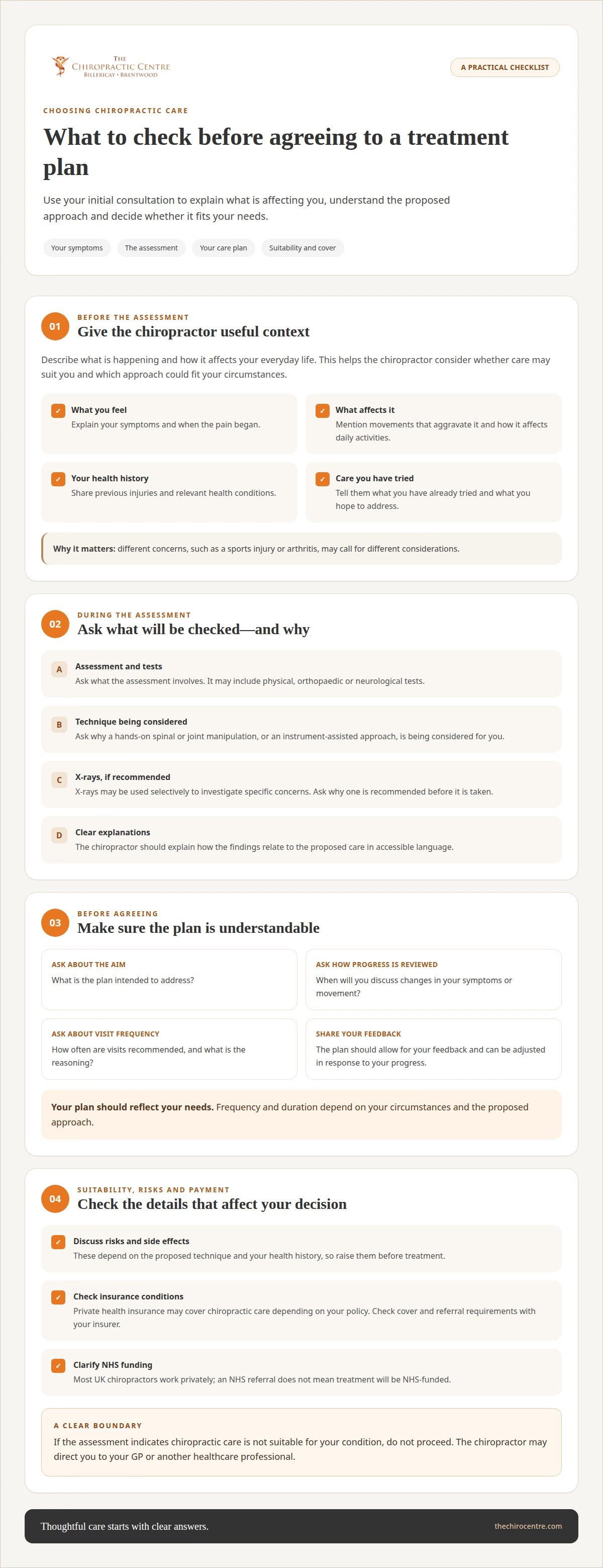
Use an initial consultation to explain your symptoms, health history and goals. Describe when the pain began, which movements aggravate it and how it affects everyday activities. Mention previous injuries, relevant health conditions and care you have already tried. This context helps the chiropractor assess whether chiropractic care is suitable and which approach may fit. For example, sports injuries and arthritis may call for different considerations, so care should reflect your circumstances rather than follow a fixed routine.
Ask what the assessment involves and why a particular technique is being considered. A chiropractor may use hands-on spinal or joint manipulation, or an instrument-assisted approach. An evaluation may include physical, orthopaedic or neurological tests. X-rays may be used selectively to investigate specific concerns, so ask why one is recommended before it is taken. The practitioner should explain how the findings relate to the proposed care in clear, accessible language.
Before agreeing to a plan, ask what it is intended to address, how progress will be reviewed and how often visits are recommended. Frequency and duration depend on your needs and the proposed approach, so ask the chiropractor to explain the reasoning. A clear plan should allow for your feedback. At review points, discuss changes in your symptoms or movement and whether the next step still fits your goals. The approach can then be adjusted in response to your progress.
Private health insurance may cover chiropractic care, depending on your policy. Most UK chiropractors work privately, so an NHS referral does not mean treatment will be NHS-funded. Check your policy’s cover and referral requirements with your insurer. Risks and side effects depend on the proposed technique and your health history, so discuss them before treatment. If an assessment indicates chiropractic care is not suitable for your condition, do not proceed; the chiropractor may direct you to your GP or another healthcare professional.
2. Reading patient reviews and clinic responses
Online reviews can offer a wider view of a clinic than one person’s account, but a high rating alone says little about communication or care. Read several comments and look for details about whether patients felt listened to, had concerns explained and understood their treatment. Specific feedback, such as clear explanations or time to discuss symptoms, is more useful than general praise without context. Consider recurring themes across different experiences rather than relying on one unusually positive or negative review.
Personal recommendations can add another perspective. Ask someone you trust, such as a friend, family member or doctor, what their experience was like and what mattered to them. They might, for example, describe how a chiropractor explained an adjustment or responded to concerns. Their needs may differ from yours, so treat their account as a starting point, not proof that the same approach will suit you. Compare it with online feedback for a broader picture.
Consider when reviews were posted as well as what they say. Recent comments may give a more current impression of patients’ experiences, while older ones may describe an earlier period at the clinic. Notice whether the clinic responds when a patient raises a concern. A respectful reply can offer clues about how the practice communicates publicly. Consider whether it addresses the issue without revealing private details. A response is only one clue, so read the review itself too.
Use a simple comparison as you read: note comments about listening, explanations and follow-up, then compare those themes across clinics. A review mentioning a back-pain appointment may be more relevant to your needs than one describing a different concern. Balance that evidence with your own priorities, including whether you feel comfortable raising questions. You can also compare patient-facing information with the clinic’s approach to chiropractic treatment to see whether the care described is clearly explained and centred on individual needs.
3. How Much Experience Does The Chiropractor Or The Clinic Have?
In the UK, chiropractors must be qualified and registered with the General Chiropractic Council (GCC) to practise. The GCC is the independent body responsible for maintaining standards in chiropractic care. Before booking, use its public register to look up the practitioner you expect to see, especially if the clinic has several practitioners. This is a useful first check whether you are seeking help with a new concern or ongoing support.
Registration confirms a professional requirement, but does not show how much experience a chiropractor has with your particular concern. Ask about relevant clinical experience, such as working with sports injuries, back pain or restricted movement. The initial consultation is also a chance to see how clearly the chiropractor explains their approach. Their answers can help you judge whether their experience relates to your needs, rather than treating time in practice alone as proof of suitability.
Ask about the practitioner’s qualifications and further training, including where they studied. The GCC register is a starting point for checking registration; a conversation can give you more context about their background and how relevant training informs their work. If mobility is your main concern, for example, ask how they assess movement and tailor care. Clear answers help you consider qualifications alongside communication and patient-centred care.
When comparing chiropractic clinics, consider location, published opening hours and how easy it is to travel there. If you live in or travel from Brentwood, Billericay, Chelmsford, Stock, Basildon or Wickford, compare routes and factor in parking, bus travel or fuel. A shorter or more manageable journey may matter if pain makes sitting or travelling uncomfortable. Check whether the clinic’s stated hours suit your routine, then weigh convenience alongside registration, qualifications and relevant experience.
Considering back and neck pain, headaches and mobility concerns
Back or neck pain can affect everyday movements in different ways. Notice whether sitting, turning your head, lifting shopping or sleeping changes your symptoms. For example, difficulty turning to reverse a car describes the movement affected more clearly than saying, “my neck feels sore”. Chiropractors in the UK can assess, diagnose and treat back and neck pain, minor sports injuries and sciatica. At your appointment, explain how the problem affects work, exercise and daily activities.
Headaches and restricted movement also need context. Note where discomfort begins, what seems to trigger it and whether it occurs with neck stiffness. If a sports injury has made reaching overhead difficult, describe which activity and movement feel limited. These details help a practitioner assess whether chiropractic care may be appropriate and explain the reasoning behind any proposed treatment. Share your preferences too, including which approaches you feel comfortable discussing, rather than assuming every clinic uses the same methods.
Chiropractors, physiotherapists and osteopaths are different practitioners who may work with musculoskeletal concerns. Their training, techniques and care plans can vary, so compare the proposed assessment, methods and goals rather than relying on job titles alone. For back or neck pain, consider whether the practitioner explains how they will assess movement and review progress. A useful question is whether the plan relates to an activity you want to return to, such as walking comfortably or playing sport.
Before booking, write down your main symptoms, when they began and one movement you’d like to manage more easily. Bring that note to a consultation and use it to explain your priorities. If pain makes travelling difficult, consider how the journey and time spent sitting might affect you. If back or neck concerns are limiting your movement, discuss your symptoms and mobility goals as a practical next step.
The Chiropractic Centre: New Patient Consultation
The Chiropractic Centre offers a New Patient Consultation, where you can discuss pain, movement concerns and what you hope to achieve. It is a useful first step if you want to talk through your situation before considering chiropractic care. You can ask how Chiropractic Adjustments may fit your needs and what to expect from the proposed approach.
Depending on the person and their concerns, care may also include Paediatric Care or Massage Therapy. The Chiropractic Centre takes an individual approach, discussing your situation and explaining suitable options so you can make an informed decision about what to do next.
If you are in Brentwood, Billericay, Chelmsford, Stock, Basildon or Wickford, contact The Chiropractic Centre to discuss your concerns and arrange a New Patient Consultation.
Take your next step towards easier movement
Choosing the right chiropractor in Essex is a personal decision, shaped by what matters most to you. Give yourself space to consider which approach feels comfortable and supports the kind of everyday progress you’re hoping for.
Turn your priorities into questions for the consultation. You might want to discuss returning to a favourite activity, moving more easily or feeling clearer about your care options.
If you’re ready to continue the conversation, contact The Chiropractic Centre. You can take things at your own pace and make a choice that feels right for you.
Frequently Asked Questions
Do I need an initial consultation with a chiropractor?
An initial consultation gives you a chance to understand the practical arrangements before deciding whether to continue. Ask how the appointment is structured, who you will see and whether you can bring someone for support. You can also ask what happens if you choose not to proceed. These points help you feel prepared and clear about your options, without committing to further care. A comprehensive preliminary assessment is similarly valuable across other private wellness fields; for example, Rooted Scalp Clinic uses an in-depth consultation and scalp analysis before recommending personalised treatments.
Do they have transparent pricing?
Before agreeing to treatment, ask for clear information about fees and what each charge covers. You can also ask whether consultation or session fees are separate, how charges may change if your plan changes, and what the cancellation terms and payment methods are. Understanding these details helps you consider the full cost of care rather than relying on a headline fee alone.
How much experience does the chiropractor or the clinic have?
Consider relevant professional development as well as time in practice. Ask what further training the practitioner has completed and how they keep their knowledge current. A clinic’s combined experience may reflect several practitioners, so it does not necessarily describe the person who will treat you. Staff biographies can clarify roles, while a conversation can help explain how the practitioner’s experience relates to your needs.
How do I find a good chiropractor?
When choosing the right chiropractor in Essex, start by defining what a good fit means to you. Write down your priorities, such as a calm communication style, care for a particular age group or help with a specific activity. Then consider how the proposed approach addresses them. Be cautious of pressure to decide quickly or promises of a particular result. Good care should leave room for you to make an informed choice.
How can I make sure the clinic is professionally registered?
In the UK, professional registration applies to individual chiropractors; it is not a general endorsement of a clinic. Search the General Chiropractic Council register for the practitioner who will provide your care. If the practice lists several chiropractors, check the person you are due to see. This helps distinguish an individual’s registration from a clinic’s reviews or other public claims.
Is there something that makes a particular clinic stand out?
A meaningful point of difference can be the attention given to adjustment safety. The Chiropractic Centre identifies this as a strength. For you, safety is worth considering as part of the overall experience: you should feel able to discuss comfort and raise concerns during care. A clinic’s approach to patient wellbeing can matter as much as its services, especially when you want to feel involved in decisions.