

One afternoon, you notice your teenager’s school blazer isn’t sitting quite right, or perhaps you spot a slight unevenness in their shoulders whilst they’re heading out for football practice. That initial moment of discovery often brings a flood of questions and a heavy weight of worry about what comes next. If you are searching for a specialised chiropractor for teenage scoliosis Essex families trust, you likely want more than just a clinical diagnosis; you want a clear plan that avoids the operating theatre and keeps your child active.
It’s completely understandable to feel anxious or even a little guilty about not noticing the change sooner, but please know that you aren’t alone in this journey. We agree that a scoliosis diagnosis shouldn’t mean a loss of confidence or a withdrawal from the sports they love. This guide explains how expert chiropractic care can support your teenager through non-surgical management, focusing on spinal health and long-term vitality. We will look at how a structured, gentle plan can help reduce curve progression and provide your teen with the improved posture and self-esteem they need to thrive during these critical years.
Key Takeaways
- Identify why the rapid growth window between ages 10 and 15 is the most vital time for proactive spinal care in Essex teens.
- Understand how a detailed clinical history and physical examination provide a clear picture of your teenager’s spinal health and mobility.
- Explore the benefits of active management over “watching and waiting” to help reduce mechanical stress on a developing spine.
- Discover how a dedicated chiropractor for teenage scoliosis Essex parents rely on can provide a clear, non-surgical pathway for your child.
- Learn practical lifestyle adjustments, from school bag safety to sports modifications, that empower your teen to stay active and confident.
Understanding Adolescent Idiopathic Scoliosis (AIS) in the Teenage Years
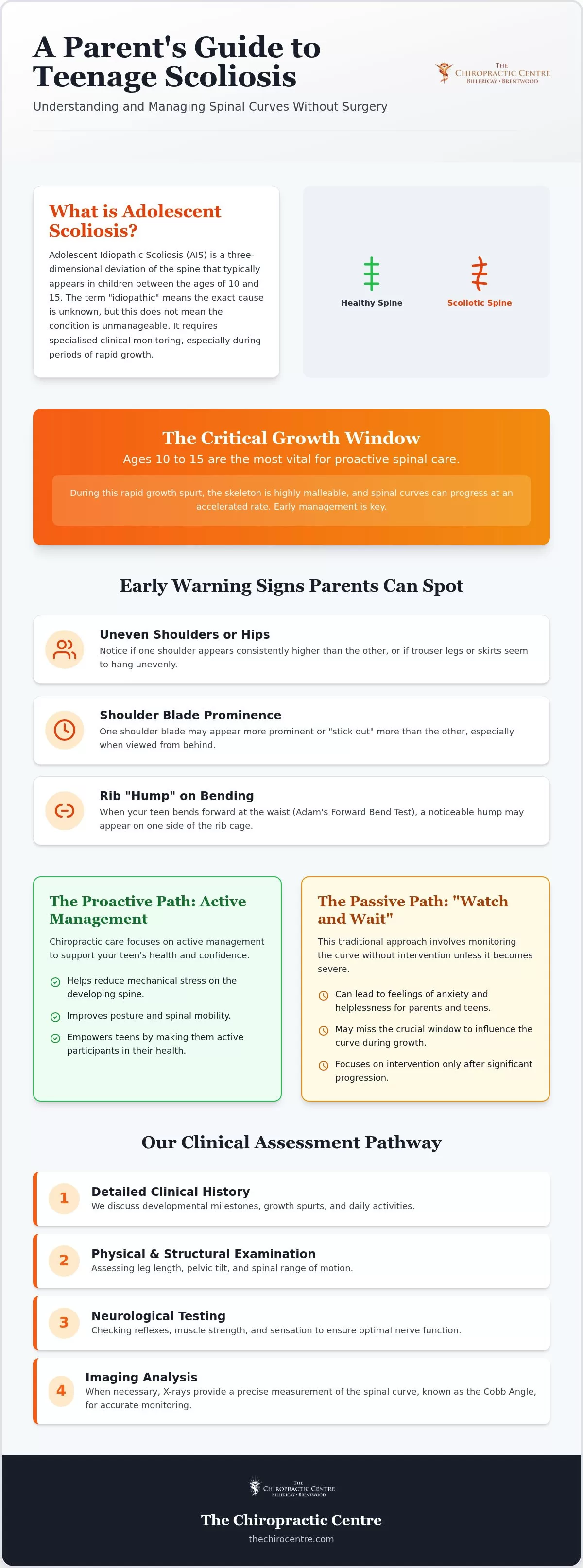
When a parent first hears the word “idiopathic,” it can feel unsettling. In clinical terms, it simply means the cause of the spinal curve is currently unknown, but this doesn’t mean the condition is unmanageable. Understanding Adolescent Idiopathic Scoliosis (AIS) is the first step toward effective care. Whilst the origin may be a mystery, the way the spine behaves during the teenage years is well-documented. AIS is a three-dimensional spinal deviation that requires specialised clinical monitoring.
The most critical window for Essex teens is the rapid growth spurt that typically occurs between ages 10 and 15. During this time, the skeleton is incredibly plastic. As bones lengthen quickly, any existing lateral curvature can progress at an accelerated rate. This is why proactive management is so vital. If you’ve been searching for a chiropractor for teenage scoliosis Essex families can rely on, you’re likely looking for a professional who understands this delicate developmental phase.
Parents often notice subtle changes before a formal diagnosis is made. You might spot:
- Uneven hemlines: A skirt or pair of trousers that seems to hang lower on one side.
- Shoulder blade prominence: One shoulder blade sticking out more than the other.
- Rib humps: A visible protrusion on one side of the back when the teen leans forward.
It’s a common misconception that “poor posture” causes scoliosis. Whilst slouching isn’t ideal, true AIS is structural, meaning the shape of the vertebrae themselves is involved. A functional curve might disappear when a child changes position, but a structural curve remains constant, requiring a different clinical approach than simple postural correction.
The Significance of Early Detection in Essex Schools
In previous decades, spinal screenings were common in UK schools, but today the responsibility often falls on parents and primary care providers. Detecting a curve early can significantly change the management outcome. A simple screening tool we use is the “Adams Forward Bend Test.” You can perform a version of this at home by asking your teen to bend forward at the waist with their arms hanging down. Look for any asymmetry in the ribs or the lower back. If you notice an uneven “hump” on one side, it’s time to seek a professional spinal health check.
The Emotional Impact of a Scoliosis Diagnosis
A diagnosis often hits right when teenagers are most self-conscious about their bodies. They might worry about how they look in sports gear or feel anxious about being “different” from their peers. We find that moving from a “watch and wait” approach to a proactive management plan restores a sense of control. Instead of feeling like a passive observer of their own body, the teen becomes an active participant in their health journey. This shift in perspective is often as important for their confidence as the physical care is for their spine; to support your child’s emotional resilience and maintain healthy communication during this time, you can check out Tracy Kimberg for professional guidance.
The Clinical Assessment: How an Essex Chiropractor Evaluates Scoliosis
The evaluation of a developing spine begins with a deep dive into your teenager’s history. We aren’t just looking at a spine on a screen; we’re looking at a growing person. A specialised chiropractor for teenage scoliosis Essex families trust will start by discussing developmental milestones, the timing of recent growth spurts, and any specific areas of discomfort or fatigue. This clinical assessment for scoliosis is vital for understanding the context of the curve and how it impacts your child’s daily life.
During the physical examination, we perform a detailed structural analysis. This includes measuring leg length and checking for a pelvic tilt, as an uneven foundation can often exacerbate or even mimic a spinal curve. We also assess the spinal range of motion to see how the vertebrae move in different planes. Neurological testing follows, where we check reflexes, muscle strength, and sensation. It’s essential to ensure the nervous system is functioning optimally, as the spine’s primary job is to protect this delicate communication network.
Whilst physical tests tell us a great deal, imaging remains the gold standard for quantifying the condition. When necessary, X-rays allow us to calculate the “Cobb Angle,” which is the precise measurement of the spinal deviation. This provides a baseline that we can compare against future checks to monitor any progression with clinical accuracy.
Measuring the Curve: Understanding the Cobb Angle
The Cobb Angle helps us categorise the scoliosis into three main groups. A curve under 20° is considered mild and typically requires consistent monitoring and conservative support. Moderate curves fall between 20° and 40°, whilst anything over 40° is classified as severe. We also look for the “Risser Sign,” a measurement of skeletal maturity on a scale of 0 to 5. If your teen is a Risser 0 or 1, they have significant growth remaining, which means we must be more proactive in our management to prevent the curve from advancing.
The “Holistic Guide” Approach to Diagnosis
Our assessment looks beyond the back to understand the body as a whole. We examine foot mechanics, looking for issues like over-pronation that might be throwing the hips out of alignment. This comprehensive view is a core part of our new patient chiropractor consultation Essex, where we build a clinical roadmap tailored to your teen’s specific needs. If you’re concerned about your child’s posture or a suspected curve, a professional spinal health check at our Billericay clinic can provide the clarity and peace of mind you need to move forward.
Non-Surgical Management: Chiropractic Care vs. “Watch and Wait”
For many Essex parents, the standard medical advice of “watch and wait” feels like an agonizing gamble. Whilst this approach aims to monitor the Cobb angle, it often leaves families feeling helpless as they wait for the next set of X-rays to see if the curve has progressed. Active management offers a different path. Choosing a chiropractor for teenage scoliosis Essex families trust means moving from passive observation to proactive care. We focus on improving spinal mobility and reducing the mechanical stress that a curve places on the surrounding joints and nerves.
Our primary goal isn’t just about the degrees on an image; it’s about the person behind the diagnosis. By maintaining movement in the spinal segments, we help the body adapt more effectively to rapid development. This proactive approach supports the teen’s quality of life, allowing them to remain active in their favourite sports and social activities whilst we carefully monitor structural changes. It’s about building a foundation of function that carries them through their teenage years with confidence.
The Science of Spinal Adjustment for Scoliosis
Chiropractic care for scoliosis involves specific, gentle adjustments designed to address the unique mechanics of a curved spine. We look at the “concave” side where joints may be compressed and the “convex” side where muscles are often overstretched. We also address compensatory patterns that develop elsewhere. For instance, a curve in the mid-back often forces the neck or lower back to work harder to keep the head level. If your teen is hesitant about what to expect, reading about what does a chiropractic adjustment feel like can help ease any nerves before their first visit.
Complementary Therapies: Dry Needling and Soft Tissue Work
A spine doesn’t exist in isolation; it’s supported by a complex network of muscles and ligaments. In a scoliosis case, these tissues often become unevenly loaded, leading to chronic discomfort. We integrate clinical massage Billericay to release the tight, “bunched” muscles that frequently develop on one side of the curve. Dry needling can also be incredibly effective for releasing stubborn tension in the deeper muscular “valleys.” This multifaceted approach ensures that as we work on spinal function, the soft tissues are also supported, providing much-needed relief during intensive growth phases.
Supporting Your Teen: Practical Lifestyle Guidance for Essex Families
Managing scoliosis isn’t just about what happens during a clinical appointment; it’s about the hundreds of small decisions your teenager makes every day. From the way they carry their books to how they sit at their desk, these habits either support or stress the spinal column. When working with a chiropractor for teenage scoliosis Essex families often find that small, consistent lifestyle adjustments make a significant difference in their child’s comfort and long-term progress.
Heavy rucksacks are a common culprit for spinal strain in Essex students. We recommend using a dual-strap bag worn over both shoulders to distribute weight evenly. Encourage your teen to use their school locker whenever possible to avoid carrying unnecessary textbooks throughout the day. Even a well-fitted bag becomes a burden if it exceeds 10% of the student’s body weight.
The “digital slump” is another modern challenge. Looking down at a phone for hours adds significant mechanical load to the neck and upper back, which can complicate scoliosis patterns. For sleep, a medium-firm mattress typically provides the best support, whilst a contoured pillow can help maintain neutral neck alignment. These environmental factors are the foundation upon which clinical progress is built.
Navigating School Life in Billericay and Brentwood
Schools in our local area can be large, and the walk between classes with a heavy bag is a real factor. We suggest parents speak with PE teachers to discuss modifications; for example, avoiding high-impact vertical loading exercises if the curve is currently unstable. Encouraging your teen to avoid the “one-sided slouch” during long assemblies or study sessions is also key for maintaining the balance we work toward in the clinic. Awareness is the first step toward better habits.
Home Exercises and Core Stability
A strong core acts as a natural brace for the spine. We often recommend “symmetrical” sports such as swimming or cycling because they engage both sides of the body equally. This is usually preferable to one-sided activities like tennis or golf during active growth phases. Simple stretches to maintain hip and shoulder mobility are also vital between visits to your chiropractor for teenage scoliosis Essex. Movement is medicine, provided it is the right kind of movement.
If you’re unsure how your teen’s daily routine is impacting their spine, you can book a Free Spinal Health Check at our Billericay clinic to get tailored advice for their lifestyle.
Choosing a Scoliosis Specialist at The Chiropractic Centre
Finding the right chiropractor for teenage scoliosis Essex families trust is about more than just finding a clinic; it’s about finding a partner for your child’s developmental journey. Our Billericay centre has spent over 10 years building a reputation as a clinical hub for non-surgical spinal care. We understand that a teenager isn’t just a “small adult.” Their skeleton is dynamic, and their emotional needs during a consultation are just as important as their clinical ones. We’ve designed our practice to be a place where families feel heard and teens feel respected.
Grayson and the team bring a deep level of expertise in paediatric chiropractor Essex care. This specific focus ensures that our adjustments are gentle, precise, and appropriate for developing joints. When you walk through our doors, you’ll find a calm, professional environment that is intentionally teen-friendly. We take the time to explain the “why” behind every assessment, empowering your teenager to take ownership of their spinal health. This education helps reduce the anxiety often associated with a scoliosis diagnosis.
Taking the first step is simple. You can book your scoliosis management Essex assessment through our website or by calling our friendly reception team for a chat about your concerns.
Our Commitment to the Essex Community
For more than a decade, we’ve served families across Chelmsford, Stock, Basildon, and Wickford. We believe that every parent deserves clarity without immediate pressure. This is why we offer a Free Spinal Health Check as an initial screening tool. It allows us to identify potential issues early whilst providing you with an expert opinion on the best path forward. Our approach is fundamentally person-centred. We treat the teenager sitting in front of us, not just the degrees on an X-ray, ensuring their lifestyle and goals remain the priority.
Next Steps for Your Teen’s Spinal Health
Preparing for your first consultation is straightforward. If you have previous scans, growth records, or medical reports, please bring them along. These documents help us build a more accurate timeline of the curve’s progression. As we discussed in earlier sections, consistent monitoring is essential, especially when a teen is in the “Danger Zone” of rapid growth. We are here for a low-pressure discussion whenever you feel ready. Your teen’s journey toward a stronger, more stable spine starts with a single, thorough assessment at our Billericay centre.
A Clear Path Forward for Your Teen’s Spinal Health
Navigating a scoliosis diagnosis is a journey that requires both clinical precision and empathetic support. By focusing on early detection during critical growth windows and moving away from a passive “watch and wait” approach, you provide your child with the best opportunity for a stable, active future. We’ve seen how specialised adjustments and soft tissue work address the unique mechanics of a developing spine; ensuring that function and confidence remain at the heart of their care.
As a dedicated chiropractor for teenage scoliosis Essex families have trusted for over 10 years, we provide specialised paediatric pathways that look beyond the curve to the person as a whole. Our team is committed to delivering the reassuring expertise you need during this pivotal time in your teen’s development. If you’re ready to move from uncertainty to a clear, long-term management plan, we invite you to Book a Free Spinal Health Check or Consultation at our Billericay Centre. With the right support, your teenager can continue to thrive in their favourite sports and daily life with a strong, resilient spine.
Frequently Asked Questions
Is chiropractic care safe for teenagers with scoliosis?
Yes, chiropractic care is safe for teenagers when delivered by a qualified professional specialising in paediatric care. Our adjustments are significantly gentler than those used for adults, taking into account the teenager’s developing skeleton and the specific mechanics of their curve. We focus on enhancing joint mobility and reducing mechanical strain without using invasive force. This supportive approach ensures your child feels comfortable and safe throughout their management plan.
Can a chiropractor actually straighten a scoliotic curve?
Chiropractic care focuses on managing the functional impact of the condition rather than “curing” the structural curve itself. Whilst we don’t claim to straighten a scoliotic spine completely, our goal is to improve spinal mobility, reduce discomfort, and support the body’s ability to adapt. By optimising joint function, we aim to slow progression and improve the teenager’s overall quality of life, focusing on how they move and feel rather than just the X-ray.
How often will my teenager need to visit the Essex clinic?
The frequency of visits depends entirely on your teenager’s specific curve and their current stage of growth. During a rapid growth spurt, we might recommend more frequent sessions to ensure the spine remains as mobile and supported as possible. Once we establish stability, many families transition to a maintenance schedule. A specialised chiropractor for teenage scoliosis Essex parents trust will always provide a clear, personalised timetable after the initial clinical assessment.
Will my teen have to stop playing sports like rugby or gymnastics?
Most teenagers don’t need to stop playing the sports they love, though some modifications might be beneficial. Activity is actually vital for maintaining core strength and spinal health. Whilst high-impact sports like rugby or high-intensity gymnastics require careful monitoring, we generally encourage staying active. We can work with your teen and their coaches to suggest specific stretches or postural habits that support their spine whilst they continue to participate in their favourite activities.
What is the difference between functional and structural scoliosis?
Functional scoliosis is often temporary and caused by factors like muscle imbalances, leg length discrepancies, or poor postural habits; the curve usually disappears when the person bends over. Structural scoliosis, such as AIS, involves a permanent change in the shape and rotation of the vertebrae themselves. Distinguishing between the two is a critical part of our assessment, as each requires a different clinical approach to ensure the spine is supported effectively during growth.
Can scoliosis cause other health issues like headaches or fatigue?
Yes, scoliosis often leads to secondary issues like tension headaches, back pain, or general fatigue. When the spine is curved, the muscles on either side must work unevenly to keep the body upright, which quickly leads to muscular exhaustion and strain. By visiting a chiropractor for teenage scoliosis Essex teens can find relief from these compensatory patterns. Improving spinal alignment and mobility helps reduce the overall physical stress on the body, often resulting in better energy levels.
Do I need a GP referral to see a chiropractor in Billericay?
You don’t need a GP referral to visit our Billericay clinic. Chiropractors are primary healthcare practitioners, which means you can book an appointment directly for a private consultation. We often work alongside other medical professionals and are happy to share our findings with your GP or specialist if you wish. This collaborative approach ensures your teenager receives comprehensive care that covers every aspect of their spinal health and general wellbeing.
What happens if the scoliosis curve continues to progress?
If we observe significant progression that exceeds conservative management thresholds, we will discuss the next clinical steps with you. This might involve a referral to an orthopaedic specialist to explore options like bracing or, in rare cases, surgical consultation. Just as elite athletes require an orthopedic surgeon Nutley NJ for specialised injury management, complex spinal cases also benefit from expert oversight. Our role is to provide proactive support whilst acting as an expert guide, ensuring you have the information needed to make the best decisions for your child’s health at every stage of their development.