
Could the best choice depend less on the name of the treatment and more on what your back needs? It’s understandable to wonder whether dry needling and acupuncture are the same, and to have questions about needles, comfort and safety. This guide to dry needling vs acupuncture for back pain Chelmsford explains how the approaches differ and what to consider before choosing a next step.
You’ll learn about their different principles and focus, what treatment may involve, and why your symptoms and preferences matter. Neither approach is automatically right for everyone, so a personalised discussion can help you weigh up the options without pressure.
At The Chiropractic Centre in Chelmsford, dry needling is one of the treatments available for musculoskeletal concerns. An individual assessment can help inform a discussion about your back pain and whether dry needling, clinical massage or chiropractic care may be relevant to your needs. You can ask questions and understand the reasoning before deciding what feels right for you.
Key Takeaways
- Understand how dry needling and acupuncture differ in their principles and intended focus.
- Use the comparison of dry needling vs acupuncture for back pain Chelmsford to prepare for a personalised discussion, rather than assuming one approach suits everyone.
- Consider your symptoms, treatment goals and comfort with needles when discussing possible options.
- Know what to expect from a conversation about your symptoms, an assessment and possible next steps.
- Explore how dry needling, clinical massage or chiropractic care may relate to your individual needs at The Chiropractic Centre.
Dry needling vs acupuncture for back pain in Chelmsford: what is the difference?
Back pain can make treatment choices feel confusing, especially when two approaches both use fine needles. The names aren’t interchangeable, though, and neither one is automatically the right fit. Understanding the principles behind each can help you ask more useful questions about your options.
What does dry needling involve for back pain?
For back pain, a clinician may consider whether particular muscles or trigger points are relevant to your symptoms, then decide whether needling is appropriate. The focus is on selected muscle tissue, but this does not guarantee a particular result. Your symptoms, health history and assessment findings inform clinical judgement, including whether to use dry needling and which areas to target.
How is acupuncture understood and practised?
In traditional acupuncture, a practitioner chooses points with reference to patterns of health and wellbeing, rather than focusing only on a local muscle. For patients interested in wider health support, doctor-led centres such as Yoyime Clinic illustrate how wellness services can be integrated alongside broader medical and aesthetic care. Contemporary acupuncture may draw on different explanations and approaches. Practitioners’ training, methods and treatment plans can vary, so the word “acupuncture” alone doesn’t tell you exactly what a session will involve.
The tools and points used can overlap, which is why the label alone may not explain the treatment. The practitioner’s training, assessment and reason for recommending an approach matter. Ask how the proposed treatment relates to your back symptoms, what it is intended to address and how the plan will be reviewed. A clear explanation should help you understand the approach before deciding whether it feels right for you.
This is the practical distinction behind dry needling vs acupuncture for back pain Chelmsford: similar-looking needles can be used within different treatment frameworks. For a general overview of what is dry needling and how it compares with acupuncture, you can read more about the method and its history. The next step is to consider how your own symptoms and circumstances inform a clinical discussion.
How dry needling and acupuncture approach back pain differently
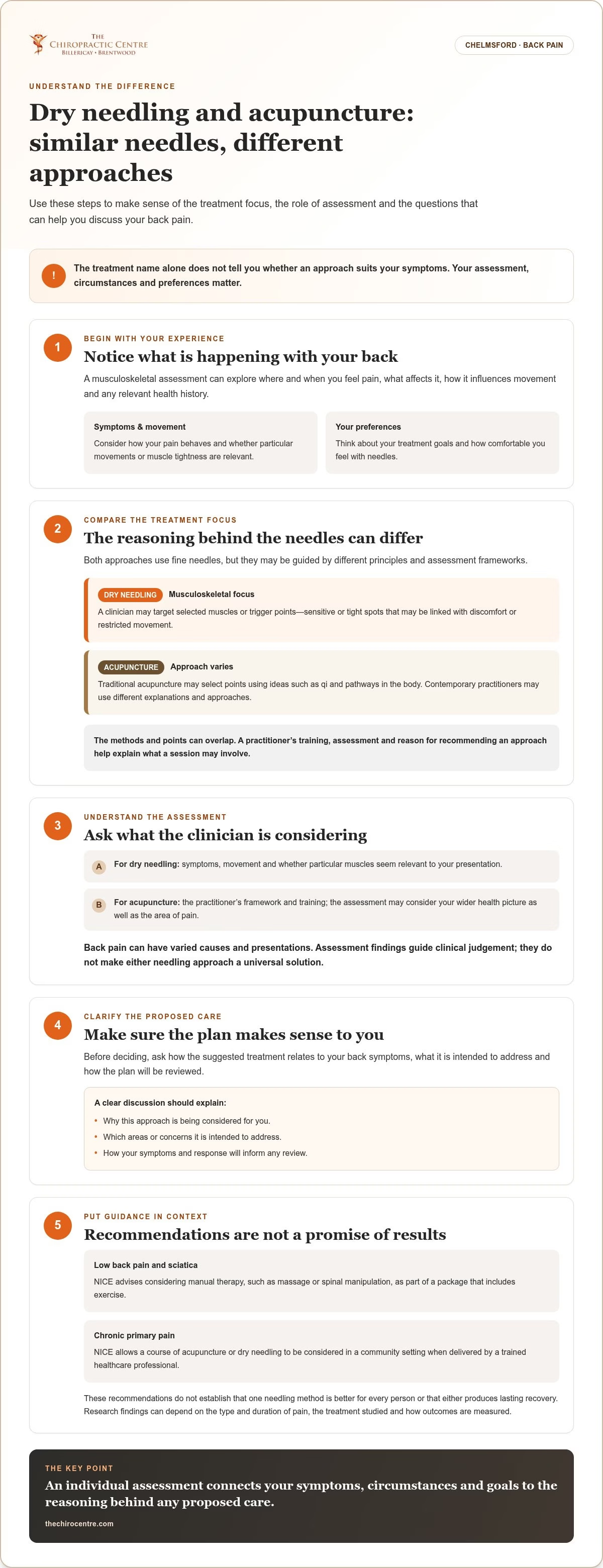
The methods may look similar, but the reasoning behind them can differ. Dry needling usually focuses on selected muscles and trigger points; acupuncture may follow traditional principles or a contemporary clinical approach. Neither label, by itself, tells you whether a treatment fits your back pain.
Needling approach, treatment aims, and the role of assessment
| Dry needling | Acupuncture |
|---|---|
| Usual rationale: A musculoskeletal approach that may target selected muscles or trigger points. | Rationale: Traditional practice may select points using concepts such as qi and pathways in the body; contemporary practice can use different explanations. |
| Assessment focus: Symptoms, movement and whether particular muscles appear relevant to your presentation. | Assessment focus: Depends on the practitioner’s framework and training, and may consider your wider health picture as well as the area of pain. |
| Intended focus: Addressing targeted muscle areas, without promising a particular result. | Intended focus: Varies with the acupuncture approach and the plan agreed with the practitioner. |
A musculoskeletal assessment can explore where and when you feel pain, what affects it, how it influences movement and any relevant health history. Back pain can have varied causes and presentations. For example, discomfort alongside muscle tightness may prompt different questions from pain that changes markedly with movement. These details help guide clinical judgement; they don’t make either needling approach a universal solution.
An individual assessment matters more than the treatment label because it connects your symptoms, circumstances and goals to the reasoning behind any proposed care.
What does the evidence say about back pain?
Proposed mechanisms are not the same as proven outcomes. NICE guidance on low back pain and sciatica advises considering manual therapy, such as massage or spinal manipulation, as part of a package that includes exercise. NICE guidance for chronic primary pain also allows a course of acupuncture or dry needling to be considered in a community setting when delivered by a trained healthcare professional. These recommendations don’t establish that one needling method is better for every person or that either produces lasting recovery.
Research findings can depend on the type and duration of pain, the treatment studied and how outcomes are measured. A short-term change in symptoms should not be taken as proof of a lasting effect. An assessment can help put general evidence into the context of your own presentation.
If you’re considering dry needling in Chelmsford, a discussion at The Chiropractic Centre can relate your symptoms and goals to the care options available at the practice.
Which option may suit your back pain, preferences, and circumstances?
Questions to discuss before deciding
You’re entitled to understand the reasoning behind a proposed treatment and share concerns before it begins. You might ask:
- What is this treatment intended to address in my case?
- How do my symptoms and assessment findings inform that recommendation?
- How will we review whether it’s helping me work towards my goals?
- Could my health history or previous treatment experiences affect the plan?
- What other options could be considered, and how do they relate to the assessment?
If needles make you uneasy, say so. Describe what worries you, ask what is proposed and take time to consider the discussion. You don’t have to hide uncertainty to make a good decision. A thoughtful conversation should leave room for your questions and preferences.
When might clinical massage also enter the discussion?
Clinical massage is a separate hands-on approach, not another name for acupuncture or dry needling. Depending on your presentation and goals, it may be discussed as part of an individual care conversation. The right option depends on your circumstances, not on choosing a treatment simply because it sounds familiar or less daunting.
For a closer look at this hands-on option, read the clinical massage guide. A personalised assessment can bring the dry needling vs acupuncture for back pain Chelmsford discussion back to what matters most: your symptoms, priorities and a clear explanation of the options.
What to expect when discussing dry needling for back pain in Chelmsford
A clear discussion should help you understand how your symptoms relate to the options being considered, without rushing you towards a decision. You can talk through your concerns, have an assessment, review suitable options and agree what happens next. Dry needling is considered in light of your individual presentation, not simply because you have back pain.
From first conversation to an individual plan
Begin by describing where you feel discomfort, what affects it and how it influences your everyday movement. Sharing relevant health information, previous treatment experiences and any worries about needles helps build a fuller picture. You don’t need to know which treatment you want before the conversation starts.
A musculoskeletal assessment can consider your symptoms and movement. The findings help inform whether dry needling is worth discussing or whether another approach may better match your needs and goals. You should hear the reasoning in plain English and have time to consider the next step. For an overview of the consultation process, see the new patient consultation guide.
Safety, consent, and clear explanations
Before treatment begins, you should understand what is proposed, its intended focus and any relevant considerations. A responsible discussion also gives you the chance to ask about alternatives and raise concerns, including discomfort or anxiety about needles. The practitioner should listen and explain the approach rather than assume you’re comfortable.
Your agreement matters. You can ask for clarification, take time to think or say that you don’t wish to proceed. No treatment is suitable for everyone, and an assessment helps inform that decision. If your symptoms or circumstances change, share this so the discussion can take account of the new information.
The aim is a plan you understand, with next steps agreed together. There’s no need to decide between dry needling and acupuncture based on the names alone; what matters is how the assessment and your preferences shape the conversation. To learn about the consultation process at The Chiropractic Centre, explore the consultation process.
Discuss dry needling and back pain care with The Chiropractic Centre
Choosing what to discuss next can feel easier in a calm, personal setting where your options are explained clearly. The Chiropractic Centre serves people in Chelmsford and nearby Essex communities, with dry needling among its treatments for musculoskeletal concerns. It is a drug-free option that may be discussed following an assessment, without a promise of a particular result.
A local, person-centred conversation about back pain
Your concerns and priorities matter. You might want to move more comfortably, understand what affects your symptoms or feel clearer about what a treatment involves. Sharing these goals helps shape a discussion around your circumstances, rather than treating a label as the answer.
Dry needling may be considered in light of your presentation and assessment findings. Massage therapy, including clinical massage, and chiropractic adjustments are distinct options that may also be discussed if relevant to your needs. The aim is to explain each approach in plain English, so you can ask questions and consider what feels appropriate. The Centre’s calm, welcoming environment supports a thoughtful conversation without pressure.
Your next step towards a clearer care plan
Dry needling and acupuncture have different approaches, and neither is automatically right for everyone with back pain. An individual assessment brings your symptoms, goals and preferences into the discussion, helping you understand which options may be relevant.
If you’d like to talk through your back pain and understand the consultation process, you can arrange a new patient consultation with The Chiropractic Centre. Bring your questions, including any concerns about needles, and take an informed next step at your own pace.
Take an informed next step for your back
Dry needling and acupuncture use different treatment frameworks, so similar-looking needles don’t mean the approaches are interchangeable. A useful discussion starts with your symptoms, goals, preferences and an individual assessment, not a label or a promise of results.
If you’re weighing up dry needling vs acupuncture for back pain Chelmsford, The Chiropractic Centre offers dry needling and clinical massage as part of its care for musculoskeletal concerns. The practice has been established for over 10 years and takes a personal, patient-centred approach, with clear explanations to help you understand the options and raise any concerns.
A new patient consultation can be a helpful starting point for discussing your back pain and what may be appropriate for you. There’s no need to have all the answers before you begin. Arrange a new patient consultation and take an informed step towards a clearer care plan.
Frequently Asked Questions
Is dry needling the same as acupuncture?
No. Both use fine needles, but dry needling and acupuncture aren’t interchangeable terms. Dry needling commonly targets selected muscle areas, while acupuncture may follow traditional frameworks or contemporary clinical approaches. Methods and explanations vary between practitioners. If you’re comparing dry needling vs acupuncture for back pain Chelmsford, ask what the proposed treatment aims to address and how the practitioner’s reasoning relates to your assessment.
Can dry needling help back pain?
Dry needling may be considered as part of a discussion about back pain, but whether it’s suitable depends on your symptoms and assessment. NICE guidance allows acupuncture or dry needling to be considered for chronic primary pain when delivered by a trained healthcare professional in a community setting. This doesn’t guarantee a particular result. A clinician can explain the intended role, alternatives and how progress may be reviewed. Seek appropriate clinical advice for new or concerning symptoms.
Which is better for back pain, dry needling or acupuncture?
There’s no single option that’s better for everyone. Dry needling and acupuncture have different treatment rationales, and a suitable discussion depends on your symptoms, health history, preferences and assessment findings. Ask how the proposed approach relates to your needs, what it aims to address and what its limitations are. Comparing the reasoning and goals of a care plan is more useful than choosing based on a treatment name alone.
Does dry needling hurt?
People’s experiences differ, and the sensation can depend on the technique and your own sensitivity. Before treatment, the practitioner should explain what’s proposed and give you space to raise concerns or ask questions. Let them know if you feel uncomfortable or want to pause. No one can promise that treatment will be painless, so discuss what you might experience in the context of your assessment and personal circumstances.
How many dry needling sessions are needed for back pain?
There’s no standard number of sessions that applies to everyone with back pain. Any plan should reflect your assessment, the practitioner’s reasoning and how you respond, rather than an assumed schedule or recovery timeline. Ask how progress will be reviewed and what might lead to a change in the plan. This helps you understand the purpose of any proposed care and decide whether the next step feels right for you.
What should I expect at a dry needling consultation in Chelmsford?
Expect to discuss your symptoms and relevant health history, followed by an appropriate assessment and a conversation about possible next steps. The practitioner should explain the reasoning in plain English and make room for your questions and consent. The Chiropractic Centre serves people in Chelmsford and nearby communities, including Brentwood, Billericay, Stock, Basildon and Wickford. Your consultation will focus on your individual circumstances and care needs.
Can dry needling be combined with clinical massage for back pain?
Dry needling and clinical massage are distinct approaches, and discussing both doesn’t mean they’re necessary or suitable for everyone. The Chiropractic Centre provides dry needling and clinical massage, with options considered in relation to your assessment and care goals. Ask what each approach is intended to address and how progress would be reviewed. A clear discussion can help you understand the plan without assuming a particular outcome.