

What if your child’s slouch reflects changing routines rather than anything you’ve done wrong? A child’s posture can shift as they grow, and an occasional slump doesn’t automatically mean there’s a problem. To understand what causes poor posture in children Basildon parents may notice, consider growth alongside everyday habits such as screen use, sitting at school and carrying a school bag.
It’s understandable to wonder whether a change is simply part of growing up or a reason to seek advice. This guide explains common influences on posture without blame, shares practical ways to support comfortable movement and outlines signs that may be worth discussing with a healthcare professional.
Activity, furniture and daily routines can all affect how children sit and move, while posture can vary through different stages of growth. You’ll also learn when ongoing discomfort, restricted movement or a persistent change may merit a professional opinion. At The Chiropractic Centre, paediatric care and postural and musculoskeletal assessments can help you better understand your child’s movement in a calm, supportive setting.
Key Takeaways
- Posture is how your child holds their body when sitting, standing and moving. It can naturally vary as they grow.
- When considering what causes poor posture in children Basildon families can look at everyday influences, including sitting, device use and other routines.
- A change in appearance alone doesn’t show that your child has a spinal or musculoskeletal condition.
- Notice patterns, check whether your child feels comfortable and encourage movement without repeatedly telling them to sit perfectly.
- If concerns persist, a postural or musculoskeletal assessment can help you understand your child’s posture, movement and daily habits.
What does poor posture in children mean for Basildon families?
Noticing a change in your child’s posture can feel worrying, especially if you’re unsure whether it’s a passing habit or something that needs attention. Posture describes how someone holds their body when sitting, standing and moving. It isn’t a fixed pose a child should maintain all day. Their position may change as they play, concentrate, rest or move between different settings.
A single slouched moment doesn’t establish a lasting posture problem, explain its cause or provide a diagnosis. Children naturally change position, and what feels comfortable for one activity may not suit another. For families wondering what causes poor posture in children Basildon, start by considering the child’s wider pattern rather than judging one snapshot or assuming growth alone is responsible.
This section offers general information, not a diagnosis of an individual child. A photograph or quick glance can’t tell you why a child is holding themselves a certain way. If you’re concerned, notice what you see over time and whether it changes with activity, comfort or surroundings. A calm, curious approach can help you understand what’s happening without making your child feel criticised.
Some spinal curves have clinical names. Kyphosis, an increased forward curve of the upper back, is one term you may encounter. Reading about a condition can provide context, but it can’t establish that your child has it. Discuss a persistent or pronounced change with an appropriate health professional rather than interpreting it from appearance alone.
How can posture change as children grow?
Growth is a changing physical stage, not a cause of poor posture in itself. As your child gets taller and develops, their comfort and movement habits may look different from one activity to the next. They might sit differently for a meal than for drawing, or stand differently while playing than when waiting in a queue. There isn’t one ideal position for every child, task or moment. Ease and the ability to move matter too.
Does slouching always mean there is a problem?
No. An occasional slouch alone can’t identify a cause or condition, and it’s not a reason to blame your child. Instead, look for a pattern. Does the change appear repeatedly, across different activities or settings? Does your child mention discomfort or difficulty moving? These observations can help you decide whether to seek advice without turning posture into a test your child must constantly pass.
- Notice whether the posture change is occasional or keeps appearing.
- Consider the activity and setting, and whether your child seems comfortable.
- Talk about what you’ve noticed gently, without repeatedly reminding them to “sit up straight”.
Keeping these observations in mind gives you a clearer starting point if you decide to discuss your concern with a professional.
What everyday factors can contribute to poor posture in children?
There’s rarely one simple explanation for the way a child sits or stands. Posture can reflect a combination of daily activities, comfort, movement and surroundings. A child who leans over a drawing one afternoon may simply be absorbed in the task. If they often seem uncomfortable or struggle to stay settled, that wider pattern may be worth noticing. These influences can help explain what causes poor posture in children Basildon families observe, but they don’t prove that a particular habit has caused a problem.
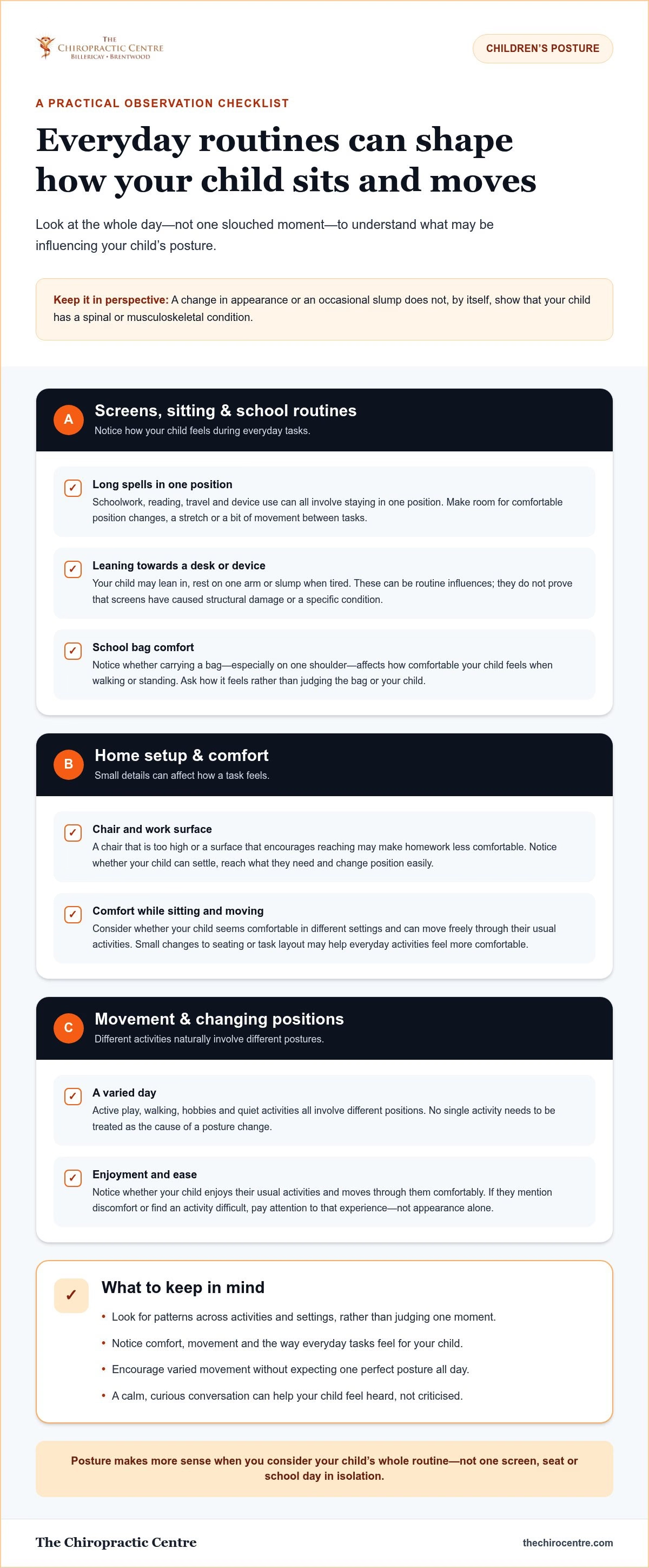
Posture makes more sense when you look at the child’s whole routine, not one screen, seat or school day in isolation.
Can screens, sitting and school routines affect posture?
Schoolwork, reading, travel and device use can all involve time spent in one position. A child may lean towards a tablet or desk, rest against one arm, or slump when tired. These are possible routine influences, not proof that screens cause structural damage or a specific condition. Rather than aiming for one rigid pose, offer comfortable chances to change position, stretch or move between tasks.
School bags can also affect comfort, particularly if a child carries one on a single shoulder or adjusts their stance to manage the load. Ask how it feels and notice whether carrying it makes walking or standing uncomfortable. The aim isn’t to judge the bag or your child, but to understand how everyday tasks feel for them.
What role do movement, comfort and the home setup play?
A chair that’s too high or a work surface that encourages reaching may make a task less comfortable. Notice whether your child can settle easily for homework, reach what they need and change position without difficulty. There’s no need to create a perfect workstation. Small adjustments to seating or task layout may make everyday activities feel more comfortable.
Movement is part of the day’s mix. Active play, walking, hobbies and quiet activities all involve different positions, and no single activity needs to be treated as the cause. Notice whether your child enjoys their usual activities and moves freely through them. If they mention discomfort or find an activity difficult, pay attention to that experience, not appearance alone.
- Notice which activities involve long spells in one position.
- Check whether your child seems comfortable at their chair, desk and while carrying their bag.
- Make room for varied movement and position changes through the day.
- Listen if your child reports discomfort or difficulty with an everyday task.
These observations can give you useful context if concerns continue. The Chiropractic Centre’s paediatric care takes a supportive approach to children’s wellbeing and movement.
When is poor posture more than an everyday habit?
A posture change can catch your eye without meaning that your child has damaged their back or has a spinal condition. Children may sit unevenly or slump at times, and appearance alone can’t explain why. It also can’t diagnose scoliosis or another musculoskeletal condition. The more useful question is whether the change continues and affects your child’s comfort or movement.
When considering what causes poor posture in children Basildon families may notice, keep the whole picture in mind. A photograph captures one position at one moment. It can’t show how your child moves during the day, whether they feel comfortable or whether their posture changes between activities. Try not to draw conclusions from one image or brief observation.
Which changes should parents pay attention to?
Notice whether the same change appears repeatedly during ordinary activities, such as walking, sitting at the table or getting dressed. Also pay attention if your child mentions ongoing discomfort or finds a familiar movement or activity difficult. These details don’t tell you the cause, but they can help you describe what you’ve noticed when discussing your concern with a clinician.
You don’t need to monitor every movement. A few calm observations over time can be more useful than repeated reminders or frequent photographs. Note what your child was doing, whether they seemed comfortable and whether the change was still present in a different setting. Share those observations if the concern persists.
Could uneven posture mean scoliosis?
An uneven stance or a difference in how your child holds their shoulders does not, by itself, confirm scoliosis. Children may shift their weight or stand asymmetrically for many everyday reasons. If you keep noticing an asymmetry and it concerns you, a professional assessment can help explore it in context. The aim is to understand what’s happening, not to label a condition from appearance alone.
If spinal curvature is on your mind, you can read the scoliosis management guide for further information. It’s general reading, not a way to diagnose your child. A clinician can consider your child’s posture alongside their movement, comfort and relevant history.
Consider seeking appropriate advice if you notice a continuing change, ongoing discomfort or difficulty with movement. Explain when you first noticed it, which activities bring it out and whether your child has mentioned discomfort. A supportive conversation with a clinician can help you decide what assessment, if any, is appropriate. You don’t have to work out the cause on your own.
What can Basildon parents do to support comfortable posture?
You don’t need to correct every slump or ask your child to hold one position throughout the day. A calm, practical approach is more useful: notice patterns, check comfort, make space for movement, then seek advice if concerns persist. Understanding what causes poor posture in children Basildon families notice means looking at everyday routines without assuming that one habit explains everything.
Try this simple sequence:
- Notice patterns. Consider when a posture change appears and whether it happens during particular activities.
- Review comfort. Check whether your child can sit, reach and use their screen or homework space comfortably.
- Encourage movement. Build natural position changes and a mix of everyday activities into the day.
- Seek advice if concerns persist. Share ongoing concerns with an appropriate healthcare professional, including any discomfort or difficulty with movement.
These steps aren’t a test your child has to pass. They’re ways to understand what feels comfortable and make small adjustments that suit your family.
How can you make everyday routines more posture-friendly?
During homework or screen activities, check that your child can use their chair and work surface comfortably, then make room for them to change position. A short pause to stand, stretch or move between tasks may feel more natural than trying to maintain a rigid pose. Look for opportunities that fit your household, such as walking together or active play, rather than adding rules that are hard to sustain.
Small changes can be enough to try. Move an item closer if your child is reaching for it, or help them find a comfortable place to sit. Let your child’s comfort guide the adjustment. There’s no need to keep correcting their posture throughout the day.
How can you talk to your child without creating worry?
Keep the conversation gentle and focused on how your child feels, not how they look. You might ask, “Does your back feel comfortable while you’re drawing?” or “Is there anything that feels tricky when you’re playing?” Listen to their answer without suggesting that they’ve done something wrong. Noticing a posture change isn’t a reason for blame.
If your child mentions ongoing discomfort or difficulty with a familiar activity, take their experience seriously and discuss persistent concerns with an appropriate healthcare professional. Describe what you’ve observed and what your child has told you, while leaving assessment and interpretation to the professional. This keeps the focus on your child’s wellbeing, rather than achieving a perfect-looking posture.
If you’d value support in understanding your child’s posture and movement, The Chiropractic Centre offers child-focused spinal health checks in Basildon.
When can a children’s posture assessment in Basildon help?
If a posture change keeps appearing, or your child mentions ongoing discomfort or difficulty moving, an assessment may give you a clearer picture of what’s happening. It can explore posture alongside movement, comfort and relevant daily routines, rather than treating appearance as the whole story. For families asking what causes poor posture in children Basildon, the aim is to understand possible influences, not to promise a particular result.
At The Chiropractic Centre, paediatric care considers both the child and their parent or carer. A conversation can cover what you’ve noticed, when it tends to happen and how your child feels during everyday activities. An assessment can support understanding, but it doesn’t guarantee that posture will be corrected or identify every possible cause or condition.
What may a musculoskeletal assessment consider?
A musculoskeletal assessment considers muscles, joints, movement and posture. A clinician may ask about your child’s usual activities and routines, as well as the concerns that brought you in. A postural assessment looks more closely at posture to identify areas for further consideration. These observations help build a picture, but one assessment cannot explain every cause or confirm every condition.
You can share practical details that may help provide context, such as when you first noticed a change, whether it appears during a particular activity and whether your child has mentioned discomfort. Your child’s comfort matters throughout. If they feel unsure, help explain what you’ve observed and ask for a clear, age-appropriate explanation of what the assessment involves.
How can local paediatric care support the next step?
A supportive assessment gives you space to discuss concerns and understand what the clinician observes. The focus is on your child as an individual, including their movement, comfort and relevant daily habits. You should leave with a clearer understanding of the discussion, without expecting that an assessment will automatically change posture or resolve a concern.
The Chiropractic Centre provides paediatric care for families in Brentwood, Billericay, Chelmsford, Stock, Basildon and Wickford. It’s reasonable to seek an assessment if a change persists or you’d like help making sense of what you’ve noticed. If you’re considering a first appointment, learn more about the new patient consultation and what it involves.
Choose a reassuring next step for your child
If you’re weighing what causes poor posture in children Basildon, a first conversation can help you raise the questions that matter to your family. You might want to understand what an assessment involves, how your child can take part, or what options are appropriate after your concerns have been heard. There’s no need to have every answer before taking that step.
The Chiropractic Centre offers a welcoming setting for families to discuss their child’s needs. To explore that conversation, find out how a new patient consultation can help you understand your child’s needs. A clear, considered first step can help you feel more prepared to support your child.
Frequently Asked Questions
Can screen time cause poor posture in children?
Screen use can be one influence, but it shouldn’t be treated as the sole cause. If your child leans towards a handheld device, try placing it on a stable surface at a comfortable viewing height, or make the text larger so they can read without leaning in. When considering what causes poor posture in children Basildon, look at what happens during different screen activities, not just the total time spent on a device.
Is slouching normal during a child’s growth?
An occasional slouch doesn’t, on its own, show that growth has caused a problem. As your child gets taller, check whether their chair and table still feel suitable. Furniture that fitted last term may now feel different. Ask whether they’re comfortable during a usual task, such as drawing or eating. If you’re unsure how to interpret a continuing change, a healthcare professional can discuss your observations with you.
Can a heavy school bag cause poor posture?
A school bag may affect comfort, but its weight alone can’t establish why a child’s posture looks different. Pack it together and remove items they won’t need that day, then check that the straps sit securely and your child can put it on and take it off comfortably. Don’t rely on a particular weight limit. If carrying the bag remains uncomfortable, include that detail when seeking advice.
Does poor posture mean my child has scoliosis?
No, a posture observation by itself doesn’t establish scoliosis. If you’re concerned about a continuing difference in your child’s back, explain what you’ve noticed to an appropriate healthcare professional. They can discuss it with you and decide what assessment or further guidance is suitable. You don’t need to interpret the shape yourself or compare your child’s body with pictures online.
Can poor posture cause pain in children?
Posture alone can’t tell you what’s causing your child’s pain. If they mention discomfort, ask where they feel it and whether it affects activities they usually enjoy, such as sport or playing with friends. Share your child’s own description with an appropriate healthcare professional, rather than suggesting they are responsible for the pain. A clinician can consider the concern in context and advise on suitable next steps.
When should I seek advice about my child’s posture?
You can seek advice if you’re worried, even if you’re not sure how to describe the change. Before an appointment, write down the questions you’d like answered and invite your child to share what they want the clinician to know. This can help keep the conversation focused on their experience. To discuss your concerns with The Chiropractic Centre, find out about a new patient consultation.