
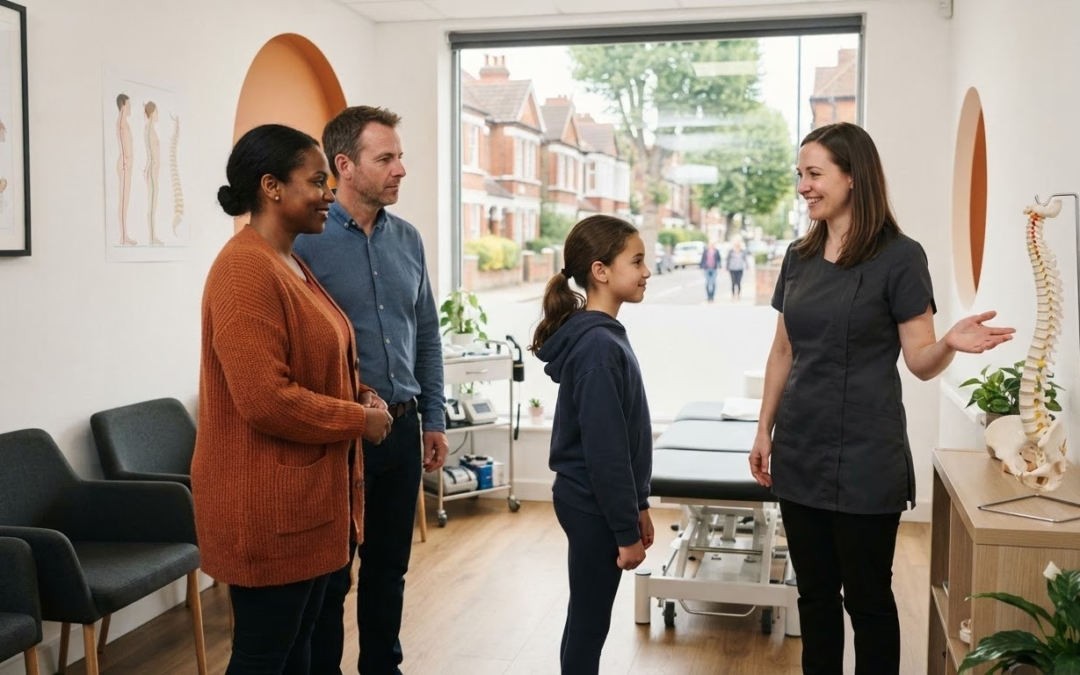
Could uneven shoulders or a change in posture mean scoliosis, or might there be another explanation? If you’re considering spinal curvature treatment Essex, start with a clear assessment rather than assumptions. A visible difference in posture can prompt questions, but it doesn’t confirm a scoliosis diagnosis by itself.
It’s understandable to feel unsure about what a curve may mean for comfort, movement or everyday activities, especially when you’re seeking guidance for your child. The right approach depends on the individual, their symptoms and the assessment findings. Care should have realistic goals and clear explanations, without promising to change the shape of the spine.
This article explains how spinal curvature differs from diagnosed scoliosis, what an assessment may involve and what an individual management plan could include. You’ll also learn how scoliosis management, chiropractic adjustments and massage therapy may fit into a personal care pathway. The Chiropractic Centre supports people across Brentwood, Billericay, Chelmsford, Stock, Basildon and Wickford with attentive, person-centred care.
Key Takeaways
- A visible curve or uneven posture alone doesn’t confirm scoliosis. The details of what you’ve noticed can help clarify your concerns.
- A step-by-step assessment can inform an individual care plan, but it can’t guarantee a particular result.
- Assessment, symptom-focused care and monitoring have different roles when considering spinal curvature treatment Essex.
- Before an appointment, note your symptoms, their effect on daily life and any questions you’d like answered.
- The Chiropractic Centre provides scoliosis management and individual chiropractic care across Brentwood, Billericay, Chelmsford, Stock, Basildon and Wickford.
Spinal curvature in Essex: what it can mean and when to seek an assessment
Noticing a curve in your back or uneven posture can feel worrying, particularly if you’re unsure whether it points to scoliosis. A difference in how your shoulders or hips sit is a reason to ask questions, but it doesn’t identify the cause by itself. Treat what you’ve noticed as a prompt to seek clarity, not as a diagnosis.
Your spine has natural curves when viewed from the side. They help support your body as you stand and move. Spinal curvature is a broad term for the spine’s shape; scoliosis describes a sideways curve of the spine, which may also involve rotation. The NHS describes scoliosis as a sideways curvature of the spine. Put simply, scoliosis is a sideways spinal curve that may cause the spine and trunk to appear uneven. There are different types of spinal curvatures, so a visible difference needs context rather than guesswork.
What does scoliosis look like?
A sideways curve may appear alongside uneven shoulders, hips or ribcage. The body’s outline can look different when standing, but appearance varies from person to person. These signs don’t establish whether scoliosis is present, what may have caused it or how pronounced a curve is. One photograph or a single observation of posture can’t answer those questions reliably.
Posture may also look uneven for reasons other than scoliosis. How you’re standing or moving at a particular moment can affect what you notice. Try not to diagnose yourself or your child from pictures or repeated mirror checks. If the difference persists or concerns you, a professional conversation can help clarify what to do next.
When is a spinal health check useful?
A spinal health check gives you a chance to discuss what you’ve observed, describe any discomfort and have your spinal health assessed. The Chiropractic Centre offers a free spinal health check as a starting conversation if you’re concerned about posture or a possible curve. It can help identify whether further assessment may be appropriate, but it isn’t the same as a confirmed scoliosis diagnosis.
You don’t need to wait until discomfort affects everyday activities before asking for guidance. Consider an assessment if you’ve noticed a lasting change in posture, are worried about a visible curve or have discomfort that concerns you. Share what you’ve noticed and when it began, if you know. These details help the practitioner understand your concerns and explain the next step clearly. If you’re exploring spinal curvature treatment Essex, begin with questions and an individual assessment, not an assumption about what the curve means.
How spinal curvature is assessed and why the details matter
A useful assessment starts with a conversation and examination, not a promise of a particular result. It helps build a clearer picture of your concerns, how your body moves and what kind of support may be appropriate. For spinal curvature treatment Essex, the aim is to understand your needs before discussing possible next steps.
Curve type, symptoms and individual circumstances all matter because they shape what questions to ask and which management goals may be relevant. A musculoskeletal assessment looks at muscles, joints, posture and movement. It can inform a care discussion, but it doesn’t confirm a medical diagnosis or determine the exact shape or degree of a spinal curve by itself.
What may happen during a musculoskeletal assessment?
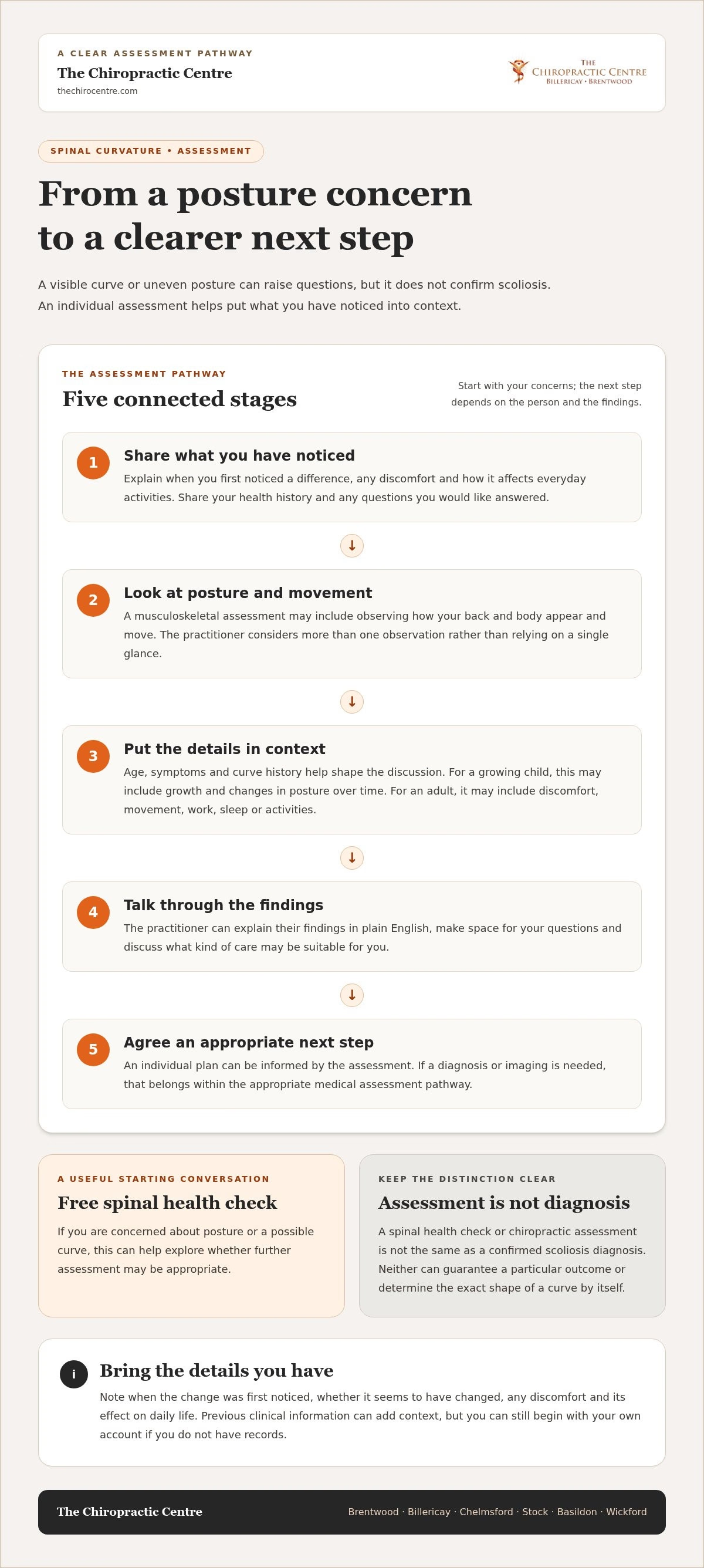
The practitioner will ask what prompted your visit and about your health history. They may then observe your posture and how you move. After the assessment, they can explain their findings and discuss possible next steps with you.
- Your concerns and history: Describe when you first noticed a difference, any discomfort and how it affects your daily activities.
- Posture and movement: The practitioner considers how your back and body appear and move, rather than relying on one observation alone.
- Discussion: Findings are explained in plain English, with time for your questions and a conversation about suitable care.
This process can inform an individual plan, but it can’t guarantee a specific outcome. A chiropractic assessment is also different from a medical diagnosis. If a diagnosis or imaging is needed, that decision belongs within the appropriate medical assessment pathway. The kyphosis diagnosis and treatment overview, for example, describes how assessment depends on the condition being considered.
Why age, symptoms and curve history matter
For a growing child, the care discussion may include questions about growth and whether posture has changed over time. For an adult, it may focus more on discomfort, movement and the effect of symptoms on work, sleep or activities. These questions don’t assume what care someone needs. They help make the assessment relevant to the person in front of the practitioner.
Curve history adds useful context. You might know when a difference was first noticed, whether it seems to have changed or whether you have previous clinical information. Bring what you have, but don’t worry if you don’t have records. The assessment can still start with your account and current concerns.
At The Chiropractic Centre, scoliosis management is shaped around the individual and informed by assessment. You can discuss your symptoms and priorities with the practitioner, whether you’re visiting from Brentwood, Billericay, Chelmsford, Stock, Basildon or Wickford. A New Patient Consultation offers a personal starting point for that conversation.
Spinal curvature treatment: compare management goals with realistic expectations
Different parts of a care pathway serve different purposes. Assessment helps build an understanding of your needs. Symptom-focused management considers comfort and movement. Monitoring keeps concerns and changes in view over time. These approaches can sit alongside one another, but they are not interchangeable, and none should be presented as a guaranteed way to change the spine’s structure.
| Part of care | Main purpose | What to expect |
|---|---|---|
| Assessment | Understand your concerns, health history, posture and movement. | Information to guide a discussion about suitable next steps, not a guaranteed outcome. |
| Symptom-focused management | Consider comfort, movement and the effect of symptoms on everyday life. | Individual care goals that may be reviewed as your needs change. |
| Monitoring | Keep concerns and changes in view over time. | Follow-up depends on your circumstances and the plan discussed with you. |
A common misconception is that chiropractic care or massage will straighten a scoliotic curve. Supporting symptoms and everyday function is not the same as correcting a structural curve. Any explanation of care should make that distinction clear. When discussing spinal curvature treatment Essex, realistic goals should be personal and based on assessment, not a promise about how the spine will look.
What can chiropractic management aim to support?
Depending on your assessment, chiropractic management may focus on comfort, movement and the activities that matter to you. Chiropractic adjustments should not be presented as a way to reverse scoliosis or correct every curve. Whether an adjustment is suitable, and which adjustment techniques may be considered, depends on your individual circumstances. Clear explanations and attention to adjustment safety should be part of the conversation.
How do clinical massage and other care fit in?
Clinical massage is a form of soft tissue therapy. It works with muscles and other soft tissues rather than reshaping the spine, and may be considered if it suits your needs. It isn’t a method for straightening a curve. The Centre offers massage therapy, including clinical massage, as part of its services. Your care discussion should focus on what is appropriate for you.
There isn’t one fixed package that fits everyone. The mix of care, if any, should follow your assessment and reflect your symptoms, preferences and daily needs. Ask what each option is intended to support, how progress will be discussed and whether the goal relates to comfort or movement rather than structural change. This helps you make an informed decision with realistic expectations.
Preparing for spinal curvature care: practical steps before your appointment
A little preparation can help you explain what’s concerning you and make good use of your appointment. You don’t need to arrive with a diagnosis or have every detail worked out. A few notes about what you’ve noticed, how you feel and what you’d like to understand are a helpful starting point.
What should you note before the appointment?
Jot down anything that may help describe your concern. If you’re attending with your child, include their observations too, in their own words where possible. Your notes don’t need to be formal or exhaustive.
- What you’ve noticed: When you first saw a change in posture or a curve, if you know, and whether it seems different over time.
- Symptoms: Any discomfort, when it occurs and whether anything seems to ease or aggravate it.
- Daily impact: Activities, positions or movements that affect comfort or mobility, such as sitting for a while or taking part in a familiar activity.
- Your questions: What you’d like to know about the assessment, possible care goals and how progress might be discussed.
If you already have relevant information, such as notes from a previous appointment or existing imaging reports, bring it along. There’s no need to arrange extra tests just for this visit. Sharing what you already have can provide useful background, and the practitioner can explain what can and can’t be understood from it.
What questions can help you understand your options?
It’s reasonable to ask for clear, everyday explanations. You might find these questions useful:
- “What do the assessment findings mean for me or my child?”
- “Which goals are suitable for my circumstances?”
- “How will we talk about progress, and when might the plan be reviewed?”
- “Is there anything about my symptoms or history that should shape the care discussion?”
The aim is to leave with a better understanding of the findings and any suggested next steps, not pressure to choose a particular approach. If something is unclear, ask for it to be explained another way. A helpful consultation makes room for your concerns and recognises that daily needs and priorities differ from person to person.
If you’re considering spinal curvature treatment Essex, a New Patient Consultation is a practical way to discuss your concerns and understand possible next steps in a calm, personal setting.
Spinal curvature treatment in Essex: a supportive local next step
The Chiropractic Centre provides scoliosis management and individual chiropractic care, with each discussion shaped around your concerns and circumstances. If you’re looking for spinal curvature support in Brentwood, Billericay, Chelmsford, Stock, Basildon or Wickford, you can start with a considered conversation about what you’ve noticed and what you hope to understand. Care should be explained clearly, with realistic goals rather than promises about changing the spine’s shape.
What can you expect from a local care pathway?
A care pathway may begin with a conversation about your concerns, followed by a discussion of assessment findings and possible goals. You’ll have the opportunity to ask questions and understand how any suggested approach relates to your needs. Chiropractic adjustments are considered in light of individual assessment, with attention to adjustment safety.
How to take the next step in Essex
A New Patient Consultation gives you an opportunity to discuss your history and priorities with the practitioner. You can ask questions, consider the information shared and decide what feels appropriate for you. There’s no need to arrive with a diagnosis or a fixed plan in mind.
A thoughtful local conversation can help you move forward with greater clarity, at a pace that feels right. Arrange a consultation with The Chiropractic Centre to discuss your concerns and possible next steps.
Take a considered next step towards care
You don’t have to have every answer before taking action. Start with what matters most to you: understanding a change you’ve noticed, feeling more comfortable during daily activities or knowing what questions to ask about your child’s posture. Bringing one clear priority to a consultation can help keep the conversation focused on your needs.
The Chiropractic Centre offers personal care grounded in listening and clear explanations. If you’re considering spinal curvature treatment Essex, a conversation can help you explore whether an individual care plan feels right for you, without pressure to commit to a particular approach or outcome. The team supports people in Brentwood, Billericay, Chelmsford, Stock, Basildon and Wickford.
Arrange a consultation with The Chiropractic Centre to discuss your concerns and take the next step at a pace that feels comfortable. A thoughtful discussion is a positive place to begin.
Frequently Asked Questions
Is spinal curvature the same as scoliosis?
No. Spinal curvature is a general term, while scoliosis describes a particular sideways curve. The spine also has natural curves when viewed from the side, which support posture and movement. For instance, a rounded upper back seen from the side is different from a sideways curve. If you’re unsure what you’ve noticed, describe it during an assessment rather than trying to identify a condition yourself.
Can chiropractic treatment straighten a curved spine?
Chiropractic care shouldn’t be presented as a guaranteed way to straighten a structural curve. If appropriate, management may instead relate to personal aims such as comfort or movement. Before deciding whether care feels right for you, ask what it’s intended to support and how you’ll review progress. You might discuss a specific everyday activity that matters to you rather than focusing only on how your posture looks.
What are common signs of scoliosis?
Possible signs include uneven shoulders or hips, a ribcage that looks different from one side, or a visible sideways curve. Some people notice discomfort or stiffness, whilst others have no symptoms. These observations can have different explanations and don’t confirm scoliosis. If you’re concerned, note what you’ve observed and whether it affects movement or comfort, then share those details during an appropriate assessment.
How is spinal curvature assessed?
An assessment may begin with questions about your health and concerns, then consider posture and movement. The practitioner can explain what the findings suggest and discuss whether further clinical assessment may be appropriate. If you have relevant reports from previous appointments, bring them along to provide background. The purpose is to clarify possible next steps, not to promise a diagnosis or a particular care outcome.
Is spinal curvature treatment suitable for adults?
Adults can seek an assessment if they have concerns about spinal curvature, discomfort or movement. You may want to talk about how symptoms affect sitting at work, walking or another activity that matters to you. Any management discussion should take your history, needs and goals into account rather than assuming one approach suits everyone. An appointment can help you consider whether suggested care feels appropriate for your circumstances.
Can exercise or posture changes treat scoliosis?
Exercise and posture habits may support general movement and wellbeing, but they shouldn’t be treated as a guaranteed way to correct scoliosis. Avoid forcing a position or starting a demanding routine solely on the basis of online advice. Instead, describe the activities you already do and any movements that feel difficult. This gives the practitioner useful context for discussing activity goals that may suit your individual situation.
Where can I get spinal curvature treatment in Essex?
The Chiropractic Centre provides scoliosis management and individual chiropractic care for people in Brentwood, Billericay, Chelmsford, Stock, Basildon and Wickford. A New Patient Consultation gives you an opportunity to discuss your concerns, ask questions and learn about possible next steps. You don’t need to arrive with a diagnosis or a fixed plan. The conversation can focus on your priorities and what you’d like to understand, helping you decide whether the care discussed feels suitable for you.