

Could dry needling for calf pain Brentwood be an option worth exploring? If calf discomfort is affecting your walking, exercise or everyday movement, it’s understandable to want relief and to wonder whether the cause is muscle tension or something else. Understanding what may be behind your symptoms is a useful first step before choosing an approach.
Dry needling may form part of care when assessment suggests a muscle-related issue, but it isn’t suitable for every cause of calf pain or every person. At The Chiropractic Centre, your concerns and movement are considered before treatment is discussed. If needling seems appropriate, you’ll have the chance to understand what it involves, including the brief sensations a fine needle may cause, and how it could fit alongside options such as clinical massage.
This article explains how dry needling may relate to calf symptoms, what an appointment can involve and why assessment matters. You’ll also find a clear way to explore personalised care in Brentwood and nearby communities, including Billericay, Chelmsford, Stock, Basildon and Wickford.
Key Takeaways
- Calf pain can have different causes, so understanding your symptoms is a useful first step before considering treatment.
- Learn what dry needling involves and how it may be considered as part of personalised care for calf symptoms.
- See how dry needling, clinical massage and acupuncture differ in their purpose and approach.
- Find out why suitability for dry needling for calf pain Brentwood depends on your symptoms, health history and assessment.
- Discover what a calm, person-centred first discussion at The Chiropractic Centre may involve.
Dry needling for calf pain in Brentwood: when might it be considered?
Calf pain can make a familiar walk feel uncertain, interrupt exercise and affect your confidence in everyday movement. If you’re considering dry needling for calf pain Brentwood, first understanding what may be causing the discomfort is more useful than assuming a tight or tender area needs treatment.
Dry needling is a clinical technique that uses fine needles in selected muscle tissue, following an assessment. It may be considered when symptoms appear to involve muscle, but calf pain has several possible causes and needling isn’t appropriate for all of them. The Dry Needling Explained overview offers general background; an individual decision still depends on your symptoms and assessment.
Which calf symptoms may involve muscle tension?
You might notice local tightness, tenderness or discomfort when using your calf. These sensations are useful to discuss, but they don’t prove that a trigger point is present or identify the cause by themselves. The two main calf muscles are the gastrocnemius, the more visible muscle at the back of your lower leg, and the deeper soleus beneath it.
An assessment can consider when symptoms began, what you were doing at the time, which movements bring them on and whether they change with activity or rest. For example, discomfort after a change in exercise gives useful context, but doesn’t establish that the muscle is the source. Your symptom history and how you move help guide what should be explored next.
When should calf pain be assessed promptly?
Sudden or unexplained calf pain should be assessed before you consider hands-on treatment or needling. Be alert to one-sided pain with swelling, warmth or redness. These symptoms can have different causes and shouldn’t be diagnosed from appearance alone, but NHS guidance advises seeking urgent medical help if you suspect a blood clot. Contact NHS 111 promptly for advice rather than proceeding with needling.
Breathlessness alongside calf symptoms needs urgent attention, particularly if it starts suddenly or comes with chest pain. Call 999 for sudden breathlessness or chest pain, following NHS advice. Don’t wait for a treatment appointment to discuss these symptoms. Clear, timely assessment takes priority.
If your symptoms are not urgent but keep returning, affect walking or limit exercise, arrange an appropriate assessment to explore what may be contributing. Dry needling may be discussed if the findings support a muscle-related approach; it isn’t a diagnosis or a guaranteed answer. A careful assessment helps focus on your wellbeing and a suitable next step.
How dry needling for calf pain works and what treatment may involve
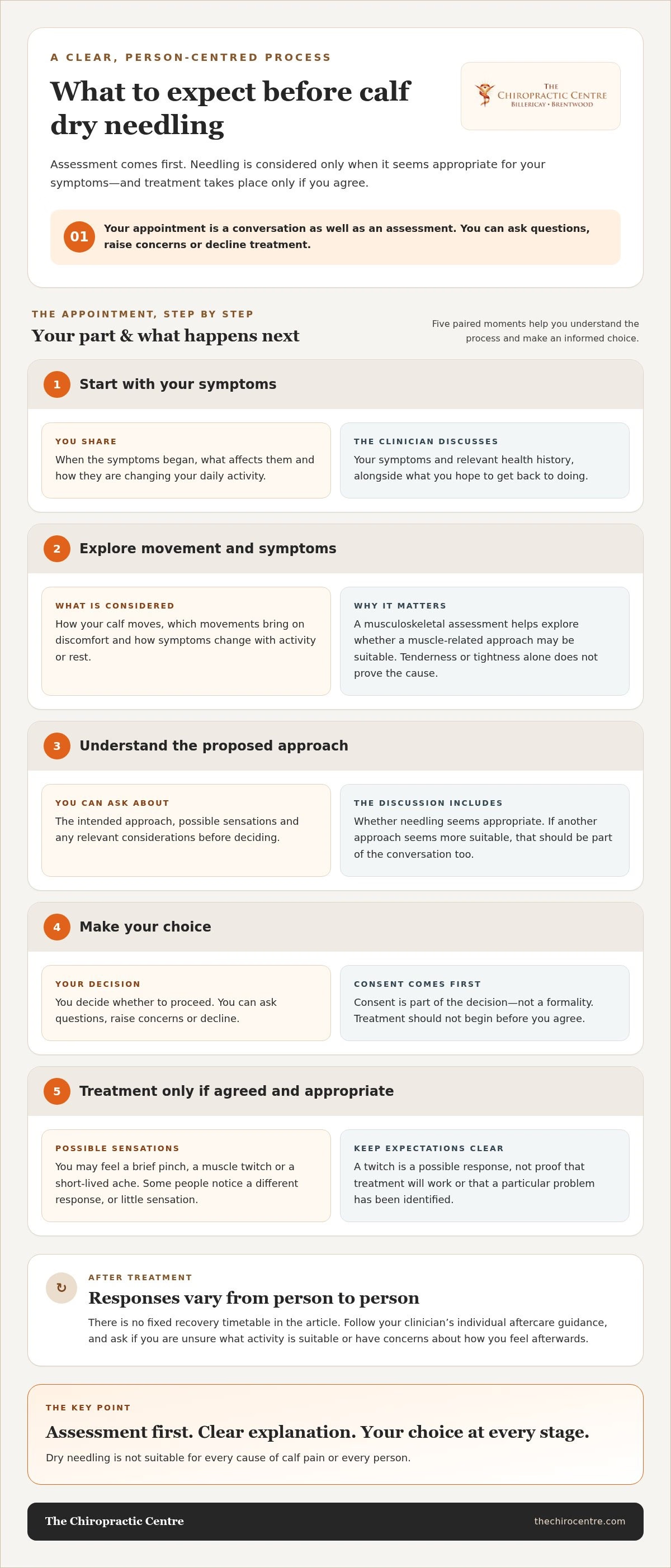
If an assessment suggests dry needling may be suitable, the appointment should be a conversation as well as a treatment. You should understand why it’s being considered, what the clinician plans to do and what sensations you might notice. You can raise concerns or ask for an explanation at any stage.
What happens before calf dry needling?
The clinician will discuss your symptoms, relevant health history and what you hope to get back to doing. They can then carry out a musculoskeletal assessment, considering your calf and how it moves, to help decide whether needling is appropriate. If another approach seems more suitable, that should be part of the discussion too.
If treatment is proposed, the steps are straightforward:
- Discussion: Share when the symptoms began, what affects them and how they’re changing your daily activity.
- Assessment: The clinician considers your movement and symptoms alongside your health history.
- Explanation: You’re told the intended approach, possible sensations and relevant considerations.
- Consent: You decide whether to proceed. You can ask questions or decline.
- Treatment: Needling takes place only if it’s considered appropriate and you agree.
Consent isn’t a formality. You should feel comfortable discussing the plan and making an informed choice before treatment begins.
What might you feel during and after treatment?
Sensation varies. Some people may feel a brief pinch as the fine needle enters, followed by a muscle twitch or a short-lived ache. Others may notice a different response, or little sensation. A twitch is a possible response, not proof that treatment will work or that a particular problem has been identified.
Dry needling is generally intended to target selected muscle tissue and may be proposed to influence local pain or tension. These are treatment aims, not guaranteed results. Research reviews consider potential effects and adverse events, but evidence cannot predict how an individual will respond; the research review on dry needling discusses these considerations. Your clinician can explain how the evidence relates to your situation.
Short-term responses after treatment differ between people, so avoid relying on a fixed recovery timetable. Follow the clinician’s individual aftercare guidance, and ask if you’re unsure what activity is suitable or have concerns about how you feel afterwards.
If you’re exploring dry needling for calf pain Brentwood, a discussion at The Chiropractic Centre can help you understand whether it may fit your needs. You can arrange a New Patient Consultation to talk through your symptoms and possible next steps.
Dry needling, clinical massage or acupuncture: which approach fits calf pain?
These approaches aren’t interchangeable, and none should be chosen on the assumption that all calf pain comes from muscle tension. Start with your symptoms and an assessment, then consider what each option involves and what feels appropriate to you. Here’s a plain-English comparison.
| Approach | Purpose and approach | Role of assessment |
|---|---|---|
| Dry needling | Uses fine needles in selected muscle areas. It may be considered as one way to address muscle-related symptoms. | Assessment helps determine whether the symptoms and health history make it a suitable option. |
| Clinical massage | Hands-on soft tissue therapy that works with muscles and surrounding tissues. | Assessment helps guide the approach, but massage doesn’t replace finding out what may be causing calf pain. |
| Acupuncture | Uses fine needles within a framework distinct from dry needling, often drawing on Traditional Chinese Medicine concepts. | Your symptoms, preferences and the proposed approach should be discussed before you decide. |
How dry needling differs from clinical massage
Dry needling uses a fine needle to target selected muscle tissue. Clinical massage is hands-on: a practitioner works with soft tissue using touch and pressure. The Chiropractic Centre offers both services, but they are different options and don’t have to be combined. If you’re considering clinical massage in Billericay, the choice should still make sense in light of your symptoms and assessment.
For example, if pressure or movement brings on familiar calf discomfort, that information can help shape a conversation about hands-on care. It doesn’t establish the cause or mean massage is automatically suitable. Equally, a tender area alone isn’t enough to decide that needling is the right approach.
How dry needling differs from acupuncture
Both methods use fine needles, which can make them sound alike. Dry needling is generally described through anatomy and the treatment of selected muscle areas. Acupuncture is associated with a different framework, including concepts from Traditional Chinese Medicine. This distinction doesn’t mean one approach is better, or that every practitioner describes the reasoning in exactly the same way.
For calf pain, the useful question isn’t simply which method sounds most appealing. Consider whether the approach relates to your symptoms, whether its purpose is clearly explained, and whether you feel comfortable giving informed consent. You can ask what the clinician is proposing, why it may fit your situation and what alternatives might be considered. Your preferences matter; treatment should be discussed with you, not assumed for you.
If you’re weighing up dry needling for calf pain Brentwood, clinical massage or acupuncture, let assessment guide the conversation. A considered choice focuses on your individual needs rather than promises or claims that one method suits everyone.
Is dry needling suitable for your calf pain in Brentwood?
There isn’t one answer for everyone. Whether dry needling is appropriate depends on what may be causing your symptoms, your health history and the findings of an in-person clinical assessment. A muscle-related pattern may lead to a discussion about needling, but treatment shouldn’t be used to explain away symptoms that need medical attention. The aim is to choose a considered next step, not to fit every calf problem to one technique.
What information helps assess calf symptoms?
A clear account of what you’ve noticed can help shape the assessment. Be ready to describe when the discomfort began, where you feel it, whether it came on suddenly and what changes it, such as walking, stretching, resting or exercise. Mention any recent change in activity, whether similar symptoms have happened before and how the calf problem affects your usual routine.
It’s also useful to share relevant health information, including health conditions, pregnancy, and medicines or supplements you take. These details don’t decide suitability on their own. The clinician considers them alongside an examination of your symptoms and movement. This is an in-person assessment, not a diagnosis made from a description alone, and it helps determine whether needling is suitable or another step is more appropriate.
When is dry needling not the first step?
Sudden, unexplained or concerning calf symptoms should be assessed before considering needling. In line with NHS guidance, seek urgent medical advice if you have calf pain with swelling, warmth or redness, particularly if it affects one leg. These signs can have different causes, so they don’t confirm a diagnosis by themselves. If you’re concerned about a possible blood clot, contact NHS 111 promptly for advice rather than arranging treatment first.
Sudden breathlessness or chest pain alongside calf symptoms needs emergency attention. Call 999. Dry needling is not a substitute for medical assessment, and a treatment appointment shouldn’t delay urgent care. If you’re unsure whether your symptoms need urgent attention, use NHS 111 for guidance.
For symptoms without urgent warning signs, a clinical discussion can help clarify whether a muscle-focused option is worth considering. You should be able to explain your goals, raise questions about your health history and understand the reasons for any suggested approach before deciding. Your comfort and consent are part of that decision.
If you’re in Brentwood and want to talk through your calf symptoms, discuss your calf symptoms with the team. A New Patient Consultation offers a considered starting point for understanding possible next steps, without assuming that needling is the right choice for everyone.
Dry Needling for Calf Pain at The Chiropractic Centre
Calf discomfort can leave you unsure whether to rest, change your activity or seek support. At The Chiropractic Centre, a first conversation gives you space to explain what’s happening and what you’d like to manage better, whether that’s walking comfortably, returning to exercise or feeling more at ease with everyday movement. The aim is to understand your needs before discussing suitable care.
What can you expect from a local consultation?
A new patient chiropractor consultation in Essex begins with your concerns and goals. You can describe how the calf symptoms affect your routine, what you’ve noticed so far and what you hope to do more comfortably. The clinician can then consider your health history and movement as part of an assessment, helping to inform a personalised plan. This process supports a clearer understanding of possible next steps; it doesn’t promise a particular diagnosis or outcome.
The Chiropractic Centre provides dry needling and massage therapy. Both are non-drug options that may form part of care for musculoskeletal concerns, offering a hands-on approach without relying on medication. They are distinct clinical options, and a consultation helps establish whether either may fit your situation. Dry needling is not assumed to be the answer, nor does it have to be used on its own. The approach should reflect your symptoms, preferences and assessment, with the reasoning explained in plain English so you can make an informed decision.
Based in Brentwood, the practice welcomes people from the local area, including Billericay, Chelmsford, Stock, Basildon and Wickford. A calm, welcoming setting and personal conversation can make it easier to raise concerns, particularly if treatment feels unfamiliar. You should have the opportunity to ask questions and understand what is being suggested before deciding how to proceed.
How to take the next step
A little preparation can help you make the most of your discussion. Before attending, consider noting:
- When the calf symptoms began and whether they have changed.
- Any recent changes to exercise, work or everyday activity.
- Movements or situations that affect how your calf feels.
- Relevant health concerns, medicines or treatment preferences you want to discuss.
You don’t need to arrive with a diagnosis or know which treatment you want. Share what you’ve experienced, including any worries about needling, and give the clinician a chance to explain the options. If dry needling for calf pain Brentwood is being considered, it should be one part of a thoughtful care plan, not a guaranteed result or a substitute for investigating symptoms that need medical attention.
If you’d like to talk through your calf symptoms in a supportive, local setting, Arrange a conversation with The Chiropractic Centre. You can take the next step at your own pace, with your wellbeing and goals at the centre of the discussion.
Take a thoughtful next step towards easier movement
You don’t need to decide on a treatment before asking for guidance. If calf discomfort is changing how you walk, exercise or manage everyday tasks, a conversation can help you explore what may be contributing and what options could suit your needs. Dry needling for calf pain Brentwood may be considered after assessment, but your care should reflect your symptoms, health and preferences, with no promise that one approach will work for everyone.
The Chiropractic Centre has supported local wellbeing for over 10 years, with a focus on listening and explaining your options clearly. Bring along any questions or details about how your symptoms affect your routine. You can take things at a pace that feels comfortable and discuss whether an assessment is a useful next move.
Discuss your calf pain with The Chiropractic Centre and take a considered first step towards feeling more confident in your movement.
Frequently Asked Questions
Is dry needling effective for calf pain?
Dry needling may help some muscle-related pain, but results vary and it won’t address every cause of calf symptoms. Research suggests possible short-term benefits for musculoskeletal pain, though the strength of evidence varies and lasting effects are less certain. For you, the value depends on what assessment finds and how you respond. In Brentwood, discuss your activity goals and expectations before deciding whether to include it in your care.
Can dry needling help calf tightness after running?
It may be considered if assessment suggests your tightness is linked to muscle symptoms, but post-run tightness can have different explanations. Note whether it affects one or both calves, how long it lasts and whether it eases with rest. A sudden change in training, footwear or running surface is useful context to share. Persistent or worsening discomfort deserves assessment rather than repeated attempts to treat the tight feeling alone.
How many dry needling sessions might calf pain need?
There’s no set number that suits everyone. The plan depends on the assessment, how your symptoms change and whether treatment supports your functional goals, such as walking comfortably or building back towards exercise. Rather than assuming a course in advance, discuss what progress would look like and when the plan should be reviewed. If there’s little change or symptoms develop differently, the clinician can reconsider the approach.
Can dry needling help a calf strain?
It may be considered as part of care for some calf muscle strains, but it doesn’t repair a strain by itself or replace an appropriate recovery plan. The timing and suitability depend on the severity and stage of the injury, your health and your movement. A clinician can help distinguish a possible muscle injury from other causes and discuss whether needling has a role alongside advice on gradually returning to activity.
Can dry needling treat Achilles tendon pain?
Dry needling shouldn’t be assumed to treat the Achilles tendon itself. Pain near the heel or lower calf can involve different structures, and location alone can’t confirm the cause. An assessment can help identify what needs attention and whether a muscle-focused treatment is relevant. If your pain is near the tendon, describe when it occurs, such as during push-off, stair climbing or after rest, before considering any treatment.
Can I run after dry needling for calf pain?
Ask your clinician for advice that reflects your symptoms, treatment and running plans. There isn’t one return-to-running rule that fits every person, and the calf may feel different after needling. Don’t use a temporary change in discomfort as the only sign you’re ready to run. Discuss a gradual return, including how to respond if pain increases during a run or later that day.
Is dry needling suitable if I take blood-thinning medication?
Tell the clinician about blood-thinning medication before any needling is considered. It can affect bleeding or bruising risk, so suitability needs an individual discussion alongside your health history and the treatment area. Don’t stop or change prescribed medication to prepare for needling unless the clinician managing that medicine advises you to. If you’re in Brentwood, Billericay, Chelmsford, Stock, Basildon or Wickford, raise this during your consultation.