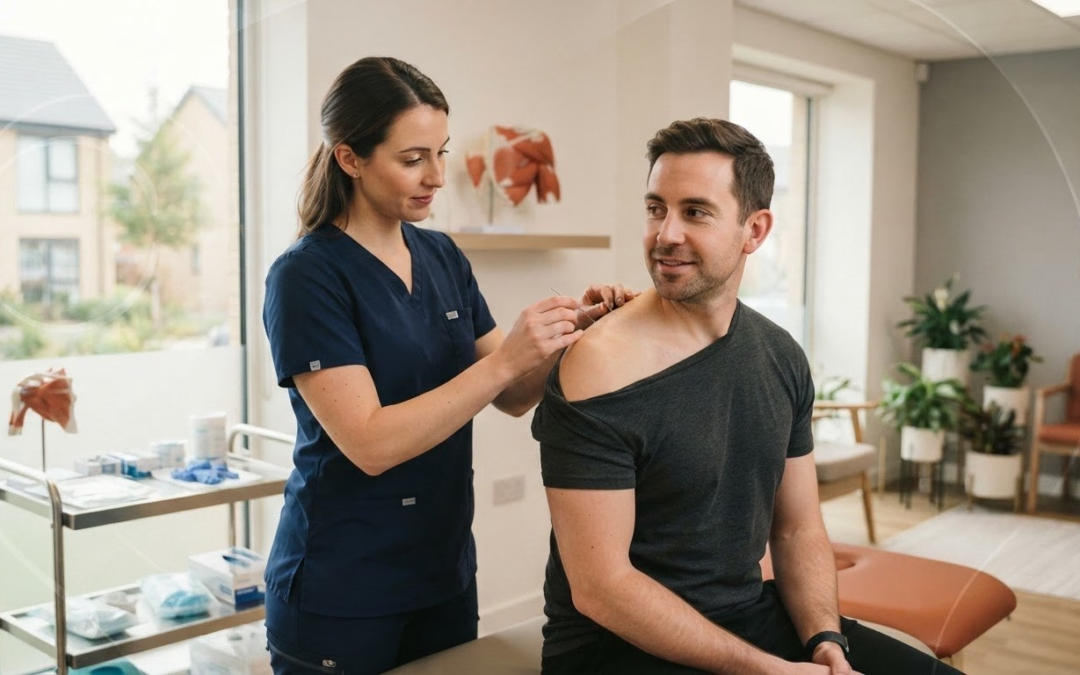
Could a treatment involving fine needles be one part of a broader plan for easing muscle discomfort, rather than a quick fix? If you’re considering trigger point dry needling Chelmsford, it’s natural to wonder what happens during an appointment, whether it may feel uncomfortable and whether it could suit your symptoms.
Those are sensible questions. Trigger point dry needling targets tight or sensitive areas in muscle, but it isn’t suitable for everyone and results can vary. At The Chiropractic Centre, dry needling is one option within personalised musculoskeletal care, guided by your needs and wellbeing. It may be considered alongside other support, such as massage therapy, rather than as a guaranteed solution on its own.
This guide explains the purpose and limits of the technique, what an initial assessment may cover and what you might experience during and after treatment. You’ll also find practical points to discuss, including your health history, concerns and goals. A clear conversation can help you understand why dry needling is being considered and whether another approach may be more appropriate, so you can make an informed decision about a next step in Chelmsford.
Key Takeaways
- Learn what a muscle trigger point is and why dry needling refers to a needle technique without injecting a substance.
- See how dry needling, acupuncture and clinical massage differ in their broad focus and methods.
- Prepare for an assessment by noting where symptoms occur, how they behave and which movements they affect.
- Explore how trigger point dry needling Chelmsford may fit into individualised musculoskeletal care at The Chiropractic Centre.
- Find out how dry needling sits alongside massage therapy as one possible option, not a guaranteed quick fix.
Trigger point dry needling in Chelmsford: what it is and what it targets
Trigger point dry needling uses a needle to target a selected area of muscle tissue associated with tension or sensitivity. A muscle trigger point is a tender, tense area within a muscle that may cause discomfort locally or sensations elsewhere. The term “dry” means no drug or solution is injected. It describes the method, not a promised result.
If you’re looking into trigger point dry needling Chelmsford, it helps to distinguish a possible muscle trigger point from a confirmed diagnosis. A sore spot can have different causes, and tenderness alone doesn’t establish what is happening. An assessment considers your symptoms and how they relate to movement and everyday activities before a suitable approach is discussed.
What is a trigger point in a muscle?
You might describe a sensitive area as a “knot”, or notice that pressing a particular spot feels uncomfortable. Some people also experience referred sensations, where discomfort seems to travel beyond the area being touched. These experiences are useful to describe, but they don’t prove that a spot is a trigger point. Your symptoms need to be considered in context.
For example, you may notice tenderness in a shoulder muscle while reaching overhead, or sensitivity in a calf after activity. These are examples of symptoms to explain, not diagnoses. The location, pattern and effect on movement all help build a clearer picture.
Why is dry needling called dry needling?
The needle is used without injecting a substance into the muscle. That’s what “dry” refers to. It doesn’t mean the technique is intended to dry out tissue, and the name doesn’t tell you how quickly you might feel a change. Responses vary, so the method is considered in light of your individual needs.
The word “needling” describes the use of a needle as the treatment method. It doesn’t mean every tender area should be treated this way. An assessment helps determine whether a muscle-focused technique is appropriate to consider or whether another form of care may better fit your situation.
Dry needling is distinct from traditional acupuncture, although both involve needles. Their rationale and approach differ. For a general overview of the technique and how it is described, you can read Dry needling.
Keep the key points in mind:
- A trigger point describes a possible sensitive or tense area in muscle, not a diagnosis on its own.
- Referred sensations may occur, but not every tender spot or spreading sensation has the same cause.
- “Dry” means no substance is injected; it makes no claim about the outcome.
This distinction can help you describe what you feel without trying to diagnose it yourself. The next step is to understand how the technique may fit into individual care.
How trigger point dry needling works: what happens in the muscle
Dry needling is considered as a targeted option for muscle symptoms, not as a treatment for every kind of pain. Following an individual assessment, the practitioner considers whether a specific area of muscle may be relevant to your discomfort or movement concerns. If needling is appropriate, a fine needle is used to address that selected area. The focus is local and muscular; this does not guarantee a whole-body effect or lasting change.
The aim of dry needling is to address a selected muscular concern, but the response and outcome vary from person to person. A treatment rationale can explain why a technique is being considered, but it cannot predict exactly how you will feel afterwards or establish that the muscle is the only source of your symptoms.
How can a trigger point relate to muscle discomfort?
A sensitive area within a muscle may be associated with local tenderness or a sense of tightness. In some cases, muscle discomfort may also make a movement feel restricted or uncomfortable. But pain can have different causes, and a trigger point should not be assumed to explain every symptom or movement limitation.
To help build a useful picture, describe what you notice in everyday terms: where it hurts, which movements feel affected and whether the discomfort changes during work, exercise or rest. These details give context to an assessment without requiring you to identify the cause yourself.
What responses might someone notice during treatment?
People experience needling differently. You might notice pressure, tenderness or a brief muscle sensation around the area being treated. Your experience may differ from someone else’s. No particular sensation is needed to prove that the technique is working, and an expected response shouldn’t be treated as a guaranteed sign of benefit.
If you feel unsure or uncomfortable, say so during care. Raise concerns before treatment and describe what you’re feeling as it happens. Clear communication keeps your comfort part of the discussion, rather than making the technique something you simply have to tolerate.
Decisions about dry needling should follow an assessment of your symptoms and needs. This helps establish whether a local muscle focus makes sense within your care, rather than assuming needling is suitable simply because an area feels tender. Your response can inform the next conversation, without promising immediate relief, faster recovery or a set course of treatment.
As you consider trigger point dry needling Chelmsford, keep these practical points in mind:
- A sensitive muscle area may be relevant to discomfort, but it may not explain the full picture.
- The treatment focus is specific to the assessed muscle concern, not a promise of wider or lasting effects.
- Your sensations and comfort matter; share concerns and changes during the appointment.
If muscle discomfort is affecting the way you move, a conversation about personalised musculoskeletal care can help you understand how dry needling may fit alongside other support. The focus remains on your individual needs and a considered next step.
Dry needling, acupuncture and other muscle treatments: how to compare them
These approaches can all form part of a conversation about muscle discomfort, but they use different methods and have different broad focuses. The comparison isn’t about deciding which treatment is best for everyone. It’s about understanding what each involves and discussing what feels appropriate for your symptoms, preferences and comfort.
| Approach | Broad focus | Method |
|---|---|---|
| Dry needling | Selected muscle areas and related muscular symptoms | A needle technique directed towards a specific muscle concern |
| Acupuncture | Depends on the approach and treatment rationale | Uses needles; its framework and aims can differ from dry needling |
| Clinical massage | Soft tissue, including areas of muscle tension | Hands-on techniques such as massage, without needles |
This is a broad guide, not a fixed description of every treatment. Techniques and individual care vary. An assessment and discussion of your needs help clarify what an option involves in your situation.
Is dry needling the same as acupuncture?
Both may involve needles, which can make the names seem interchangeable. They aren’t identical: dry needling generally focuses on selected muscle concerns, while acupuncture may follow a different treatment framework and aim. Neither label alone tells you exactly what an appointment will involve, as approaches can vary.
If needles make you apprehensive, say so. You can discuss what concerns you, what you hope to address and what would help you feel comfortable before deciding on an approach. You don’t need to dismiss your concern or agree to a technique before you understand it.
When might massage therapy be considered alongside dry needling?
Massage therapy is a separate hands-on option for soft tissue concerns. It doesn’t use needles and may be discussed on its own or as part of individualised musculoskeletal care. Combining it with dry needling isn’t essential; whether either approach is considered depends on your needs and assessment.
For instance, you may prefer hands-on treatment, feel uncertain about needles, or want to understand how the approaches differ. Sharing that preference helps shape a care discussion around you, rather than assuming a particular combination is necessary. Clinical massage: Therapeutic massage performed by trained professionals to complement other clinical treatments such as dry needling.
As you explore trigger point dry needling Chelmsford, use the comparison to prepare questions rather than make a diagnosis or choose a treatment based on the name alone. Ask what the proposed method focuses on, how it relates to your movement concerns and what alternatives might be considered. Clear explanations can help you weigh the options at a pace that feels comfortable.
Considering trigger point dry needling in Chelmsford: questions to discuss
An assessment is a chance to explain what you’re experiencing and understand whether dry needling may fit your needs. You don’t need to arrive with a diagnosis or know the technical name for a muscle. Clear, everyday details about your symptoms and priorities can guide the conversation.
What should you share during an assessment?
Think about when the concern began, what changes it and how it affects your usual activities. You might mention that reaching for a shelf feels uncomfortable, sitting at your desk makes an area feel tense, or a movement you enjoy has become harder. These details describe your experience without assuming what is causing it.
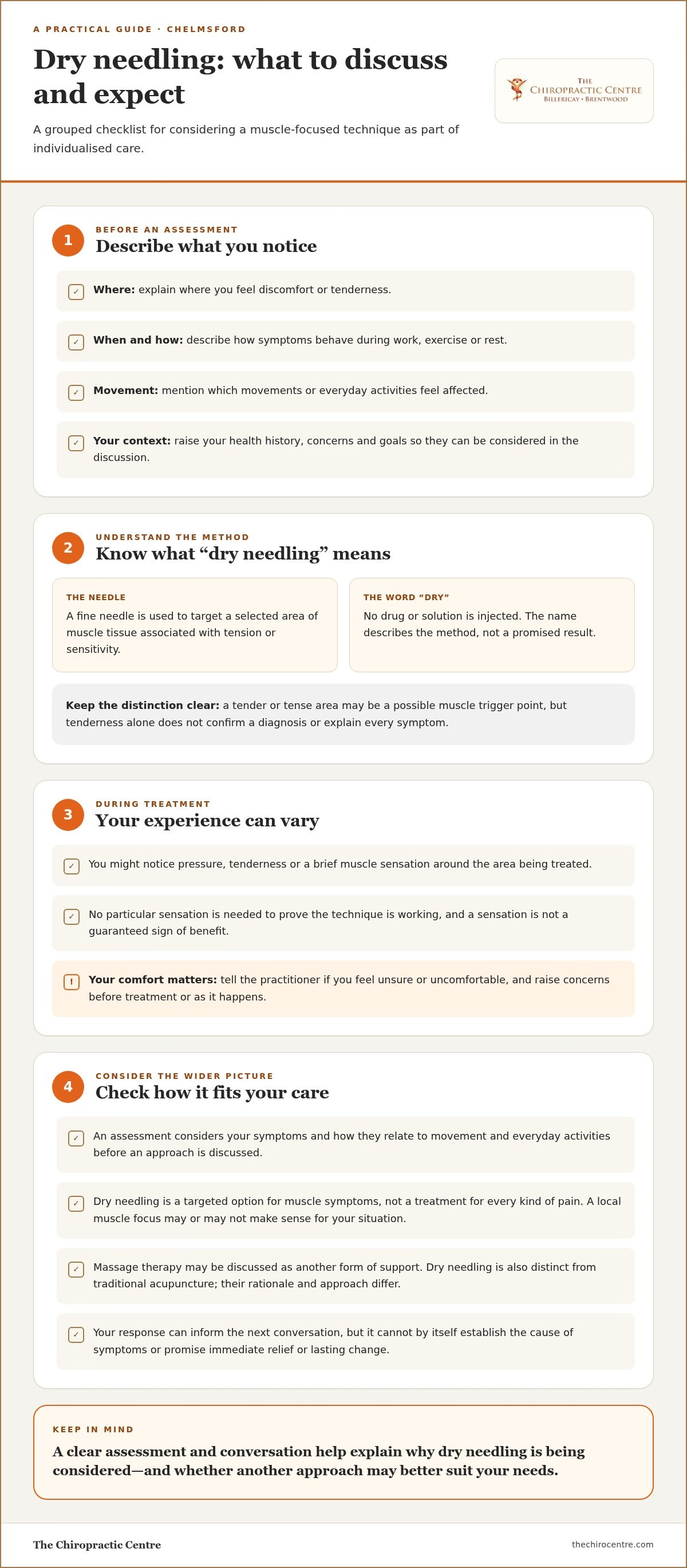
It can also help to mention relevant health history, any changes in your symptoms and care you’ve already received. Share sensitivities, concerns about needles or preferences for hands-on care. Use this checklist to organise your thoughts:
- Location: Where do you feel discomfort or sensitivity? Does it stay in one area or seem to spread?
- Behaviour: When did you first notice it? Does it change with rest, activity or particular positions?
- Movement: Which everyday tasks, work activities or forms of exercise feel affected?
- Background: What relevant health history or previous care would help explain the wider picture?
- Preferences: Do you feel uneasy about needles, have sensitivities, or prefer a different approach?
You don’t need perfect answers. If a symptom has changed, describe what you’ve noticed and when. If you’re unsure whether something is relevant, mention it so it can be considered in context.
How can you decide whether the approach feels right for you?
Ask for a plain-English explanation of the proposed approach and why it’s being considered for your concerns. You might ask what sensations you could notice, what other options may be suitable, and how your comfort will be discussed during care. An assessment helps inform those decisions; it doesn’t mean dry needling is automatically the right choice.
Your questions and preferences belong in the conversation. If you feel apprehensive, say so. Talk through what would help you feel at ease, ask for an explanation before proceeding and raise discomfort or uncertainty as the conversation continues. Taking time to understand the plan can make it easier to decide whether you feel comfortable with the next step.
For trigger point dry needling Chelmsford, The Chiropractic Centre’s personalised approach starts with understanding you, your symptoms and your movement concerns. If you’re ready to discuss your needs, arrange a New Patient Consultation and begin with a conversation about the options that may suit you.
Dry needling at The Chiropractic Centre: personalised care near Chelmsford
The Chiropractic Centre provides dry needling, massage therapy and other musculoskeletal care for people in Chelmsford and nearby communities, including Brentwood, Billericay, Stock, Basildon and Wickford. If you’re considering care for muscle discomfort, a chiropractic adjustment may also be discussed where appropriate to your needs. Each option is considered in context, rather than treated as a one-size-fits-all answer.
The practice has a 5.0 Google rating based on 192 reviews, alongside 240+ reviews overall. These figures offer a sense of feedback from people who have visited, while your own care remains centred on your needs and circumstances.
A personal, holistic approach to muscle care
Muscle discomfort can affect more than one isolated area. It may influence how you move, work, exercise or manage everyday routines. A holistic approach considers you as a whole, including the concerns you bring to an appointment and how they fit into your wider wellbeing.
Dry needling is one possible part of personalised musculoskeletal care. Massage therapy offers a distinct hands-on approach to soft tissue, while chiropractic adjustments address joint movement. These options don’t automatically need to be combined. What may be considered depends on your individual needs, and no technique can promise a cure or lasting result for everyone.
A calm, welcoming setting can make it easier to talk openly about what’s troubling you, what you hope to address and any reservations you have. You can ask for explanations in plain English and share preferences as the conversation develops. This helps keep your comfort and goals in view as possible care is considered.
Your next step with The Chiropractic Centre
If you’re unsure where to begin, a conversation can help clarify your concerns and the options that may be appropriate. The New Patient Consultation provides an entry point for discussing your needs. You can also choose a Free Spinal Health Check to start a conversation about your spinal health and movement. Neither route requires you to arrive knowing which treatment you want.
Before taking a next step, note what activities feel affected and what questions you’d like answered. You can discuss your preferences, including how you feel about dry needling, and talk through what an individualised approach may involve. The focus is on understanding your situation and considering care that fits, rather than promising a particular outcome.
Whether you’re local to Chelmsford or part of a nearby community, you deserve care that listens and treats you as an individual. If you’re ready to talk through your concerns, arrange a consultation with The Chiropractic Centre.
Take a considered next step
Choosing care doesn’t mean committing to a particular technique before you understand it. Use what you’ve learned to start a practical conversation about your priorities, your comfort with needles and the movements you’d like to manage more easily. A personalised assessment can help clarify whether dry needling is worth considering as part of your care.
If you’re exploring trigger point dry needling Chelmsford, The Chiropractic Centre offers a welcoming place to discuss your needs and possible next steps. Ask questions, explain what matters to you and take time to understand the options before deciding how to proceed.
Arrange a New Patient Consultation with The Chiropractic Centre and take a positive, informed step towards care shaped around you.
Frequently Asked Questions
Does trigger point dry needling hurt?
It can feel uncomfortable for some people, but the sensation varies and isn’t the same for everyone. You might notice a brief pinch, pressure or a muscle twitch, or find the experience manageable. Tell the practitioner if you feel pain or want to pause. You can discuss what to expect beforehand and decide whether you feel comfortable proceeding; you don’t need to push through discomfort silently.
Can dry needling cause soreness afterwards?
Some people may notice tenderness or soreness in the treated area afterwards, although responses differ. Consider how that might fit around your plans, especially if you have a physically demanding day ahead. Ask what changes to your usual activities might be appropriate for you, and get in touch with the practice if a reaction concerns you or feels different from what was discussed.
Can trigger point dry needling help shoulder pain?
It may be considered if an assessment suggests a muscle-related concern is relevant, but shoulder pain has different possible causes and needling isn’t guaranteed to help. For trigger point dry needling Chelmsford, explain which shoulder movements are difficult, such as reaching overhead or putting on a coat. That context helps the practitioner consider whether a muscle-focused approach may fit your needs.
How many dry needling sessions will I need?
There isn’t a fixed number that applies to everyone. The decision depends on your individual assessment, how your symptoms affect you and how your care is reviewed over time. Rather than assuming you’ll need a set course, ask how progress will be considered and what would guide any next step. Your plan should reflect your circumstances, not an automatic session count.
What happens if I feel anxious about needles?
Tell the practitioner before treatment is considered. You can ask for a clear explanation, share what specifically worries you and discuss other approaches, such as massage therapy. You’re allowed to take time to decide, ask to pause the conversation or decline needling. Being open about anxiety helps the discussion focus on your comfort as well as your muscle symptoms.
Is dry needling suitable for everyone?
No. Whether it may be appropriate depends on your individual circumstances, so suitability should be discussed following an assessment. Share relevant health information, sensitivities and any changes in your wellbeing, even if you’re unsure whether they matter. The practitioner can consider these details alongside your symptoms and goals. If needling doesn’t seem like a suitable option, other aspects of musculoskeletal care may be discussed.
Can I combine dry needling with massage therapy?
Massage therapy and dry needling may both be considered within personalised care, but they don’t have to be combined. Whether using both makes sense depends on your needs and the assessment, rather than a standard package. Explain whether you prefer hands-on treatment, have concerns about needles or want to explore one approach at a time. The discussion can help shape an option that feels appropriate for you.