
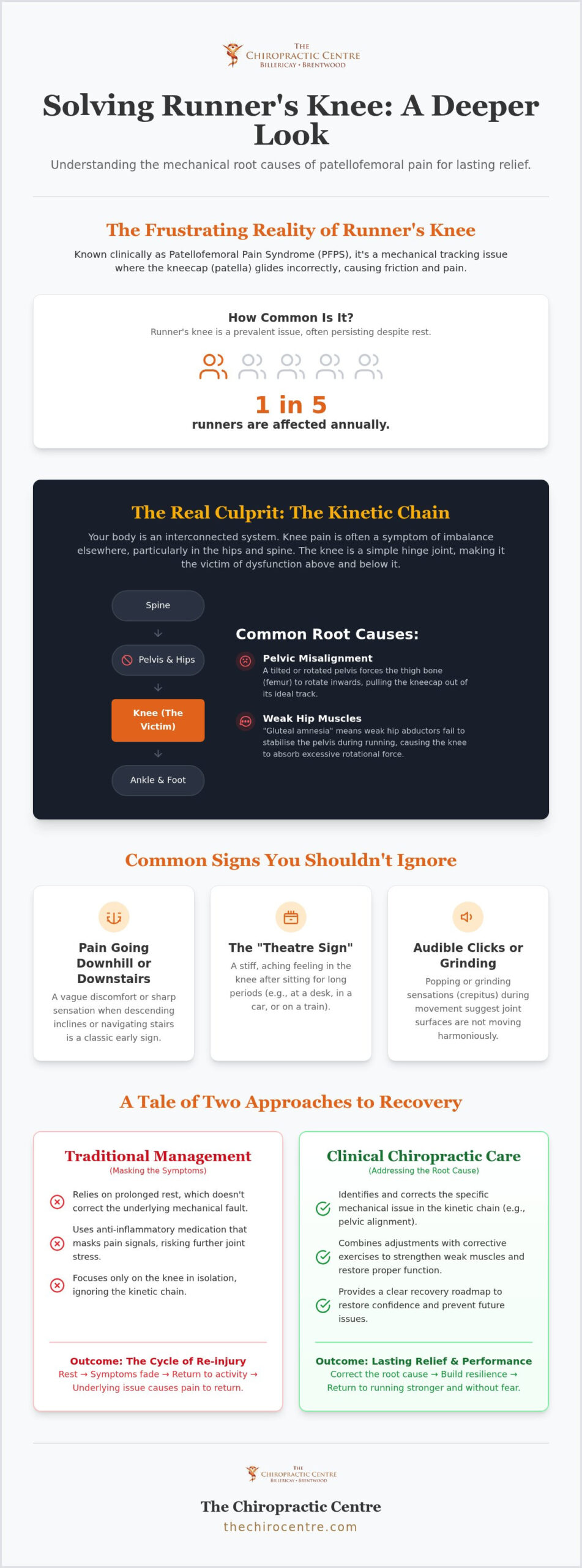
What if the sharp, nagging ache beneath your kneecap actually has very little to do with your knee itself? It is a frustrating reality for many, as runner’s knee affects approximately one in five runners annually, often persisting despite weeks of complete rest. You might feel a growing sense of fear that this injury is permanent or find yourself confused as to why the pain returns the moment you step back onto the Essex trails. If you have been searching for a chiropractor for runners knee Brentwood, you likely realise that masking the discomfort with ice or ibuprofen is no longer enough.
We understand how vital movement is to your sense of wellbeing and vitality. Our clinical approach focuses on the mechanical root causes of patellofemoral pain, looking at how your hips, spine, and ankles work together as a single kinetic chain. You deserve more than a temporary fix; you need a clear recovery roadmap that restores your confidence. This guide explores how addressing these underlying imbalances can resolve your discomfort and provide the lasting relief necessary to get you back to your favourite routes without the fear of a recurring injury.
Key Takeaways
- Learn why runner’s knee is often a mechanical tracking issue caused by imbalances in your hips and spine rather than just a ‘dodgy’ joint.
- Discover how a specialist chiropractor for runners knee Brentwood identifies the root cause of your pain to prevent recurring discomfort.
- Understand the clinical advantage of corrective care over simply masking symptoms with rest or medication.
- Gain practical advice for navigating local Brentwood running routes, including how to manage the challenging inclines at Weald Country Park during your recovery.
- Explore how a personalised, integrated care pathway can help you return to peak performance and long-term wellness on the Essex trails.
Understanding Runner’s Knee: More Than Just a ‘Dodgy’ Joint
Many runners in our community describe the sensation as a “dodgy knee” that only flares up after a few miles. However, from a clinical perspective, what you are experiencing is likely Patellofemoral Pain Syndrome (PFPS). This condition isn’t typically caused by a single traumatic fall or a sudden twist. Instead, it is a mechanical tracking issue where the patella, or kneecap, does not glide smoothly within the groove of the thigh bone. When this alignment is off, even by a millimetre, the resulting friction creates a dull, persistent ache that can sideline even the most dedicated athlete. It’s a common struggle, but it doesn’t have to be a permanent one.
If you have been searching for a chiropractor for runners knee Brentwood, you have probably already tried the standard advice of rest and ice. It is incredibly frustrating when you follow those steps, wait two weeks, and feel that familiar twinge the moment you restart your training. This happens because PFPS is an overuse injury rooted in mechanical dysfunction. Without addressing why the tracking is off, the pain will almost certainly return. We see this often in our clinic, where patients feel stuck in a loop of recovery and re-injury.
Common Signs You Shouldn’t Ignore
The symptoms of runner’s knee are often subtle at first. You might notice a vague discomfort when descending the steeper trails at Thorndon Country Park or a sharp sensation when navigating stairs at the office. Many of our patients also report the “theatre sign,” which is a stiff, aching feeling in the joint after sitting for long periods, perhaps during a slow Essex commute on the A12 or the train into London. You may also hear audible clicking, popping, or a grinding sensation during movement. These sounds suggest the joint surfaces aren’t moving as harmoniously as they should, indicating that your body is overcompensating for a deeper issue.
Why Traditional Rest Often Fails
Rest is often the first recommendation, but it rarely provides a permanent solution for mechanical issues. Whilst rest might reduce immediate inflammation, it does nothing to strengthen weak muscles or correct a misaligned pelvis that might be forcing your knee to overcompensate. When you stop moving, the symptoms fade, but the underlying “glitch” in your movement pattern remains. This creates a cycle of recurrence where you feel better, push your pace, and then end up right back where you started. Relying solely on anti-inflammatory medication can be equally problematic; it masks the pain and may lead you to ignore signals that your joint is under excessive stress, potentially leading to further degradation over time.
The Kinetic Chain: Why Your Spine and Hips Dictate Knee Health
To understand why your knee hurts, it is essential to look beyond the joint itself. Your body operates as a series of interconnected links known as the kinetic chain. When you run, energy and force travel from the ground through your foot, up the leg, into the hip, and finally through the spine. If any single link in this chain is misaligned or weak, the other joints must compensate. The knee is a relatively simple hinge joint, making it particularly vulnerable to these mechanical failures elsewhere. It’s often the “victim” of dysfunction in the more complex joints above and below it.
As a chiropractor for runners knee Brentwood, we focus on identifying these hidden culprits. Often, a subtle pelvic tilt or a minor spinal misalignment can alter your entire running gait. This shift forces the knee to track incorrectly, leading to the inflammation and pain described in the previous section. Clinical research into kinetic chain exercises for patellofemoral pain highlights that rehabilitation is most successful when it addresses these broader movement patterns rather than just the knee in isolation. A joint pain chiropractor Brentwood can assess these connections to find exactly where your movement is breaking down.
The Pelvic-Knee Connection
An unlevel pelvis is one of the most common issues we see in local runners. When one side of the pelvis sits higher or is rotated, it forces the femur (thigh bone) to rotate internally. This rotation changes the “Q-angle”—the angle at which the femur meets the tibia—pulling the kneecap out of its groove. This problem is frequently worsened by “gluteal amnesia,” where the hip abductors fail to fire correctly, leaving the knee without its primary stabiliser. Spinal adjustments restore pelvic symmetry to offload the knee and allow the surrounding muscles to function as intended. To see how specialised podiatry clinics address these foundational issues, learn more about Local Foot Doc.
Foot Biomechanics and Alignment
The foundation of your kinetic chain starts at the feet. Overpronation, where the arch of the foot collapses inward, creates a ripple effect that rotates the lower leg and puts excessive torque on the knee. Whilst many runners turn to orthotics to solve this, these inserts might fail to provide lasting relief if the hip or lower back remains restricted. We believe in a total-body assessment because your feet and hips must work in harmony to protect your knees. If you are concerned about your running mechanics, a New Patient Consultation is an excellent way to gain clarity on your specific biomechanical needs.
Chiropractic vs. Traditional Management: Why a Clinical Approach Wins
When you visit a GP for knee pain, the standard advice often centres on rest, ice, and anti-inflammatory medication. This traditional diagnosis and treatment of runner’s knee is designed to manage symptoms and reduce immediate swelling. Whilst this provides short-term relief, it rarely addresses why the joint became inflamed in the first place. For an active runner, this reactive approach can be incredibly frustrating. Choosing a chiropractor for runners knee Brentwood means moving beyond symptom-masking and into the world of corrective care. We don’t just want to stop the pain; we want to ensure your body is mechanically sound enough to prevent it from returning.
Leaving mechanical issues untreated often leads to a “domino effect.” A slight limp to protect a sore knee can quickly evolve into hip bursitis or lower back strain as your body forces other structures to pick up the slack. Our goal is to break this cycle early. Many patients feel apprehensive about chiropractic care if they associate it with aggressive movements, but modern clinical adjustments are remarkably gentle and precise. By restoring proper motion to the joints, we help the body heal naturally and efficiently. A new patient chiropractor consultation Essex provides the clinical roadmap needed to identify these specific imbalances before they lead to more significant injury.
Addressing the Root Cause
A “clicky” knee is often a sign that the nervous system isn’t receiving the correct signals from the joints. Chiropractic adjustments focus on mechanoreceptors, which are tiny sensors in your joints that tell your brain where your body is in space. When a joint is restricted, these signals become blurred, leading to poor proprioception and clumsy movement patterns. By adjusting the spine and pelvis, we “reset” these signals. This shift moves your care from a reactive struggle against pain to a proactive strategy for performance enhancement, ensuring every stride you take is as efficient as possible.
Integrated Therapies for Soft Tissue
While adjustments correct the skeletal alignment, the surrounding soft tissues often require dedicated attention. Years of running with poor mechanics can leave IT bands tight and quadriceps overactive. We use clinical massage Billericay to release these chronic tension patterns, allowing the joint to move freely. We also incorporate dry needling to deactivate painful trigger points that may be referring pain to the knee. Combining these therapies with chiropractic adjustments creates a powerful synergy, typically leading to faster recovery times and a more resilient body. This integrated approach ensures that both the “hardware” of your bones and the “software” of your muscles are working in perfect harmony.
Navigating Recovery: Professional Assessment and Local Advice
Recovery from patellofemoral pain is rarely a straight line. Whilst some patients experience a reduction in symptoms within a few visits, a full return to peak performance typically requires a structured four to six week protocol. This timeline allows for the correction of joint restrictions and the subsequent strengthening of the supporting muscles. During this phase, we often advise Brentwood runners to modify their favourite routes. For instance, the steep declines at Weald Country Park can place up to eight times your body weight through the patellofemoral joint. Avoiding these hills temporarily prevents the flare-up cycle whilst we work on your underlying mechanics.
A specialist chiropractor for runners knee Brentwood will use gait analysis to see how your body handles load. We look for specific markers like “Trendelenburg gait,” where the hip drops during the stance phase, or excessive foot pronation. Our specialists then implement a “return to run” protocol, often starting with walk-run intervals on flat Essex terrain. This graduated loading ensures that your knee can handle impact without the tracking issues returning. It is about building a body that’s resilient enough for the miles ahead.
What to Expect During Your Assessment
Your journey begins with a comprehensive physical evaluation. We conduct range of motion testing and specific orthopaedic evaluations to confirm the diagnosis and rule out other issues. A functional movement screening helps us identify the weak links in your stride, such as poor core stability or restricted ankle mobility. If you are unsure where to start, we offer a free spinal health check as an initial screening tool to see if chiropractic care is the right path for your recovery.
Brentwood Lifestyle Factors
Local lifestyle habits often contribute to the mechanical failures we see on the trail. If you spend your morning commuting from Brentwood station, your hip flexors are likely in a shortened, tight position for hours. This tightness pulls on the pelvis, creating the misalignment we discussed earlier. We also recommend visiting local Essex running shops for a professional shoe fitting to ensure your footwear supports your specific foot type. Simple desk stretches, performed every hour, can prevent your joints from “setting” in a restricted position before you head out for an evening run. If you want to stop guessing and start a professional recovery plan, schedule your new patient consultation to get started.
Reclaiming Your Stride: The Chiropractic Centre’s Integrated Care Pathway
At The Chiropractic Centre, we don’t just treat symptoms; we partner with you on a journey toward lasting wellness. We understand the deep frustration of chronic knee pain and offer an empathetic, non-surgical approach designed to restore your confidence on the track. Whether you’re training in Billericay or Brentwood, our personalised care plans are tailored to your specific biomechanical needs and lifestyle goals. We believe that everyone deserves to move without fear, and our role is to guide you through that transformation with clinical expertise and genuine support. You’re more than a patient to us; you’re an athlete with a goal, and we’re here to help you reach it.
In addition to restoring physical function, many people find that prioritising their skin health and self-care helps complete their journey toward total wellness; for advanced non-surgical treatments in the local area, Nefretiti Laser Clinic & Aesthetics offers a variety of professional aesthetic and laser therapies.
A Multi-Disciplinary Approach
Grayson and our dedicated team collaborate closely on complex cases, ensuring that every patient benefits from our collective expertise. Having chiropractic adjustments, massage therapy, and dry needling available under one roof allows us to address the skeletal, muscular, and nervous systems simultaneously. This integrated care is the cornerstone of our success, as it allows us to treat the person rather than just the injury. We’re proud of our 10-year history of helping Brentwood athletes overcome their physical limitations and return to peak performance. When you choose us as your chiropractor for runners knee Brentwood, you’re choosing a team that values clinical precision as much as personal connection. This collaborative environment means your progress is monitored from multiple angles, ensuring the most efficient path to recovery.
Your Path to Long-Term Mobility
True recovery involves more than just reaching a pain-free state; it requires a commitment to long-term mobility. Maintenance care is a proactive strategy that helps prevent future running injuries by ensuring your kinetic chain remains balanced and efficient as your mileage increases. To support your progress between visits, we offer a selection of in-house products, such as high-quality foam rollers and therapeutic topical gels, specifically chosen to aid your recovery at home. We encourage you to stop “powering through” the discomfort and start listening to what your body is telling you. Ignoring these signals only leads to longer recovery times down the road. Booking a New Patient Consultation is the first step toward a pain-free 2026 and a future of limitless movement on the Essex trails. Let’s work together to get you back to the sport you love.
Reclaim Your Freedom on the Essex Trails
Runner’s knee doesn’t have to be the end of your training season. By shifting your focus from temporary relief to mechanical correction, you can address the deep-seated imbalances in your hips and spine that allow patellofemoral pain to persist. Our team has served as trusted local experts for over 10 years, providing a comprehensive care pathway that integrates clinical massage and dry needling to support your recovery. We look beyond the joint to ensure your entire kinetic chain is functioning optimally.
If you are tired of the cycle of rest and recurrence, visiting a chiropractor for runners knee Brentwood is the first step toward a sustainable recovery. We offer free initial spinal health checks to help you understand your options without any pressure. You deserve to run with confidence, vitality, and the knowledge that your body is built to last. Book your New Patient Consultation at our Brentwood or Billericay clinic today and start your journey toward pain-free movement. We look forward to helping you return to the trails you love.
Frequently Asked Questions
Can a chiropractor really help with knee pain, or do they just do backs?
Yes, chiropractors are trained to treat the entire musculoskeletal system, including the extremities. Because the knee is a central link in your kinetic chain, its health is directly influenced by the alignment of your hips and lower back. As a chiropractor for runners knee Brentwood, we assess how these regions interact to ensure your knee isn’t being forced to overcompensate for mechanical issues elsewhere in the body.
How many sessions will I need before I can start running again?
Most runners require a structured recovery protocol lasting between four and six weeks before returning to high-impact training. Whilst some patients notice a reduction in discomfort after just two or three visits, the extra time is necessary to stabilise the joint and strengthen supporting muscles. We prioritise a gradual return to ensure the mechanical root cause is fully resolved, preventing the injury from returning.
Is runner’s knee the same as a meniscus tear?
No, runner’s knee is distinct from a meniscus tear. Runner’s knee, or Patellofemoral Pain Syndrome, is primarily a mechanical tracking issue involving the kneecap and thigh bone, often caused by overuse or misalignment. A meniscus tear involves a physical rip in the cartilage of the joint, usually resulting from a sudden twist or trauma. A clinical assessment is essential to differentiate between these two conditions accurately.
Will I need to have an X-ray before my first adjustment?
X-rays are not a mandatory requirement for every patient but are used only when clinically indicated. During your initial consultation, we perform a thorough physical and orthopaedic examination to determine if imaging is necessary to ensure your safety. If we suspect underlying structural issues that require further investigation, we will discuss the best path forward for your specific case before proceeding with any adjustments.
What should I wear to my first chiropractic appointment in Brentwood?
We recommend wearing loose, comfortable clothing such as gym wear, shorts, or leggings to your first appointment. This allows us to perform a comprehensive movement screening and range of motion tests without any restriction. If you are visiting us after work, feel free to bring a change of clothes; we have facilities available where you can quickly change before your clinical assessment begins.
Can I still go to the gym whilst receiving treatment for runner’s knee?
You can usually continue with gym activities, provided you modify your routine to avoid aggravating the knee joint. We often suggest focusing on upper-body strength or low-impact exercises like swimming or using a stationary bike on a low-resistance setting. We will provide specific guidance on which movements to avoid and which exercises will actually support your recovery by strengthening your kinetic chain.
Is chiropractic care for runners covered by private health insurance?
Many private health insurance providers in the UK do cover chiropractic care, though individual policies vary significantly. We recommend contacting your insurer directly to confirm the details of your coverage and any specific requirements for making a claim. Most major providers include chiropractic services within their musculoskeletal or physical therapy pathways, acknowledging the clinical value of these treatments for sports injuries.
What happens if my knee pain doesn’t improve with chiropractic care?
If your condition does not respond to conservative care within a reasonable timeframe, we will refer you to the appropriate medical specialist. Our clinical priority is your long-term health and wellbeing. We maintain strong links with local healthcare professionals and can facilitate a referral for further diagnostic imaging or an orthopaedic consultation if your case requires a different therapeutic approach beyond our scope.