
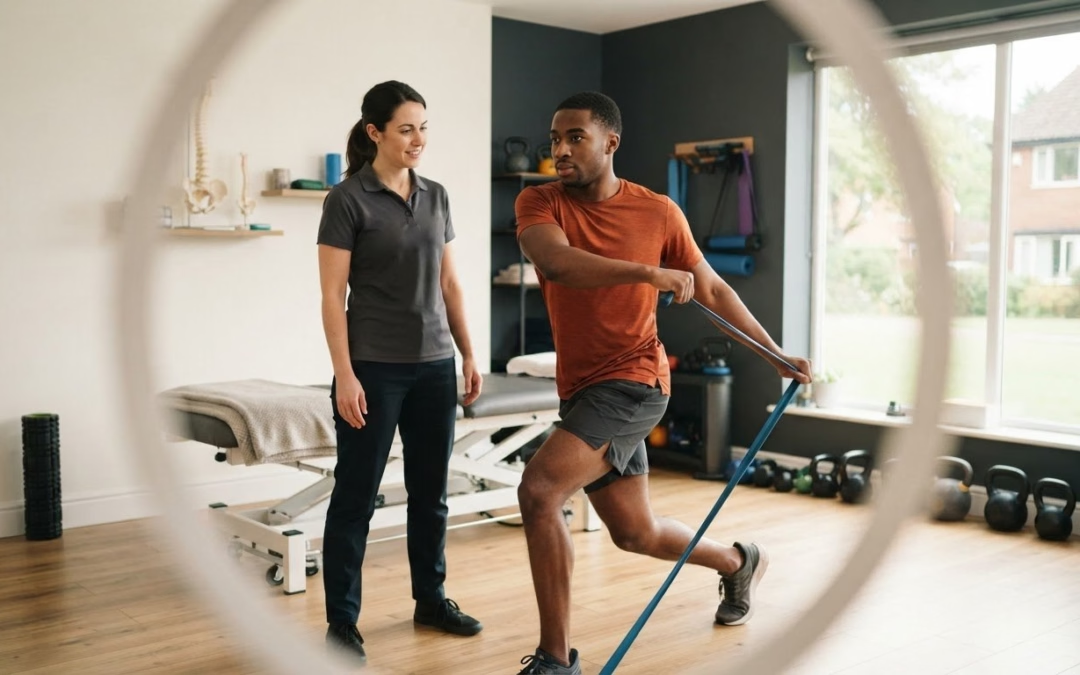
Could preventing sports injuries with chiropractic care Billericay be part of a more thoughtful training routine? If recurring stiffness or discomfort is interrupting your sport, you may be wondering whether a movement concern needs attention and what hands-on care can realistically contribute. Chiropractic care cannot guarantee that you will avoid injury, but an individual assessment can help you understand how you move and whether tailored support could fit your wider prevention plan.
Safer participation starts with everyday choices: prepare for activity, build training gradually and notice changes in comfort or mobility. At The Chiropractic Centre in Billericay, an assessment can inform a conversation about whether chiropractic adjustments, clinical massage or another suitable option may support your wellbeing. These are considered in light of your needs, not as a promise to prevent every sporting injury.
This practical guide covers preparation, training progression, recovery and signs that may be worth discussing at an assessment. It also explains what chiropractic care can and cannot contribute, so you can make informed choices about staying active in Billericay and nearby communities including Brentwood, Chelmsford, Stock, Basildon and Wickford.
Key Takeaways
- Injury prevention means managing risks you can influence, not removing every possibility of injury. Notice recurring strains or movement limits without assuming every ache signals a serious problem.
- Build your routine around preparation, gradual training changes, monitoring how you feel, recovery and regular review.
- Explore preventing sports injuries with chiropractic care Billericay by considering how an individual assessment could guide support suited to your needs and goals.
- Chiropractic adjustments and clinical massage have different purposes. Recurring symptoms that affect your sport may be a reason to seek an assessment.
- The Chiropractic Centre offers chiropractic adjustments, massage therapy and dry needling as part of its clinical services in Billericay.
Preventing sports injuries in Billericay starts with understanding your movement
Sport asks your body to repeat movements, manage changing forces and recover between sessions. Injury prevention means reducing risks you can influence, not removing every chance of getting hurt. A recurring strain or stiffness that changes how you train deserves attention, but a passing ache does not automatically mean you are injured. Notice when symptoms occur and what activities affect them, rather than trying to diagnose yourself.
Training load, recovery, mobility and technique can affect one another. A sudden increase in distance or lifting volume may ask more of your body than it is used to. Inadequate recovery can leave you tired, while restricted movement or a change in technique may alter how an activity feels. These factors do not point to one certain cause and vary by activity. The general overview of sports injury also describes the range of injuries and contributing factors associated with physical activity.
Which factors can raise sports-injury risk?
Make changes to training thoughtfully. If you have taken a break, adding extra sessions, distance or weight all at once can challenge your current capacity. Fatigue can also make it harder to control movement, coordinate your actions or maintain your usual technique, particularly towards the end of a demanding session.
The demands differ by sport. Running involves repeated impact and a gradual increase in distance; lifting asks you to control a load through a movement; sports with frequent changes of direction require you to brake, turn and accelerate. Notice how your body responds during and after these demands. A repeated pattern of discomfort, reduced range or difficulty completing a familiar movement is useful information to discuss, but it does not prove a particular injury.
What can chiropractic care contribute to prevention?
An individual musculoskeletal assessment can help identify movement or musculoskeletal concerns to discuss in the context of your activity, symptoms and goals. At The Chiropractic Centre in Billericay, the findings can inform a conversation about whether chiropractic care, such as an adjustment, is suitable. Clinical massage is a separate option that may also be considered according to your needs. Neither replaces gradual training, recovery or attention to technique.
Risk reduction can support safer participation, but no treatment can guarantee that you will avoid future sports injuries. That distinction matters when considering preventing sports injuries with chiropractic care Billericay. Your history and assessment should guide any care, rather than an assumption that the same approach suits every athlete. Sensible training and recovery remain central, with professional input as one possible part of a wider plan for staying active.
Build a safer sports routine with practical preparation and recovery
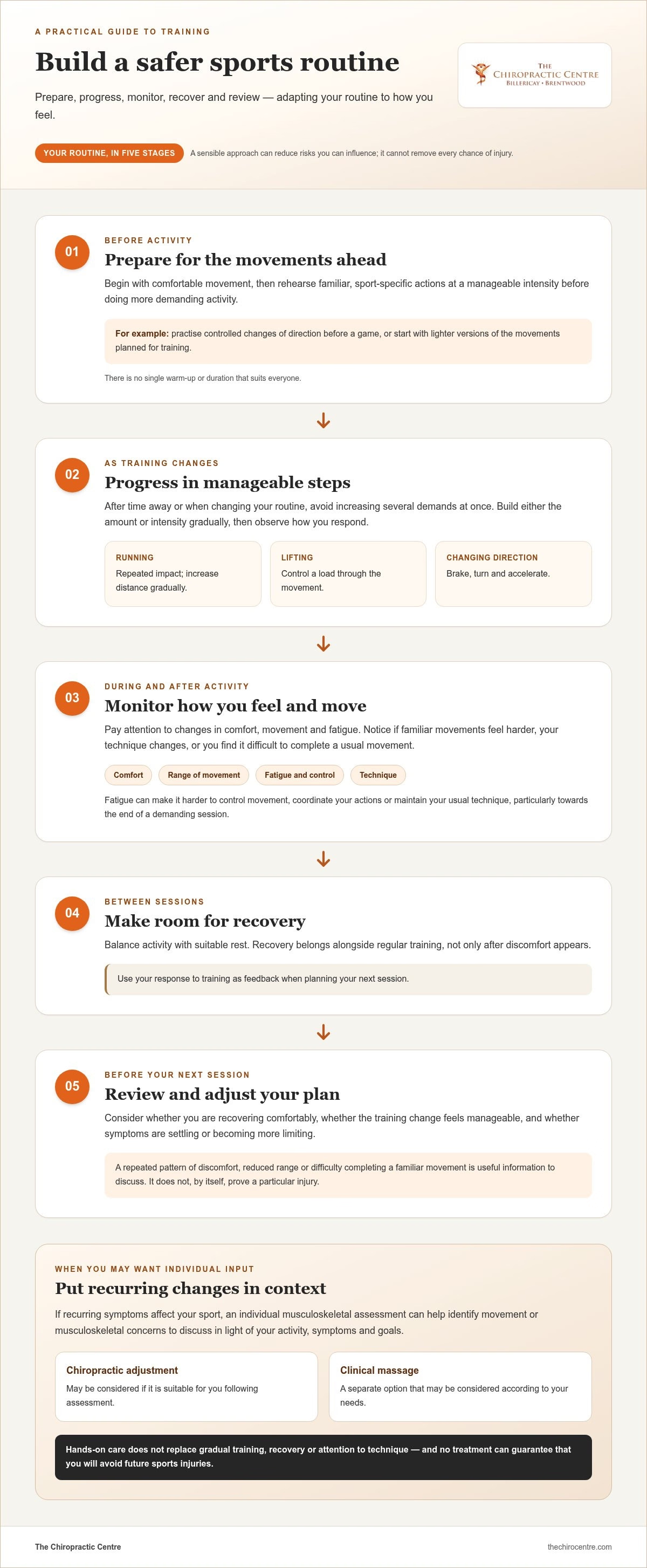
A routine does not need to be complicated to be useful. Prepare for the activity, progress your training gradually, monitor how you feel, make room for recovery and review what your body is telling you. This gives you a practical way to adjust your routine rather than pushing through every change in comfort or movement.
- Prepare: ease into the movements your activity asks of you.
- Progress: increase training in manageable steps.
- Monitor: notice changes in comfort, movement and fatigue.
- Recover: balance activity with suitable rest.
- Review: consider what felt manageable before your next session.
Prepare for sport without overcomplicating your warm-up
Choose a progressive warm-up that suits your sport and how you feel that day. Start with comfortable movement, then rehearse familiar, sport-specific actions at a manageable intensity before moving into more demanding activity. For example, practise controlled changes of direction before a game, or begin with lighter versions of the movements planned for a training session. There is no single routine or duration that suits everyone.
Use training progression and recovery to manage load
Gradual changes help you manage training demands more thoughtfully, but they cannot remove every risk. For preventing sports injuries with chiropractic care Billericay, sensible preparation and progression remain central; hands-on care is only one possible part of a wider approach. The American Chiropractic Board of Sports Physicians focuses on sports chiropractic and offers a further perspective on this specialist area.
Review your routine over time. Consider whether you are recovering comfortably, whether a change in training feels manageable and whether symptoms are settling or becoming more limiting. Persistent, worsening or concerning symptoms warrant appropriate clinical assessment rather than repeated attempts to train through them. If you are unsure whether a movement concern needs individual attention, a chiropractic assessment in Billericay gives you an opportunity to discuss your activity and wellbeing. Keep your routine flexible and adapt it to your sport, experience and needs.
Chiropractic care or clinical massage: what may suit your sporting needs?
Hands-on care is not one-size-fits-all, and an assessment is not the same as a treatment. It builds a picture of your health history, the activities or movements you find difficult and what you hope to return to or maintain. That information can guide a discussion about suitable support. If you are in Billericay and considering care for a sporting concern, non-drug options such as an adjustment or clinical massage may be worth discussing. Neither is right for everyone or guarantees an outcome.
An adjustment and clinical massage have different purposes. An adjustment is a specific chiropractic treatment involving a controlled movement of a joint. Clinical massage is hands-on soft tissue therapy that may be considered for muscle tension. These drug-free approaches do not replace sensible training, and one option will not suit every person or concern. Your history, assessment findings and goals all matter.
When might an adjustment be considered?
An adjustment may be discussed if your assessment indicates that it could be appropriate for your needs. The chiropractor should explain the proposed approach in plain language, consider your circumstances and make safety a priority. There are different adjustment techniques, and the choice should reflect your individual needs rather than an assumption that every athlete needs the same method. Read about what a chiropractic adjustment feels like to understand more about the experience.
For example, if a restriction or discomfort affects a movement you use in sport, an assessment can help clarify whether chiropractic care is relevant to discuss. It cannot establish that an adjustment will prevent an injury, resolve every limitation or improve sporting performance for everyone. Treatment decisions should reflect your particular presentation and wellbeing.
How can clinical massage support a sports-care plan?
Clinical massage is therapeutic massage delivered by trained professionals as hands-on soft tissue therapy. Within an individual plan, it may be considered when muscle tension is part of the concern you want to address. As a non-drug option, it may suit some people seeking hands-on support, but its role depends on your needs and assessment findings. Massage is distinct from an adjustment, even if both are discussed as care options.
If you are considering hands-on soft tissue care, the clinical massage guide explains this option further. A useful conversation centres on what you are experiencing, which activities matter to you and what the assessment suggests may be suitable. The aim is to make a considered choice, not to imply that massage prevents all sporting injuries. Training habits, recovery and attention to symptoms remain part of looking after yourself.
When should a Billericay athlete seek an individual assessment?
If discomfort keeps returning, limits a familiar movement or changes how you take part in sport, an individual assessment may help you understand what to consider next. You do not need to assume every ache signals an injury, but repeated symptoms are useful information, especially if they affect training or everyday activity. Persistent, worsening or concerning symptoms warrant appropriate clinical assessment. Sudden or severe symptoms may need urgent assessment through appropriate health services.
What happens during a musculoskeletal assessment?
You can explain what sport you do, which symptoms you have noticed and how they affect you. The practitioner may ask about your relevant health history and what you would like to achieve. They can then carry out suitable movement and musculoskeletal checks, such as looking at how a relevant joint moves or how you perform a comfortable movement. The findings help determine whether care is appropriate and which options to discuss.
Knowing what to expect can make a first appointment feel more straightforward. The new patient consultation guide outlines the process and how an assessment can help shape a personal care plan. Use the appointment to ask questions and explain what matters to you; you do not need to arrive with a diagnosis.
What information should you bring to the conversation?
A few notes can help you describe your experience clearly. Think about when the discomfort began, which movements or activities affect it, and whether it changes during or after exercise. Mention recent changes to your training and any previous injuries that seem relevant. You could also describe the sport or activity you hope to return to, continue or enjoy with greater confidence.
These details connect your symptoms with your routine, whether you run, lift weights or take part in another activity. If you are considering preventing sports injuries with chiropractic care Billericay, an assessment gives you a chance to discuss your own needs rather than rely on general assumptions. At The Chiropractic Centre, a personal conversation and suitable checks can inform whether chiropractic adjustments or another approach may be considered.
If recurring symptoms are affecting your activity, an individual assessment gives you a chance to discuss your movement, history and goals with the team in Billericay.
Explore personalised sports-injury support at The Chiropractic Centre in Billericay
If recurring discomfort or movement concerns are affecting your sport, The Chiropractic Centre offers local support in Billericay and nearby Essex communities. Your first step is a conversation about what you do, what you have noticed and what you want to keep doing. An individual assessment puts those details in context before suitable care is discussed.
Chiropractic adjustments, massage therapy and dry needling are among the clinical services available. They have different purposes, so they are not automatically suitable for the same concern or person. The focus is your wellbeing, with adjustment safety and your individual needs considered as part of the care discussion. No treatment can guarantee that you will avoid a future sports injury.
How care can be shaped around your sport and goals
Your activity matters. A runner, someone who lifts weights and a player who frequently changes direction place different demands on their bodies. An assessment and conversation can take your sport, concerns and goals into account, helping guide which hands-on options may be appropriate to discuss. This keeps the discussion personal rather than assuming one treatment fits every athlete.
For readers considering preventing sports injuries with chiropractic care Billericay, a useful aim is informed support that complements sensible training and recovery. An adjustment, massage therapy or dry needling may be considered where appropriate, but none should be presented as a guaranteed route to injury prevention or a particular sporting outcome. You can discuss how a proposed option relates to your priorities.
Take a considered next step in Billericay
If recurring concerns are limiting your activity, an assessment can help you explore what may be contributing and what support could suit your situation. Share your sporting goals and questions so the discussion reflects what matters in your day-to-day life.
A free spinal health check is also available as an initial opportunity to discuss spinal health. It is not a diagnosis or a substitute for an individual assessment when symptoms need closer attention. If symptoms are sudden or severe, seek urgent assessment through appropriate health services.
Taking a next step does not mean committing to a particular treatment. You can learn about the clinic in Billericay and its approach to personal care. The Chiropractic Centre welcomes people from Billericay, Brentwood, Chelmsford, Stock, Basildon and Wickford who want to discuss their wellbeing in a calm, supportive setting.
Take your next step towards confident movement
Your sporting goals are personal, so any support you consider should start with what matters to you: the activities you want to continue, the movements that concern you and the questions you would like answered. An assessment can help you make an informed choice about suitable care, without promising that any treatment will prevent every injury. The Chiropractic Centre has supported the local community for over 10 years, bringing experience and a personal approach to conversations about your wellbeing.
If you are weighing up preventing sports injuries with chiropractic care Billericay, focus on a practical next step: discuss your movement and goals, then consider which options fit your needs. Take the time to understand the approach and decide what feels right for you.
Arrange a personal assessment with The Chiropractic Centre to discuss your sporting goals and take a considered step towards staying active.
Frequently Asked Questions
Can chiropractic care prevent sports injuries?
No treatment can guarantee that you will avoid a sports injury. An assessment may help identify movement or musculoskeletal concerns to discuss, but it cannot remove every risk or replace careful training. If you are considering preventing sports injuries with chiropractic care Billericay, view it as one possible part of your wider approach. Gradual increases in activity, preparation suited to your sport and time for recovery remain important.
Is chiropractic care suitable if I play sport but do not have pain?
You can discuss your sporting goals during an assessment even if you are currently pain-free. You may want to talk about a movement that feels restricted or ask whether a concern warrants attention. Any care discussion should consider your health history and assessment findings, rather than assume you need treatment or promise to prevent future injury. Sensible training progression and recovery still matter, whether or not you seek hands-on care.
Can I have an adjustment before returning to sport after an injury?
Possibly, but whether an adjustment is appropriate depends on your injury, symptoms, health history and assessment. A practitioner can discuss suitable options, but this is not the same as clearance to return to sport, and there is no fixed timeline that suits everyone. If symptoms are ongoing or concerning, seek appropriate assessment before resuming demanding activity. For sudden or severe symptoms, seek urgent assessment through appropriate health services.
Does sports massage help prevent injuries?
Clinical massage may be considered within an individual plan if soft tissue concerns, such as muscle tension, are relevant to your needs. It cannot guarantee that you will avoid injury, and it is not a substitute for an assessment or an adjustment. Consider massage alongside how you build training, respond to fatigue and recover between sessions. Whether it is suitable, and what it may contribute, depends on your circumstances.
What should I do if a sports injury keeps coming back?
Pay attention to recurring symptoms, particularly if they are changing how you train or limiting an activity you enjoy. An appropriate assessment can take account of your sporting demands, health history and movement without assuming a cause in advance. Note when symptoms occur and which activities affect them to support the conversation. Seek urgent assessment through appropriate health services for sudden or severe symptoms.
What happens at a sports-related chiropractic assessment in Billericay?
You will discuss your symptoms, sporting activity, relevant health history and goals, followed by musculoskeletal checks suited to your concerns. The findings inform a conversation about possible next steps, which may include an adjustment or massage therapy if appropriate. The Chiropractic Centre serves people across Brentwood, Billericay, Chelmsford, Stock, Basildon and Wickford. An assessment can guide discussion, but it does not guarantee a diagnosis or sporting outcome.