
If you’ve noticed a change in your posture, discomfort or reduced mobility, the first useful step may be understanding how it affects you. A scoliosis clinic Essex residents can access should give you space to discuss your concerns and explore realistic options, without promising to straighten a curve.
At The Chiropractic Centre, scoliosis management is personalised around your needs and wellbeing. A Free Spinal Health Check or New Patient Consultation can be a starting point for discussing your spinal health, posture and movement. You can also talk through how chiropractic adjustments, massage therapy and lifestyle support may fit into an approach focused on your comfort and function.
This guide explains what an initial scoliosis-focused discussion may cover, what questions to raise and how to think about possible next steps. Whether you’re in Brentwood, Billericay, Chelmsford, Stock, Basildon, Wickford or a surrounding area, you can take a calm, informed approach to your spinal health with a local team.
Key Takeaways
- A visible change in posture alone can’t establish whether you have scoliosis. Your individual concerns and history matter.
- A musculoskeletal assessment can explore your history, posture and movement, but should not be presented as a medical diagnosis.
- Compare care approaches by looking for clear explanations, personalised support and realistic aims, not promises of curve correction.
- Before an appointment, note when you noticed changes, how they affect comfort or movement, and any relevant previous assessments.
- A scoliosis clinic Essex residents can access may offer an initial conversation through a Free Spinal Health Check or New Patient Consultation.
What does a scoliosis clinic in Essex help you understand?
Scoliosis is a sideways curve of the spine. The curve may be described as C-shaped or S-shaped, but a mirror or photograph can’t tell you whether you have scoliosis, what may have caused it or whether you need specific care. The Scoliosis overview offers general background. An individual conversation can help you discuss how your spinal health and movement affect you.
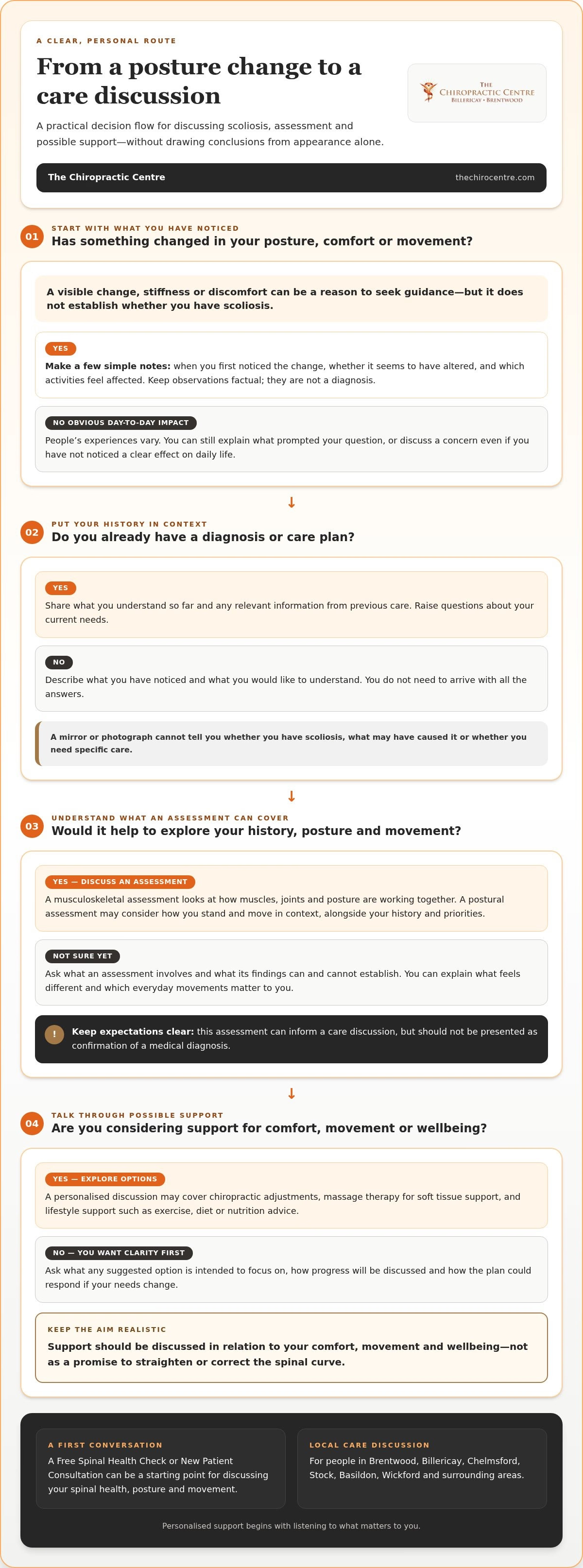
People’s experiences vary. You might notice an uneven shoulder line, stiffness or discomfort, or no obvious day-to-day impact. These observations can be useful reasons to seek guidance, but they don’t prove that you have scoliosis. A clinician can listen to what you’ve noticed and consider your concerns in context, rather than drawing conclusions from one visible feature.
What signs might prompt a scoliosis assessment?
You might notice that one shoulder or hip appears higher, your posture looks different, or certain movements feel stiff or uncomfortable. These signs can have different explanations, so avoid diagnosing yourself from appearance alone. Instead, note when you first noticed a change, whether it seems to have altered, and which activities feel affected. That gives you a clear starting point for a professional discussion.
For example, you could note that your shoulders look uneven in photographs or that a particular everyday movement feels less comfortable. Keep your notes factual and simple. They’re not a diagnosis; they help you explain what matters and make the conversation more focused.
Who might seek scoliosis management?
Adults and young people may want to discuss a new concern about posture, comfort or movement. Parents and carers may also seek guidance after noticing a change in a child’s posture. If you already have a diagnosis or care plan, you can explain what you understand so far and raise questions about your current needs.
It’s normal to feel uncertain, particularly if you’ve spotted a change but don’t know what it means. You don’t need to arrive with all the answers. A scoliosis clinic Essex residents visit can provide a calm setting to talk through your observations and consider an appropriate next step, whether you’re coming from Brentwood, Billericay or elsewhere in the area.
The purpose of the discussion is to understand your concerns and consider support, not to promise that a spinal curve will be corrected. You can ask what an assessment involves, what its findings can and can’t establish, and how any suggested support relates to your comfort and movement. Clear, realistic explanations help you make an informed decision about what to do next.
How is scoliosis assessed and managed at a clinic?
An assessment is an opportunity to put your concerns into context and discuss what support may suit you. At a scoliosis clinic Essex patients can expect a conversation shaped around their own history, posture, movement and priorities, rather than a fixed plan based on appearance alone. A musculoskeletal assessment looks at how muscles, joints and posture are working together. It can inform a care discussion, but shouldn’t be presented as confirmation of a medical diagnosis.
What happens during a musculoskeletal assessment?
The conversation may begin with what has brought you in, any relevant health history and what you hope to understand. You can explain whether you have a previous diagnosis or care plan, what feels different and which everyday movements matter to you. A postural assessment may then consider how you stand and move in context. The aim is to understand your concerns, not to draw conclusions from one observation.
There’s no need to prepare a perfect account. If a movement feels uncomfortable, describe when you notice it and how it affects your routine. Raise questions as they occur, too. A clear explanation of what an assessment can and can’t tell you helps keep expectations realistic. If you have relevant information from previous care, sharing it can make the discussion more useful.
How can a management plan reflect your needs?
Care planning should connect what you’ve discussed with your priorities, such as feeling more comfortable or moving with greater ease. Chiropractic adjustments may form part of personalised scoliosis management at The Chiropractic Centre. Adjustment safety should be considered, and the approach explained so you understand why a particular option is being discussed. Massage therapy may be relevant for soft tissue support, while exercise, diet or nutrition advice can form part of a wider holistic approach.
These forms of support focus on your comfort, movement and wellbeing. They shouldn’t be framed as a promise to straighten or correct the spinal curve. A useful plan makes its intended focus clear and leaves room for your questions. You might ask how progress will be discussed, which changes to pay attention to, and how the plan can respond if your needs shift.
Progress is personal. For one person, it may mean finding everyday movement more manageable; for another, it may mean having a clearer understanding of their options. Discussing how you feel and function can help guide ongoing conversations, without guaranteeing a particular result. If you’re considering a first discussion, a New Patient Consultation offers a way to talk through your concerns and explore a considered next step.
How can you compare scoliosis clinics and care approaches?
Comparing care isn’t about finding the most certain-sounding promise. It’s about understanding what an assessment can tell you, how a plan relates to your circumstances and whether its aims are explained clearly. Not every approach is intended to straighten the spine. When considering a scoliosis clinic Essex residents can access, focus on your individual needs and realistic support for comfort and movement.
Your age, concerns, health history and any existing clinical advice all matter. A young person with a recent concern may have different questions from an adult with an established diagnosis. If you already have guidance as part of your care, it’s useful context. A thoughtful conversation should take that into account instead of assuming the same plan suits everyone.
What makes a scoliosis care plan feel personalised?
A plan should start with what matters in your daily life, not just a description of your posture. Consider whether the discussion makes room for your history, concerns, activities and goals. If adjustments or supportive therapies are suggested, you should understand their purpose and how they relate to what you’ve shared. Your experience can then inform future conversations and any review of the plan.
| What to compare | A clear, personalised approach | Questions to keep in mind |
|---|---|---|
| Assessment | Explores your history, concerns, posture and movement in context. | Has the discussion considered your circumstances, rather than relying on one visible feature? |
| Personalisation | Connects proposed support with your goals and everyday activities. | Can you see why an adjustment or supportive therapy is being discussed? |
| Realistic aims | Explains whether the focus is comfort, movement or wellbeing, without promising curve correction. | Are the intended aims and uncertainties described plainly? |
| Communication | Welcomes questions and explains how your experience can inform future discussions. | Do you feel listened to and able to make sense of the next step? |
What should realistic scoliosis care promise?
Look for honest language. Support may aim to help you manage discomfort or work towards easier movement, but that isn’t the same as changing or curing scoliosis. A posture photograph or another person’s experience can’t predict what you’ll experience. Your progress should be discussed in relation to your needs, and uncertainty acknowledged rather than hidden behind confident claims.
It’s reasonable to ask what a suggested approach is intended to support, how your experience will be reviewed and how it fits with any existing clinical advice. Clear answers should help you feel informed, not pressured. The Chiropractic Centre provides personalised scoliosis management with a holistic approach and your wellbeing at the centre of the conversation. You can explore a scoliosis management discussion as a considered next step.
What should you prepare before a scoliosis clinic appointment in Essex?
A little preparation can help you use your appointment to discuss what matters most, but you don’t need to arrive with a diagnosis or a perfectly organised account. Before meeting a scoliosis clinic Essex team, jot down what you’ve noticed and the questions you’d like answered. Even brief notes can help you explain your concerns clearly, especially if you feel unsure or anxious on the day.
Which questions can help you understand your options?
Useful questions focus on what the assessment can establish, what any suggested care is intended to support and how your experience will inform future discussions. You might ask how an option relates to your concerns and goals, and how progress will be reviewed. These questions can help you understand the reasoning behind a plan and decide whether the next step feels right for you.
- What can this assessment help me understand, and what can’t it establish?
- How does the suggested care relate to my concerns and everyday activities?
- What are the aims of the proposed approach?
- How will we talk about progress, and what happens if my needs change?
You don’t have to ask everything at once. Choose the questions that matter most, and bring them on paper or in a note on your phone. Clear answers should help you understand the purpose of any proposed support without implying a guaranteed result.
What information can you bring to the appointment?
A short timeline is often enough to make your account more specific. Note when you first noticed a change, whether it has altered since, and whether it affects comfort or movement in particular situations. If you have a previous assessment, diagnosis or existing care advice, you can share relevant details. You don’t need to gather particular documents or arrange imaging just to prepare.
It may also help to think about what you’d like to do more comfortably or what you most want clarified. For a young person, a parent or carer can help describe when a change was noticed and bring the young person’s questions into the conversation. Keep the focus on observations rather than trying to explain their cause.
The Chiropractic Centre serves people from Brentwood, Billericay, Chelmsford, Stock, Basildon, Wickford and surrounding Essex areas. Whether you’re attending with a new concern or information from previous care, use the discussion to understand possible next steps at your own pace. If you’re ready to talk through your spinal health, book a New Patient Consultation.
Explore scoliosis management at The Chiropractic Centre in Essex
If you’re looking for a scoliosis clinic Essex residents can access for a supportive conversation, The Chiropractic Centre provides personalised scoliosis management shaped around your concerns and wellbeing. The aim is to understand how your spinal health relates to comfort, movement and everyday life, then discuss appropriate support. Care is individual, not a promise to straighten or correct a spinal curve.
You can begin with a Free Spinal Health Check or a New Patient Consultation. These offer a starting point to discuss what you’ve noticed, share relevant history and raise your questions. The clinic’s drug-free approach may include hands-on chiropractic adjustments and lifestyle support, with options focused on movement and wellbeing. The conversation is tailored to you, rather than assuming everyone needs the same approach.
How does The Chiropractic Centre approach scoliosis management?
Chiropractic adjustments may sit within a broader holistic approach. Depending on your needs, support around exercise, diet or nutrition may also be relevant, alongside massage therapy. These drug-free options can form part of a personal plan focused on your wellbeing and day-to-day goals. Any suggested care should be explained clearly, including its intended purpose and how your experience can inform future discussions.
Personal care means making space for your questions and taking your circumstances into account, whether you’re a young person, an adult, or a parent or carer seeking guidance. If you already have a care plan or advice from another clinician, sharing that context can help shape a useful conversation. You can also read the scoliosis management guide to learn more about the clinic’s approach.
Where can you access care around Essex?
The Chiropractic Centre serves Billericay, Brentwood and surrounding Essex communities, including Chelmsford, Stock, Basildon and Wickford. If you’re planning a first visit, the New Patient Consultation guide explains more about the general consultation process.
A calm first conversation can help you consider your options. Arrange a Free Spinal Health Check or New Patient Consultation to discuss your concerns with the team. Start with what you’d like to understand, then explore a considered next step at a pace that feels right for you.
Take a considered first step for your spinal health
Understanding your options can help you decide what feels right for you. A scoliosis clinic Essex residents can access should give you room to discuss your concerns without pressure to pursue a particular outcome. The Chiropractic Centre has been in business for over 10 years and has supported over 1,000 happy clients. Its rating is 5.0 based on 192 Google reviews, with 240+ total reviews.
You don’t need every answer before starting a conversation. Think about what you’d most like to understand, then raise it during a Free Spinal Health Check. This can be a first step towards discussing your spinal health and whether a New Patient Consultation may suit you. Any care plan should reflect your individual needs and wellbeing.
Ready to talk through your concerns? Arrange a Free Spinal Health Check with The Chiropractic Centre.
Frequently Asked Questions
Is scoliosis always painful?
No. Pain isn’t a reliable way to tell whether someone has scoliosis or how pronounced a curve may be. Some people notice no discomfort, whilst others may have aches that change with activity or posture. If you’re concerned about persistent or worsening pain, discuss it with a qualified health professional rather than assuming scoliosis is the cause. A clear account of what affects your comfort can help that conversation.
Can chiropractic care cure scoliosis or straighten the spine?
No. Chiropractic care shouldn’t be described as curing scoliosis or reliably straightening the spine. Its role in a care discussion is different from changing the underlying curve. If adjustments are proposed, ask what they are intended to address, what uncertainties remain and how the approach fits with any advice you already have. Clear answers help you weigh the option without relying on dramatic before-and-after claims or guarantees.
Can adults develop scoliosis?
Yes. Scoliosis can first become apparent or be identified during adulthood. Noticing a spinal difference later in life doesn’t, by itself, show when it began or what caused it. If you’re seeking advice as an adult, explain whether the concern is new to you or whether you’ve known about it for some time. That distinction can help keep the discussion focused on your circumstances.
Does everyone with scoliosis need treatment?
No. A diagnosis doesn’t automatically mean that hands-on care is needed. Depending on your situation, a discussion may focus on understanding the condition and whether any support is appropriate, rather than starting treatment. If you’re unsure, ask what the options are and what each is meant to address. You can take time to consider the explanation and decide whether a proposed next step suits your needs.
Can exercise help if you have scoliosis?
Exercise can be part of looking after general fitness and staying active, but there isn’t one routine that suits everyone with scoliosis. Pay attention to how an activity feels and avoid pushing through discomfort. If you’re considering a new exercise programme, discuss how it fits your individual needs and any existing clinical advice. The aim should be a sensible approach to activity, not an assumption that exercise will alter the curve.
What should I bring to a scoliosis appointment?
If you have written information from a previous assessment or care plan, bringing it can help clarify terms or advice you’ve received. You might also take a trusted person if you’d find it helpful to have support during the conversation or to remember what was discussed. There’s no need to gather a particular set of documents. The most useful preparation is whatever helps you feel comfortable asking your questions.