
According to the NHS, scoliosis most often starts between the ages of 10 and 15. A spinal curve greater than 10 degrees is classed as scoliosis, and scoliosis symptoms in teenagers in Billericay may first show as a change in the back’s appearance, such as uneven shoulders or hips, or a rib cage that looks more prominent on one side. Pain isn’t always present, so noticing a change in posture can raise questions even when your teenager feels well.
It’s understandable to wonder whether an uneven appearance is part of growing or a sign that needs attention. This guide explains scoliosis symptoms in teenagers in Billericay, what signs may appear, how healthcare professionals assess the spine, and how curve severity and remaining growth shape care decisions. You’ll also learn why growth stage matters when monitoring a curve and how to choose a supportive next step for your family.
Key Takeaways
- Look for changes in posture, shoulder or hip height, and the shape of the rib cage, even if your teenager feels well.
- A healthcare professional can examine the back and assess whether an X-ray is needed to measure a spinal curve.
- Care decisions depend on the curve’s severity and whether your teenager is still growing, so monitoring may be part of the plan.
- Understanding the assessment and treatment options can help you support your teenager with confidence and know what to discuss next.
What causes Adolescent Idiopathic Scoliosis?
Early signs may include one shoulder or hip sitting higher, an uneven waist, or the body leaning to one side. You might also notice a rib prominence, a curved spinal outline, or clothes hanging unevenly. These changes can appear gradually during growth and may be noticed before any discomfort.
“Idiopathic” means that no specific cause has been identified. Adolescent idiopathic scoliosis is not thought to result from poor posture, exercise or diet, and it cannot be prevented through lifestyle changes. Scoliosis may run in families: genes can increase the likelihood of developing it. Around 30% of adolescents with this form have a family history of scoliosis. A relative’s diagnosis may be useful context, but it doesn’t establish a diagnosis for your teenager.
Look for differences that remain visible during everyday activities rather than assuming that one photograph or stance proves there is a spinal curve. Examples include:
- Shoulders or shoulder blades appearing uneven.
- One hip sitting higher, or the waist looking asymmetrical.
- Ribs appearing more prominent on one side, especially when bending forwards.
- A sideways lean or clothes that twist or fit unevenly.
These visual signs can prompt an assessment, but they do not show the curve’s size or whether it will progress. A healthcare professional examines posture and the back; an X-ray can measure the curve if a specialist considers it necessary. Monitoring during growth helps track changes. Bracing may be considered based on curve severity and remaining growth, not appearance alone. A brace aims to limit progression; it does not necessarily straighten the curve.
Back pain can occur, but it is not a reliable way to identify scoliosis. Pain associated with scoliosis is more common in adults, and teenagers may have a spinal curve without symptoms. Discomfort should therefore be considered alongside visible changes and examination findings, not treated as proof of scoliosis.
Cauda equina warning signs are different from signs of a spinal curve. New problems controlling or passing urine or bowel movements, numbness around the bottom or genitals, or leg weakness need urgent medical assessment. These are not typical visual signs of scoliosis. Seek urgent help rather than waiting for a routine appointment.
Physical examination and diagnosis
A physical examination looks for spinal asymmetry; an X-ray can measure a curve and help confirm scoliosis. Parents may notice changes in their teenager’s back, although scoliosis may also be identified during a routine examination.
Postural and spine examinations
A postural and spine examination checks how the shoulders, hips, ribs and back align. It helps assess a visible difference instead of guessing at the curve’s size.
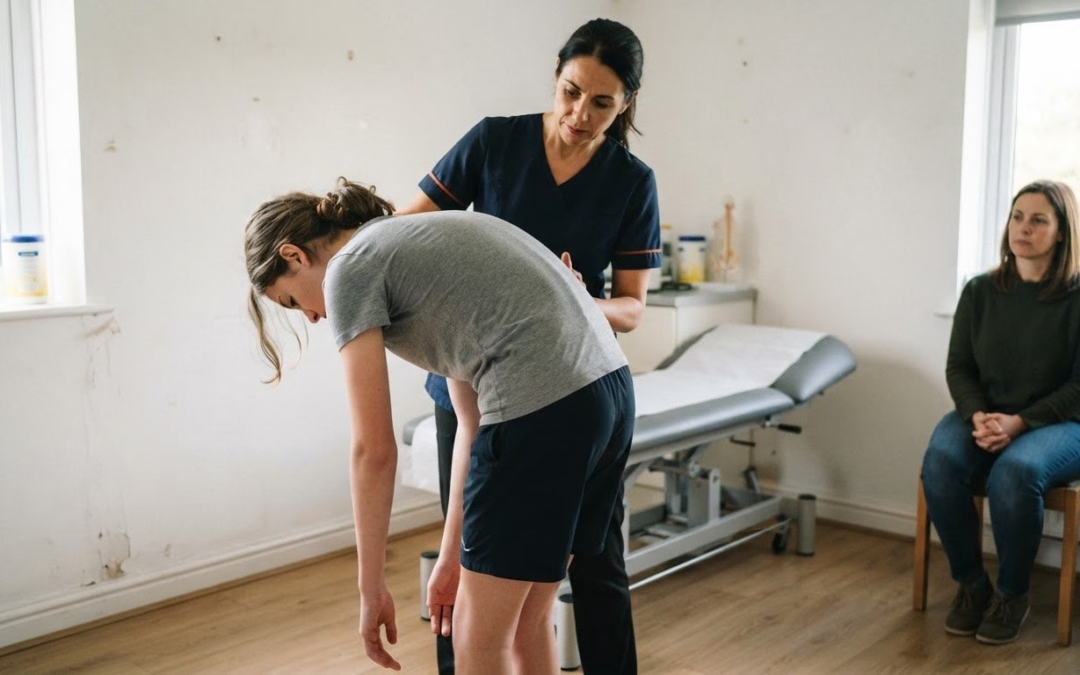
A healthcare professional may observe your teenager standing, examine the spine and compare shoulder and hip levels. They may ask your teenager to bend forwards to check whether one side of the rib cage sits higher. A specialist will usually use an X-ray to confirm scoliosis and measure the curve. MRI or CT scans may be recommended in some cases.
Checking for signs at home
A home check means observing your teenager’s posture for unevenness, not trying to diagnose scoliosis. It can help you describe a change clearly when seeking medical advice.
With your teenager standing naturally, notice whether one shoulder, shoulder blade or hip appears higher. Check whether the waistline looks uneven or clothing hangs differently on each side. You can also observe the back as they bend forwards, without forcing the movement. A difference in the rib cage or trunk is a reason to arrange an assessment, not proof of a severe curve. Home observations cannot measure spinal curvature or show whether it is progressing.
Seeing a GP about possible scoliosis
See a GP if you think your teenager may have scoliosis or notice a persistent change in posture. If the GP suspects a spinal curve, they should refer your teenager to a specialist.
At the appointment, describe what you have observed, such as an uneven shoulder when standing or a rib prominence when bending. Mention when you first noticed the change and whether it seems to be progressing as your teenager grows. The specialist’s examination and X-ray findings help guide decisions; a visible difference alone does not mean surgery is needed. Share any relevant family history, as scoliosis may run in families.
Treatment choices based on curve severity and growth
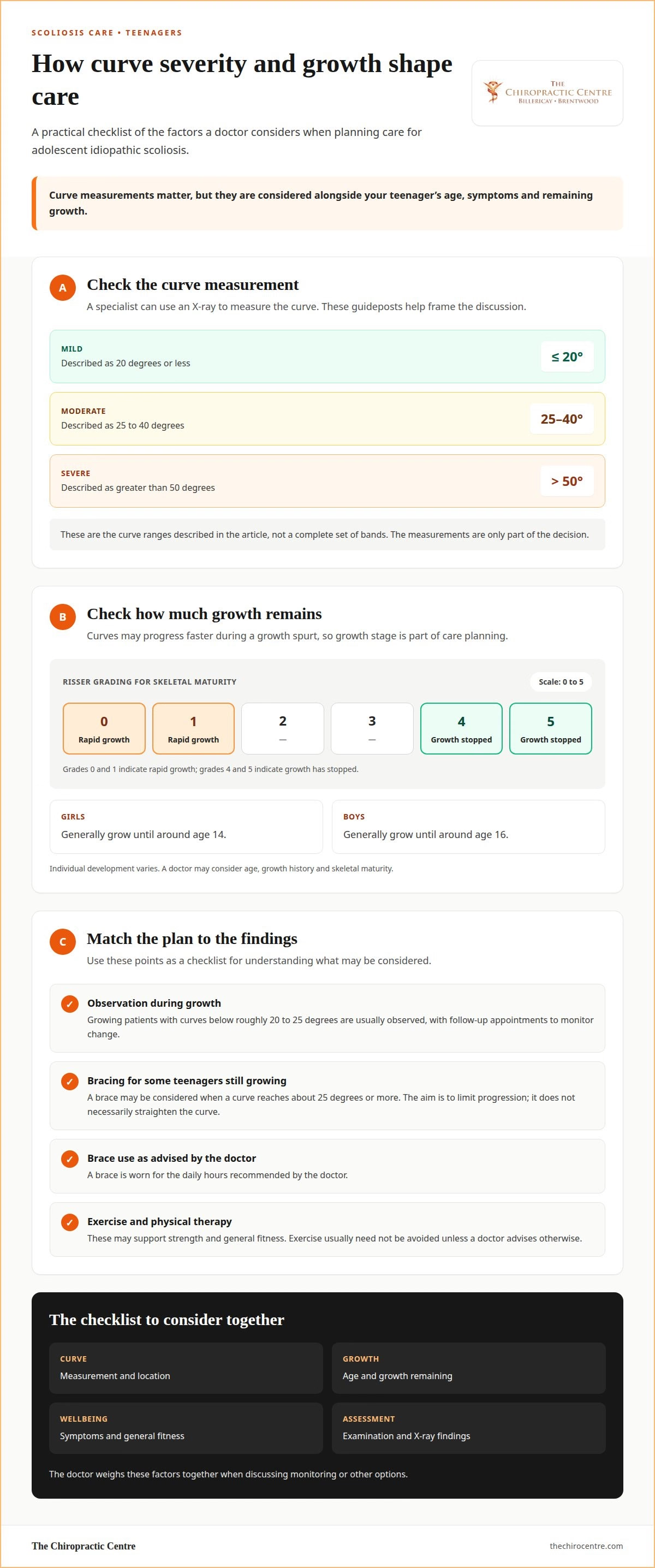
For adolescent idiopathic scoliosis, treatment depends on curve size, age and how much spinal growth remains. A doctor considers examination and X-ray findings together, since curves may progress faster while a teenager is growing.
Growth spurts matter because a changing skeleton can allow a curve to worsen. Growth potential is assessed using factors such as age, growth history and skeletal maturity. The Risser grading system rates skeletal maturity from 0 to 5: patients at grades 0 and 1 are growing rapidly, while grades 4 and 5 indicate growth has stopped. Girls generally grow until around age 14 and boys until around age 16, though individual development varies.
Curve measurements help guide the discussion, but are not the only consideration. A mild curve is described as 20 degrees or less; moderate curves measure 25 to 40 degrees, and severe curves exceed 50 degrees. Growing patients with curves below roughly 20 to 25 degrees are usually observed, with follow-up appointments to monitor change. For some teenagers still growing, bracing may be considered when a curve reaches about 25 degrees or more. The doctor weighs curve location, severity, symptoms and growth remaining.
Exercise and physical therapy may support strength and general fitness. Exercise usually need not be avoided unless a doctor advises otherwise. A brace is worn for the daily hours recommended by the doctor. These approaches aim to manage progression and support wellbeing, not promise to straighten every curve.
In Essex, the NHS pathway starts with a GP assessment if scoliosis is suspected. The GP should refer your teenager to a specialist, who can examine the spine and use an X-ray to confirm and measure the curve. Specialist care may include monitoring, bracing or physical therapy, depending on the curve and growth stage. A teenager diagnosed with scoliosis can discuss suitable options with the specialist.
Scoliosis symptoms in teenagers
According to the National Health Service, scoliosis most often starts in children aged 10 to 15 years. Yet a teenager may feel completely well, with no pain or change in movement. The first clue can be an altered appearance noticed while dressing, standing for a photograph, or getting ready for sport. A spinal curvature can develop without obvious symptoms, so feeling normal does not rule it out.
Scoliosis is a change in the spine’s shape, not a symptom every teenager can feel. Back pain alone does not diagnose scoliosis, and an uneven appearance does not show the curve’s size. An examination and, when needed, imaging establish whether scoliosis is present. The practical takeaway for families is to discuss persistent changes with a healthcare professional rather than rely on discomfort as the only sign.
Some teenagers worry that a diagnosis means giving up exercise or everyday activities. Most people with scoliosis can live normal lives and take part in activities, including sport. Walking, running and football are weight-bearing exercises that support bone strength; regular activity can also help maintain fitness and muscle strength. A doctor may advise individual changes, but scoliosis alone is not a reason to avoid exercise.
Emotional effects deserve attention too. A visible curvature or wearing a brace may affect body image and self-esteem, particularly during the teenage years. Changes in clothing choices, reluctance to take part in swimming, or anxiety about changing rooms can signal a need for extra understanding. Listen without making the curve the focus of every conversation, and include your teenager when discussing treatment options.
Therapy and monitoring have different roles: exercise supports general wellbeing, while follow-up checks whether a curve changes during growth. Neither replaces diagnosis or promises to straighten the spine. If your teenager has a diagnosed curve, ask the specialist how its location, severity and growth stage shape care. Keeping school, sport and confidence in view helps families consider the whole teenager, not only the curvature.
The Chiropractic Centre: Scoliosis Management
The Chiropractic Centre provides Scoliosis Management for teenagers and families seeking support with spinal health and wellbeing. If you’ve noticed a change in posture or your teenager has a diagnosis, a New Patient Consultation is an opportunity to discuss their concerns and consider suitable care.
Paediatric Care recognises the needs of younger patients, while Massage Therapy may support comfort as part of an appropriate care plan. These services complement, rather than replace, diagnosis and treatment decisions made by your teenager’s GP or specialist. Bringing relevant assessment information can help focus the discussion on your teenager’s situation, growth and wellbeing.
If you’d like to discuss scoliosis support for your teenager, contact The Chiropractic Centre.
Make space for your teenager’s questions
A conversation about scoliosis can feel easier when your teenager has a say in what happens next. Invite them to share their concerns, whether about comfort, sport, clothing or how their back looks. Their priorities can help shape a thoughtful discussion about care and everyday wellbeing.
If you’re concerned about scoliosis symptoms in teenagers in Billericay, bring your questions and your teenager’s perspective to a supportive conversation. The next step does not need to solve everything at once; it can help you understand what support feels appropriate for your family.
Contact The Chiropractic Centre to discuss your teenager’s needs. With clear information and a caring approach, you can move forward together with greater confidence.
Frequently Asked Questions
What is scoliosis?
Scoliosis is a structural change in the spine’s shape. The term describes an anatomical finding, not a teenager’s fitness, character or effort. If it appears in a clinic letter, ask the clinician to explain the wording and what it means for your teenager. Understanding the report helps families separate the diagnosis from assumptions about sport, school or everyday independence.
Do alternative treatments help with AIS?
Alternative treatments should not be relied on to change a spinal curve. Keep complementary care aligned with your teenager’s clinical plan, and tell their treating team what they are using. Discuss a proposed therapy before starting it, particularly if it affects activity or causes discomfort. Focus on wellbeing and realistic aims, not claims that a complementary treatment corrects AIS.
What is AIS?
AIS stands for adolescent idiopathic scoliosis. It is the clinical term for scoliosis identified during adolescence when no specific cause is found. The abbreviation may appear in a report or conversation with a clinician, but it does not describe a teenager’s individual needs. Ask the clinician to explain unfamiliar terms and how they relate to your teenager’s circumstances.
What are common symptoms of scoliosis in teenagers?
Symptoms vary, so a clear record can make an appointment more useful. If you’re concerned about scoliosis symptoms in teenagers in Billericay, note when you first noticed a change and whether it affects activities or comfort. Include your teenager’s concerns, such as feeling self-conscious in sports kit. These details help ensure the conversation covers day-to-day experience as well as clinical terminology.
How is scoliosis diagnosed in teenagers in the UK?
Diagnosis involves clinical assessment, with imaging used to examine the spine when appropriate. Before an appointment, write down what prompted your concern, when you noticed it and any questions your teenager wants answered. You can also ask what the findings mean in plain English, which changes should prompt follow-up, and how progress will be discussed at future appointments.
Where can teenagers in Billericay get scoliosis advice or assessment?
For advice about scoliosis symptoms in teenagers in Billericay, start with your GP for medical assessment. The Chiropractic Centre provides a local setting to discuss spinal health and your teenager’s wellbeing. When arranging a conversation, explain whether you want to understand an existing diagnosis or discuss a recent concern, so the appointment can focus on your family’s questions.