What if the most effective way to manage your spinal curve wasn’t found in an operating theatre, but through the natural rhythm of movement and clinical care? Many people diagnosed with scoliosis feel a heavy sense of inevitability, fearing that a major operation is the only way to stop the “hump” from progressing or to escape chronic back pain. It is completely normal to feel anxious about the long recovery times and risks associated with invasive procedures. This guide shows you that a proactive approach to scoliosis treatment without surgery is not just possible, it is often the preferred clinical path for long-term vitality.
We will explore how a combination of clinical chiropractic adjustments, targeted exercises, and modern management strategies can help you reclaim your posture and live a life defined by movement rather than limitations. By shifting the focus from simply straightening a curve to optimising your body’s overall function and stability, you can discover a clear, non-surgical roadmap for your long-term health. Whether you are managing adult discomfort or looking for early intervention for a child, understanding these non-invasive options is the first step toward a more comfortable and confident future.
Key Takeaways
- Learn how the Cobb Angle influences your care pathway and why scoliosis is a three-dimensional challenge rather than just a simple curve.
- Discover how clinical chiropractic adjustments support scoliosis treatment without surgery by improving mobility in stiff spinal segments and balancing the pelvis.
- Compare the benefits of modern corrective bracing and specialised scoliosis exercises to help stabilise your spine and prevent curve progression.
- Master simple ergonomic adjustments and supportive sleeping positions designed to reduce muscular fatigue and manage daily discomfort at home or work.
- Understand why a professional baseline assessment is the essential first step in creating a personalised, non-invasive roadmap for your spinal health journey.
Understanding Scoliosis: Can You Manage the Curve Without Surgery?
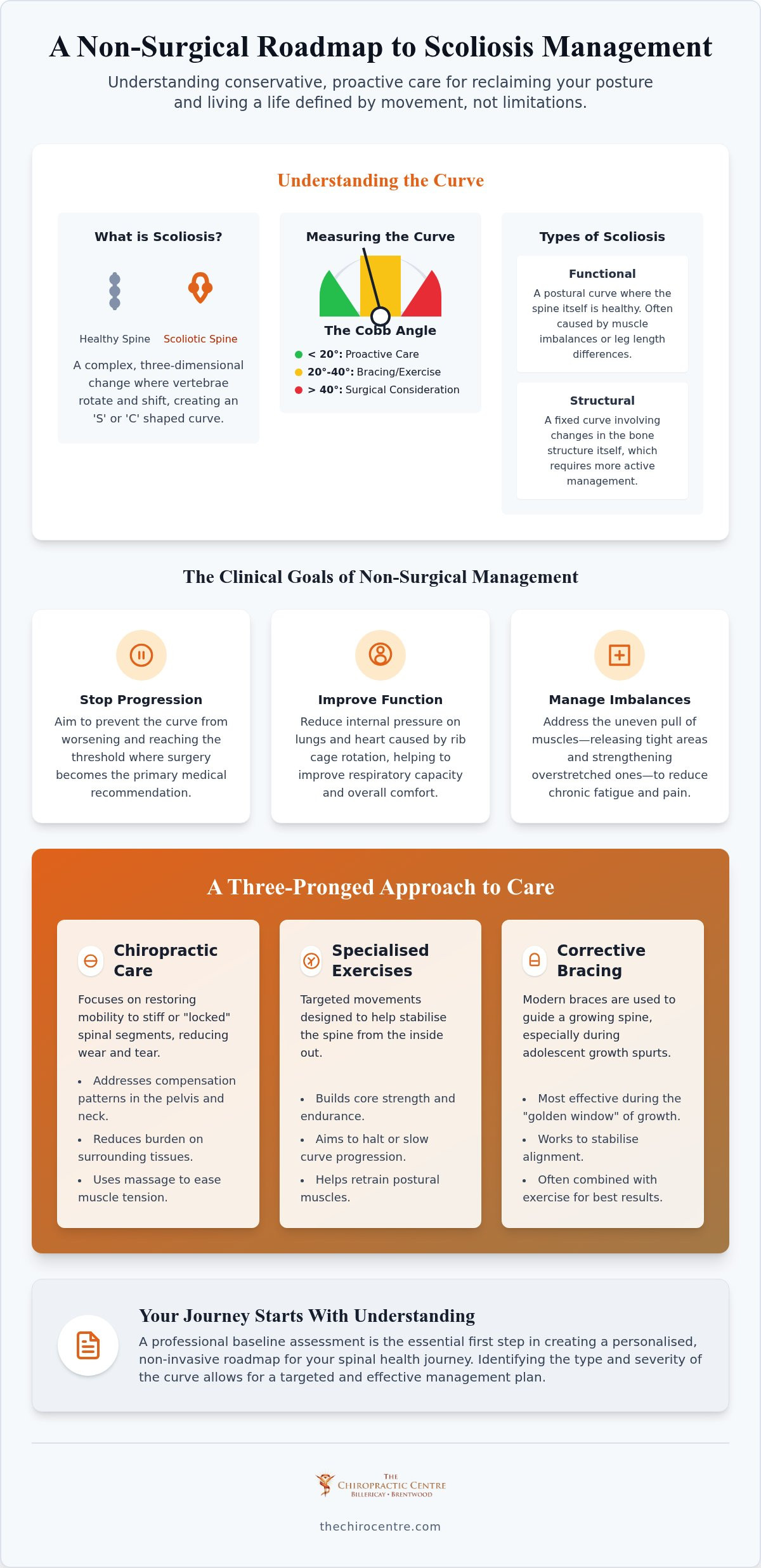
Scoliosis isn’t just a simple side-to-side bend. It’s a complex, three-dimensional change in spinal alignment where the vertebrae rotate and shift. This results in the characteristic “S” or “C” shape often seen on X-rays. Clinicians use the “Cobb Angle” to measure the severity of this curve. In the UK, a Cobb Angle under 20 degrees often leads to a “watch and wait” approach, but this is exactly where proactive scoliosis management strategies are most vital. Understanding your Cobb Angle helps us determine the most effective roadmap for your care, whether that involves observation or active therapy.
We distinguish between functional and structural scoliosis. Functional scoliosis is often postural, meaning the spine is healthy but appears curved due to muscle imbalances or leg length differences. Structural scoliosis involves a fixed change in the bone structure itself. Identifying which type you have is the essential first step toward effective scoliosis treatment without surgery.
Early detection represents the “golden window” for non-surgical success. Whilst the spine is still growing, conservative interventions have the highest chance of stabilising the alignment. This is why we advocate for early screenings, particularly for children and teenagers who are approaching growth spurts. It’s much easier to guide a growing spine than it is to correct a fully matured one.
The Clinical Goals of Non-Surgical Management
Our primary aim isn’t always to achieve a perfectly straight spine. Instead, we focus on how the body functions as a whole. When we implement a plan for scoliosis treatment without surgery, we work toward several key clinical outcomes:
- Stopping progression: We aim to prevent the curve from reaching the threshold where surgery becomes the only medical recommendation.
- Improving respiratory function: Reducing the internal pressure on the lungs and heart caused by rib cage rotation.
- Managing muscular imbalances: Addressing the uneven pull of muscles that leads to chronic fatigue and daily pain.
Why Patients Seek Alternatives to Spinal Fusion
Many people feel anxious about spinal fusion because it involves permanent hardware and a loss of spinal flexibility. They want a holistic approach that addresses their lifestyle and vitality. Additionally, with long waiting lists for specialist NHS consultations, many families choose private conservative care to manage symptoms immediately. Taking a non-invasive path allows you to stay active and maintain the natural movement of your spine. It’s about finding a partner in your health who looks beyond the X-ray to the person behind the curve.
The Role of Chiropractic Care in Scoliosis Management
Chiropractic care offers a unique clinical perspective on scoliosis treatment without surgery. Whilst many conventional approaches focus solely on the degree of the curve, we look at how the spine moves. In a scoliotic spine, certain segments often become “locked” or stiff. These restricted joints can accelerate wear and tear and increase discomfort. Chiropractic adjustments aim to restore mobility to these specific areas. This isn’t about “cracking” the spine straight; it’s about ensuring each joint contributes its fair share to your body’s movement, reducing the burden on the surrounding tissues.
We don’t just focus on the primary curve. The body is a master of compensation. If your mid-back curves to one side, your neck and pelvis often shift in the opposite direction to keep your head level. By addressing these compensatory patterns in the pelvis and neck, we help create a more stable foundation for the entire skeleton. This holistic approach is supported by various Nonsurgical Treatment Options for Scoliosis that emphasise maintaining function and quality of life over time.
Muscle health is equally critical to your comfort. Muscles on the “convex” side of a curve often become overstretched, whilst those on the “concave” side become hypertonic or tight. We use clinical massage and dry needling to release these stubborn tensions. This dual approach helps the nervous system communicate more effectively with the musculoskeletal system, which can significantly reduce the daily muscular fatigue many patients experience. If you’re ready to see how these therapies could benefit you, booking a New Patient Consultation is an excellent starting point.
Paediatric Chiropractic: Early Intervention in Essex
For younger patients, we monitor growth spurts with clinical precision. Rapid growth can cause a curve to progress quickly, making early detection vital. Our paediatric chiropractor Essex team uses exceptionally gentle, low-force techniques tailored for developing spines. We aim to keep the spine as mobile and balanced as possible during these critical years, providing a supportive environment for healthy development and preventing the curve from reaching a surgical threshold.
Adult Scoliosis: Addressing Wear and Tear
In adults, the focus shifts to managing the effects of time and gravity. Adult scoliosis often leads to secondary issues like disc degeneration or nerve compression. If you’re struggling with shooting leg pain or numbness, visiting a sciatica chiropractor Essex expert can help manage the nerve-related symptoms that often accompany a shifting spine. We work to improve your posture and reduce the “slump” that can occur as muscles tire, helping you stay active and independent.
Comparing Conservative Therapies: Bracing, Exercise, and Adjustments
Effective scoliosis management is rarely about a single intervention. It’s about building a personalised “toolkit” that addresses the spine from multiple angles. For many, the goal is to find a sustainable scoliosis treatment without surgery that fits into their daily life. This multi-modal approach typically combines clinical adjustments to ensure joint mobility with structural support from bracing and functional retraining through specific exercises. By approaching the curve from these different perspectives, we create a more robust environment for spinal health.
Chiropractic care plays a vital role here by “preparing” the spine. If a joint is stuck or restricted, a brace cannot effectively guide it, and an exercise programme won’t target the right muscles. By maintaining mobility in the stiff segments of the curve, we help the body respond more effectively to other corrective therapies. This creates a synergy where the sum of the parts is far greater than any individual treatment. It’s a proactive way to manage your health whilst avoiding the risks associated with more invasive procedures.
The Schroth Method and Muscular Symmetry
The Schroth Method is a form of Scoliosis Specific Exercise (SSE) that focuses on three-dimensional correction. It uses a technique called rotational breathing to help expand “collapsed” areas of the ribcage from the inside out. This isn’t your typical gym workout. General exercises can sometimes strengthen the wrong muscles, accidentally reinforcing the curve’s pattern. Instead, we focus on building core strength that supports the spine in a more neutral position, helping you maintain your posture even when you aren’t thinking about it. It’s about retraining your brain and muscles to work together in a more balanced way.
Modern Bracing: Not Your Grandparents’ Back Brace
Modern bracing has undergone a revolution. Gone are the days of heavy, rigid plastic shells that were impossible to hide. Today’s corrective braces use advanced 3D scanning and computer modelling to create low-profile designs that are nearly invisible under a school uniform or office attire. These braces don’t just “hold” the spine; they use an over-corrective principle to guide the spine toward a more balanced alignment. Whilst often associated with teenagers, modern bracing is increasingly used for adults to provide stability, reduce pain, and prevent the “slump” that can worsen as we age. For many, it’s a key component of a successful long-term management plan.
Daily Strategies for Living Well with Scoliosis
Clinical appointments provide the framework for your care, but the choices you make during the other 165 hours of the week truly define your progress. Managing scoliosis treatment without surgery requires a commitment to small, daily refinements that protect your spine from unnecessary strain whilst you go about your day. These micro-adjustments to your environment and habits help maintain the mobility gained during your chiropractic sessions. Postural awareness is the ability to self-correct the spine’s midline throughout the day.
Your sleeping environment is a prime place to start. For many, side sleeping with a pillow placed between the knees helps keep the pelvis level, reducing the uneven pull on the lower back muscles. If you prefer sleeping on your back, a small cervical roll can support the natural curve of your neck. Footwear also plays a surprising role in spinal balance. Even a minor leg-length discrepancy can create a functional tilt in the pelvis, which the spine then compensates for by curving further. Addressing these imbalances with appropriate footwear or clinical advice can provide a more level foundation for your entire skeleton.
The Desk Worker’s Guide to Scoliosis
The modern “desk slouch” is a significant challenge for those with thoracic curves. When you lean forward, you increase the pressure on the front of the vertebrae, which can encourage a curve to rotate. To combat this, ensure your monitor is at eye level and your feet are flat on the floor. Specific stretches for the “concave” or compressed side of your curve can help open up the ribcage and reduce muscular tension. For more tailored advice on setting up your workspace to support your spine, our posture correction chiropractor Essex team can provide a detailed assessment during your visit.
Nutrition and Bone Health
A holistic approach to scoliosis treatment without surgery includes supporting your spine from the inside. Bone density is a critical factor, particularly for adult patients. Ensuring adequate intake of Vitamin D and Calcium helps maintain the structural integrity of your vertebrae. It is also essential to stay hydrated for your intervertebral discs, which are mostly water. When these discs are well-hydrated, they act as better shock absorbers for your spine. Reducing systemic inflammation through a balanced diet can also lower the sensitivity of the muscles that often feel “locked” or fatigued by the curve.
To get started on your own personalised plan for daily spinal health, you can book a New Patient Consultation with our clinical team today.
Personalised Scoliosis Management at The Chiropractic Centre
At The Chiropractic Centre in Billericay, we understand that a scoliosis diagnosis can feel overwhelming. Our clinical team has spent over 10 years in Essex supporting individuals through these challenges with a blend of professional authority and empathetic warmth. We don’t view you as a curve on a chart. Instead, we see a person who wants to stay active, work without pain, and enjoy life with confidence. This person-centred philosophy is at the heart of our scoliosis treatment without surgery.
Our clinic is a community hub where we integrate various therapeutic tools to support your progress. We combine precise chiropractic adjustments with massage therapy and dry needling to manage the muscular fatigue that often triggers chronic discomfort. We also value collaboration. If you’re already seeing a consultant or physiotherapist, we’re happy to communicate with them to ensure your care plan is fully aligned with your overall health goals. It’s about creating a supportive environment where you feel heard and empowered.
Your First Visit: The Scoliosis Assessment
Your clinical journey starts with a new patient chiropractor consultation Essex. This baseline assessment is essential for creating a safe and effective roadmap for scoliosis treatment without surgery. We perform a thorough postural analysis and spinal screening to identify specific areas of restriction and compensation. We’ll take the time to discuss your health history and your specific goals, ensuring that every recommendation we make is grounded in your unique needs and lifestyle.
Free Spinal Health Checks in Billericay
We believe that every family in our community should have access to early screening. That’s why we offer Free Spinal Health Checks at our Billericay centre. These 15-minute sessions are a low-pressure opportunity to have your spine, or your child’s spine, checked for early signs of scoliosis. We look for subtle postural cues like uneven shoulders, a tilted pelvis, or rib prominence. It’s a simple, vital step for local families who want peace of mind about their spinal health. You can book your screening by calling our front desk or visiting us in the heart of Billericay.
Reclaiming Your Spinal Health and Vitality
Managing a spinal curve doesn’t have to mean waiting for an operation or living in fear of future limitations. As we have explored, the combination of clinical chiropractic care, specialised exercises, and modern bracing offers a powerful, proactive alternative for those seeking scoliosis treatment without surgery. By focusing on joint mobility and muscular balance, you can reduce daily discomfort and actively work to stabilise your spine. It’s about shifting the focus from the curve itself to the quality of life you want to lead.
At The Chiropractic Centre, we bring over 10 years of clinical experience in Essex to every patient we see. Our highly rated local clinic provides bespoke paediatric and adult care pathways for families across Brentwood and Billericay. We believe that professional guidance and empathetic support are the foundations of lasting wellness. Book Your Free Spinal Health Check in Billericay Today to establish your clinical baseline and start your journey toward a stronger, more confident future. You don’t have to navigate this path alone; we are here to guide you every step of the way.
Frequently Asked Questions
Is it possible to straighten a scoliosis curve without surgery?
Complete straightening is rarely the clinical goal for structural scoliosis, as the bone shape itself has changed. However, achieving a more balanced alignment and stopping the curve from progressing is entirely possible. Clinical scoliosis treatment without surgery focuses on improving the body’s symmetry and reducing the Cobb angle through bracing and specific exercises. This approach helps you maintain a more neutral posture whilst significantly reducing the daily discomfort associated with spinal rotation.
What is the best age to start non-surgical scoliosis treatment?
Early intervention during the “golden window” of adolescent growth, typically between ages 10 and 15, offers the best chance for curve reduction. This is when the spine is most adaptable to corrective bracing and specialised exercises. That said, adults of all ages can benefit from management strategies. In older patients, the focus shifts toward stabilising the spine, managing wear and tear, and preventing the postural “slump” that often occurs later in life.
Can chiropractic adjustments make scoliosis worse?
Clinical chiropractic adjustments are designed to improve joint mobility and won’t make a scoliosis curve worse when performed by a trained professional. We don’t use force to “push” the spine straight; instead, we focus on restoring movement to stiff segments. This reduces the mechanical stress on the surrounding muscles and ligaments. By improving how your nervous system communicates with your musculoskeletal system, adjustments actually help your body support its own alignment more effectively.
Does the NHS provide non-surgical treatment for adult scoliosis?
The NHS primarily offers monitoring for mild cases and surgery for severe curves, often leaving a gap for adults with moderate symptoms. Whilst physiotherapy might be offered, intensive scoliosis-specific exercises or modern corrective bracing are frequently only available through private clinical centres. Many adults choose private care to access a more proactive roadmap that focuses on pain reduction and long-term spinal health rather than simply waiting for the condition to deteriorate further.
How can I tell if my child has scoliosis at home?
You can perform a simple screening called the Adam’s Forward Bend Test. Ask your child to bend forward at the waist with their arms hanging down. Look for a visible hump on one side of the ribcage or an unevenness in the lower back. Other signs include one shoulder sitting higher than the other, a tilted pelvis, or clothes that seem to hang unevenly. If you notice these cues, a professional spinal health check is the next logical step.
Can massage therapy help with scoliosis-related back pain?
Massage therapy is an excellent tool for managing the muscular imbalances that scoliosis creates. Muscles on the concave side of the curve often become chronically tight, whilst those on the convex side can suffer from overstretching and fatigue. Targeted clinical massage helps release this hypertonicity and improves local blood flow. When integrated into a wider plan for scoliosis treatment without surgery, it provides significant relief from the “heavy” or aching sensation many patients feel daily.
How often do I need to visit a chiropractor for scoliosis management?
Your visit frequency depends entirely on your specific goals and the stability of your curve. Initially, you might visit once or twice a week to restore joint mobility and address acute pain. Once we achieve a stable baseline, most patients move into a maintenance phase, visiting every few weeks or months. This rhythmic approach ensures that small postural shifts are caught early, keeping you mobile and comfortable whilst supporting the long-term vitality of your spine.
Are there specific exercises I should avoid if I have scoliosis?
It is generally wise to avoid repetitive, high-impact activities or exercises that force the spine into extreme extension or rotation, such as certain gymnastics moves or heavy overhead lifting. These movements can sometimes increase the mechanical pressure on the curve. Every spine is unique, so what is safe for one person might be counterproductive for another. We always recommend a clinical assessment before starting a new fitness programme to ensure your exercises support your spinal health.