
Could a familiar band of pressure across your head be something other than a tension-type headache? Recurring pain can interrupt work, rest and everyday plans. The right tension headache treatment Essex depends on your symptoms and wider health picture. Tension-type headaches are often described as pressing or tightening, while migraine can involve throbbing pain, nausea or sensitivity to light and sound. Neck-related headaches may have different features too, so symptoms alone can’t confirm the cause.
If you’re unsure what’s behind your headaches, you’re not alone. This guide explains common tension-type headache patterns, explores factors such as muscle tension, sleep and stress, and outlines practical steps and non-drug support. You’ll also learn when it’s sensible to seek medical advice and how an individual musculoskeletal assessment may help inform care. The Chiropractic Centre supports people in Brentwood, Billericay, Chelmsford, Stock, Basildon and Wickford with services including massage therapy and chiropractic adjustments, considered in light of your needs and wellbeing.
Key Takeaways
- Tension-type headaches may feel like pressing or tightening pain, but a symptom pattern alone can’t confirm the cause.
- Neck tension, prolonged positions, workload and stress may be relevant for some people, though they aren’t universal causes.
- Learn how tension-type, migraine and cervicogenic headaches can differ, and when to seek professional advice.
- Track your headache pattern, notice daily habits and try comfortable movement as practical wellbeing steps.
- Explore how personalised, non-drug support and a New Patient Consultation could inform your options for tension headache treatment Essex.
Tension headache treatment in Essex: what the symptoms may mean
Recurring head pain can make it harder to concentrate, finish a day’s work or feel at ease during everyday activities. If it keeps returning, it’s understandable to want a clearer idea of what might be happening. Tension headache treatment Essex should begin with your experience and health needs, rather than assuming every headache has the same cause.
A tension-type headache is commonly described as pressing or tightening pain, often felt on both sides of the head and usually mild to moderate. This is a general description, not a way to diagnose yourself. A clinician considers your history and symptoms because headache patterns can overlap and have different explanations. For a broad reference, see the Tension Headache Overview.
How tension-type headaches can feel
You might notice steady, band-like pressure or tightness around your forehead or the back of your head. Some people also feel discomfort in the neck or shoulders, but that doesn’t prove those areas are causing the headache. The pattern varies from person to person.
Even moderate discomfort can wear you down when it recurs. You may find it harder to focus on a screen, stay comfortable at your desk or unwind after a busy day. Noting what the pain feels like, when it appears and how it affects you can help you describe it clearly during an assessment.
Tension headache, migraine or neck-related headache?
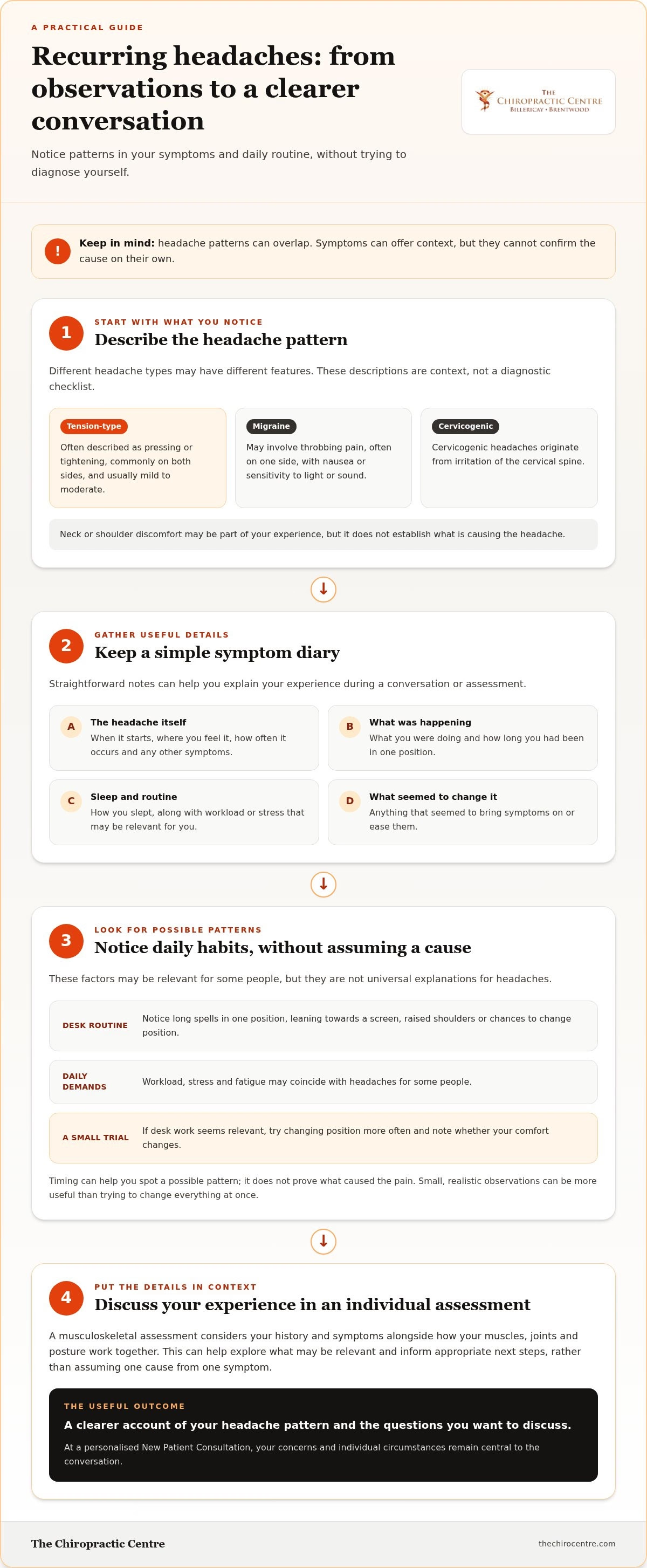
Headache labels aren’t interchangeable. Migraine may involve throbbing pain, often on one side, alongside nausea or sensitivity to light or sound. Cervicogenic headaches originate from irritation of the cervical spine. Neck symptoms can be relevant, but they don’t establish the cause on their own.
These patterns provide context, not a diagnostic checklist. Features can overlap, and a headache may not fit neatly into one description. An online comparison can’t account for your health history or assess your movement and symptoms in person. If neck or shoulder discomfort is part of your experience, you can also learn about clinical massage in Billericay as one form of hands-on support. Whether it suits you depends on your individual circumstances.
For a clearer picture, note how often the pain occurs, where you feel it and whether other symptoms come with it. An individual assessment can help explore what may be relevant and inform appropriate next steps. The aim is to understand your situation, not to force your experience into a label.
Why tension headaches may involve the neck, muscles and daily habits
A headache may appear alongside a busy day, a long spell at a desk or a tense neck, but timing alone doesn’t prove what caused it. Prolonged positions, workload and stress may be relevant for some people; they aren’t universal explanations. Looking at your routine can help you spot possible patterns without blaming yourself or assuming one change will resolve the pain.
Headache contributors vary from person to person. An individual assessment is more useful than assuming one cause from one symptom.
Posture, desk habits and neck tension
Holding one position for a long time may leave some people feeling stiff or uncomfortable, particularly around the neck and shoulders. Notice whether your screen encourages you to lean forward, whether your shoulders creep upwards as you concentrate, and whether you have chances to change position during the day. These observations can guide practical adjustments, but posture alone doesn’t establish the reason for a headache.
Spinal compression describes force that reduces the space between vertebrae, often associated with prolonged sitting. It describes mechanical pressure, not proof that compression causes tension-type headaches. A musculoskeletal assessment considers how your muscles, joints and posture work together, alongside your history and concerns. This gives a fuller picture than focusing on one area in isolation.
Stress, fatigue and individual headache patterns
Stress and fatigue may coincide with headaches for some people, while other factors or combinations may matter for others. A simple symptom diary can help you notice patterns without treating them as definite causes. Record when discomfort starts, what you were doing, how long you’d been in one position, how you slept and whether anything seemed to bring symptoms on or ease them.
Keep your notes straightforward. You might notice a headache after a demanding afternoon, for example, but that doesn’t mean stress alone explains it. The NINDS Headache Research resource describes different headache types, a reminder to consider symptoms in context rather than reduce them to a single trigger.
Use your observations to guide a conversation, not to diagnose yourself. If a pattern seems linked to desk work, you could try changing position more often and note whether your comfort changes. If sleep or workload appears relevant, record that too. Small, realistic observations are more useful than trying to change everything at once.
If recurring symptoms are affecting your comfort, a personalised New Patient Consultation gives you an opportunity to discuss your concerns and explore appropriate next steps. For tension headache treatment Essex, the focus should remain on your individual circumstances, with any musculoskeletal findings considered as part of the wider picture.
Is every recurring headache a tension headache? When to seek advice
No. A recurring headache doesn’t automatically point to a tension-type pattern or a musculoskeletal cause. Even if you recognise features described earlier, those clues can’t establish what is behind your pain. A clinician may need to consider how symptoms began, how they have changed and how they affect you before discussing an appropriate route for care.
What can help distinguish common headache patterns?
Rather than using a checklist to label yourself, use the patterns below as prompts for a fuller conversation. Consider not only which description sounds familiar, but what information could help a health professional understand your experience.
| Headache pattern | Details worth noting | Possible next step |
|---|---|---|
| Tension-type | How often it occurs and whether it is affecting work, rest or everyday tasks. | Discuss recurring symptoms with an appropriate health professional. |
| Migraine | Whether symptoms come with other changes in how you feel or function. | Describe the full pattern, including associated symptoms, during an assessment. |
| Cervicogenic | Whether head pain is accompanied by neck symptoms or changes in neck movement. | Ask for an assessment that considers your symptoms and musculoskeletal health. |
This table is educational, not diagnostic, and shouldn’t replace professional assessment. The Mayo Clinic Tension Headache Guide provides further background, but a general description can’t account for your individual history or determine the cause of your symptoms.
When should you seek medical advice?
Seek medical advice if headaches are new, unusually severe, changing, getting worse or repeatedly disrupting your daily life. If you’re unsure what to do, contact your GP or NHS 111 for guidance. For sudden, extremely painful head pain, or symptoms such as weakness, numbness, difficulty speaking, vision loss, confusion or drowsiness, call 999 or go to A&E if you think it may be an emergency.
Explain when the pattern changed, what you were doing at the time and whether anything else felt different. If you have kept notes, share them. These details can support a more informed discussion than trying to match yourself to a label from a table.
Chiropractic adjustments and massage therapy don’t replace medical assessment when symptoms need clinical attention. Once appropriate medical advice has been considered, a musculoskeletal assessment may help explore whether movement, muscles or joints are relevant to your situation. For tension headache treatment Essex, the next step should be guided by your health needs, not by assuming every recurring headache has the same explanation.
What you can do for tension headaches before seeking treatment
Before choosing a treatment, consider what you need help with most. Is the main difficulty concentrating, getting through work or settling into your usual evening routine? Focusing on how headaches affect your day can help you decide what to discuss with a health professional, without trying to work out the cause on your own.
A simple headache-pattern check-in
Use a brief check-in to clarify the impact of your symptoms, rather than keeping a detailed record of possible triggers. Note which everyday tasks have become harder, what you’ve already tried and whether it made a difference. If you’ve received care before, include what was discussed or what you found helpful. These details give an appointment a practical starting point.
Preparing a few questions can also help. You might ask what an assessment involves, which options may suit your needs and when you should seek medical advice. You don’t need to arrive with a diagnosis or a perfect account. A clear sense of your priorities is enough to begin a useful conversation.
Everyday adjustments that support wellbeing
Keep any changes manageable and guided by comfort. You might pause when symptoms are interfering with a task, then return to activity gradually if that feels comfortable. Gentle movement can be part of a general wellbeing routine, but stop if it aggravates your symptoms. These steps aren’t a proven cure; they’re a way to respond thoughtfully while paying attention to how you feel.
Try not to change several parts of your routine at once. A small, realistic adjustment is easier to maintain and gives you a clearer sense of whether it suits you. If symptoms continue to affect everyday life, or feel unusual or concerning, seek appropriate medical guidance rather than relying on self-care alone.
At an appointment, share what you hope to get back to, whether that’s focusing at work, enjoying a walk or resting more comfortably. Mention previous care and any questions you’ve prepared. A new patient chiropractor consultation in Essex gives you an opportunity to discuss your concerns and consider suitable next steps with the team.
You don’t need to settle on a treatment before discussing your needs. If you’re considering tension headache treatment Essex, an individual conversation can help you understand what support may be appropriate and when another kind of medical advice is needed.
Personalised tension headache support at The Chiropractic Centre in Essex
If recurring head pain is affecting your comfort, it can help to explain what you’re experiencing and discuss suitable next steps. The Chiropractic Centre provides personalised chiropractic care and massage therapy for people in Billericay, Brentwood and surrounding Essex areas. Care starts with your concerns and health history, rather than assuming every headache has the same explanation or needs the same support.
How an individual assessment can guide support
A musculoskeletal assessment considers your muscles, joints and posture in the context of your needs. You can talk through where and when you feel discomfort, how it affects daily life and any relevant neck or shoulder symptoms. This helps inform an individual care plan, but it doesn’t mean every headache can be explained by musculoskeletal factors or assessed separately from your wider health.
After understanding your concerns, the team can discuss whether chiropractic adjustments or massage therapy may be appropriate as part of personalised, non-drug support. These services aren’t a promise of headache relief, and the right approach depends on the person. If you’re curious about an adjustment, raise what to expect during the conversation so your questions and comfort remain central.
Take a supportive next step in Billericay or Brentwood
A New Patient Consultation gives you an opportunity to discuss your symptoms, health history and goals before considering appropriate next steps. The clinic’s Free Spinal Health Check is another way to begin a conversation about spinal and musculoskeletal wellbeing. Neither should be treated as a diagnosis of every headache. If symptoms are new, severe or concerning, seek appropriate medical advice.
Support can also look beyond hands-on care. Nutrition and diet advice, alongside exercise and lifestyle coaching, can help you consider broader wellbeing habits as part of an individual plan. These are not guaranteed headache treatments; they provide context for discussing your routine and what feels realistic for you.
If you’d like to talk through your concerns, you can Book a New Patient Consultation at The Chiropractic Centre. Bring notes about your headache pattern and questions about care, including what a chiropractic adjustment feels like. This helps make the discussion personal and clear, whether you’re exploring tension headache treatment Essex or seeking support for wider musculoskeletal wellbeing.
Take a considered next step towards support
Recurring headaches don’t have to be something you simply work around. A considered next step is to discuss what you’re experiencing and explore care that reflects your needs, while seeking medical advice for symptoms that are new or concerning. If you’re looking into tension headache treatment Essex, The Chiropractic Centre offers a supportive setting to talk through your wellbeing.
The team has been in business for over 10 years and has supported over 1,000 happy clients. The clinic has a 5.0 average based on 192 Google reviews, with 240+ reviews in total. These details offer a sense of the experiences others have shared, while your own care should remain individual.
When you’re ready, Book a New Patient Consultation at The Chiropractic Centre to discuss your concerns and the support that may suit you. A clearer plan can begin with being listened to.
Frequently Asked Questions
What does a tension headache feel like?
A tension-type headache commonly feels like pressure or tightness, but the exact sensation and severity vary. You might notice a steady ache rather than throbbing pain; migraine can involve throbbing and symptoms such as nausea or sensitivity to light or sound, though experiences differ. Symptoms alone can’t confirm a diagnosis. If headaches keep returning, change in character or cause concern, speak with an appropriate health professional about assessment.
Can massage therapy help with tension headaches?
Massage therapy may be considered if muscle tension is relevant to your experience, but it isn’t a guaranteed cure and shouldn’t replace medical advice. At The Chiropractic Centre, massage therapy is available as part of personalised support, with your concerns and symptoms considered before discussing suitable options. The right next step depends on your circumstances and assessment. If your headache is new, worsening or worrying, seek medical guidance before treating it as a muscle issue.
Is a tension headache the same as a migraine?
No. Tension-type headache and migraine are different headache patterns, although some symptoms may overlap and a short description can’t establish which one you have. Migraine may include nausea or sensitivity to light or sound, while tension-type pain is often described as pressure or tightness. If headaches are frequent, severe or changing, seek appropriate advice. A clinician can consider your history and help guide suitable next steps.
Can neck problems cause headaches?
Some headaches originate from irritation of the cervical spine, the neck part of the spine, and are called cervicogenic headaches. However, neck discomfort alongside head pain doesn’t prove that the neck is the cause. Headaches can have different explanations, and symptoms may overlap. An individual assessment can help consider relevant musculoskeletal factors and guide appropriate support, while medical advice remains important if symptoms are persistent or concerning.
When should I seek medical advice for a headache?
Seek medical guidance for a headache that is sudden, severe, unusual, worsening or otherwise concerning. A sudden, extremely painful headache, or one accompanied by weakness, numbness, difficulty speaking, vision loss, confusion or drowsiness, needs urgent attention. Call 999 or go to A&E if you think it may be an emergency. A chiropractic or massage appointment doesn’t replace urgent or medical assessment when needed.
What happens at a tension headache appointment in Essex?
At a New Patient Consultation, the team listens to your concerns and considers whether musculoskeletal factors are relevant to your situation. You can explain how symptoms affect your routine and raise questions about care. Depending on your needs and assessment, next steps may include discussing chiropractic adjustments or massage therapy. The approach is individual, with no assumed treatment plan, visit count or promised outcome.
Can stress or posture contribute to tension headaches?
Stress, fatigue or spending a long time in one position may be relevant for some people, but they aren’t universal explanations for headaches. You could note when symptoms arise alongside sleep, work activities and changes in routine, then share those observations with a health professional. A diary can help you describe patterns, but it can’t diagnose the cause. Seek advice if headaches persist or worry you.